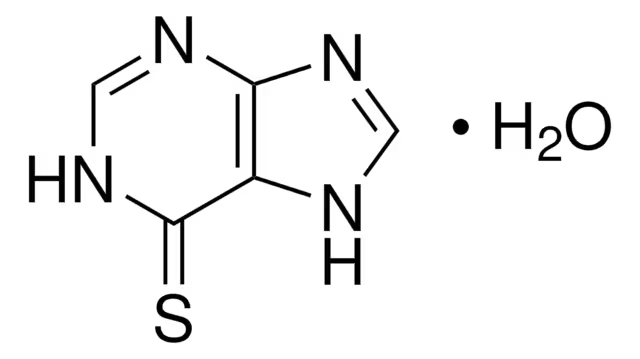
CAS Number50-44-2
Synonyms1,9-DIHYDRO-6H-PURINE-6-THIONE; 1H-Purine-6(9H)-thione; 6-Mercapto-1H-purine; EINECS 200-037-4; MFCD00599524; 9H-purine-6-thiol; THIOHYPOXANTHINE; 1,9-Dihydropurine-6-thione DISCONTINUED,see M225450; 1,7-Dihydro-6H-purine-6-thione; 7H-Purine-6-thiol
Molecular FormulaC5H4N4S
Molecular Weight170.19
Purity98%
Density1.6±0.1 g/cm3
Boiling Point490.6±25.0 °C at 760 mmHg
Melting Point>300 °C (lit.)
Appearancepowder
EINECS200-037-4
Symbol
Signal WordWarning
| Chemical & Physical Properties | |
|---|---|
| CAS Number | 50-44-2 |
| Catalog No. | 2A-9016555 |
| Chinese Name | 6-巯基嘌呤 |
| Synonyms | 1,9-DIHYDRO-6H-PURINE-6-THIONE; 1H-Purine-6(9H)-thione; 6-Mercapto-1H-purine; EINECS 200-037-4; MFCD00599524; 9H-purine-6-thiol; THIOHYPOXANTHINE; 1,9-Dihydropurine-6-thione DISCONTINUED,see M225450; 1,7-Dihydro-6H-purine-6-thione; 7H-Purine-6-thiol |
| Molecular Formula | C5H4N4S |
| Molecular Weight | 170.19 |
| Purity | 98 |
| Density | 1.6±0.1 g/cm3 |
| Boiling Point | 490.6±25.0 °C at 760 mmHg |
| Melting Point | >300 °C (lit.) |
| Appearance | powder |
| Storage Condition | Store at RT |
| Packaging | III |
| Application | 6-Mercaptopurine is a purine analogue that is an antagonist of endogenous purines and has been widely used as an antileukemic and immunosuppressive drug. |
| EINECS | 200-037-4 |
| HTC | 2933599090 |
| PubChem ID | 24888330 |
| MDL Number | MFCD03854445 |
| SMILES | O.Sc1ncnc2[nH]cnc12 |
| InChI | 1S/C5H4N4S.H2O/c10-5-3-4(7-1-6-3)8-2-9-5;/h1-2H,(H2,6,7,8,9,10);1H2 |
| InChI Key | WFFQYWAAEWLHJC-UHFFFAOYSA-N |
| Beilstein/REAXYS | 4012091 |
| NACRES Code | NA.22 |
| UNSPSC | 12352005 |
| Hazard Symbols | 6.1(b) |
| MSDS | msds/16555_1_50_44_2.pdf |
| Bioactivity | 6-Mercaptopurine is a purine analogue which acts as an antagonist of the endogenous purines and has been widely used as antileukemic agent and immunosuppressive drug. Related Catalog Signaling Pathways >> Cell Cycle/DNA Damage >> Nucleoside Antimetabolite/Analog Research Areas >> Cancer Target endogenous purines[1] In Vitro 6-Mercaptopurine hydrate (6-MP) induces NR4A3 transcriptional activity 1.6- to 11-fold (P<0.01) in a dose-responsive manner. It is found that 6-Mercaptopurine hydrate leads to a dose-dependent increase in NR4A3 protein levels. 6-MP treatment increases cell surface GLUT4 in both basal cells 1.8- to 3.6-fold (P<0.01) and insulin-stimulated cells 2.9- to 4.4-fold (P<0.01) over that in controls. It is also found that 6-Mercaptopurine hydrate increases phospho-AS160 significantly in a dose-responsive manner under both basal and insulin-stimulated conditions[2]. In Vivo In the fetal telencephalons of the 6-Mercaptopurine hydrate (6-MP)-treated group, the S phase cell population increases at 36 and 48 h and returns to the control level at 72 h after treatment. The G2/M phase cell population begins to increase at 24 h, peaks at 36 h, decreases at 48 h, and finally returnes to the control level at 72 h. On the other hand, the sub-G1 phase cell population (apoptotic cells) begins to increase at 36 h, peaks at 48 h, and then decreases at 72 h[3]. Kinase Assay L6 myotubes are treated with DMSO control or 6-Mercaptopurine hydrate (6-MP) for 24 h, with the final 3 h of incubation including treatments in serum-free DMEM, and further incubated in the absence or presence of 100 nM insulin for 60 min at 37°C. Then, protein lysates (50 μg) are collected and subjected to SDS-PAGE and immunoblotted with primary antibodies against overnight at 4°C. The proteins are finally quantified by densitometric analysis of scanned films using Image J software[2]. Cell Assay Cell viability is measured using Cell Viability Assay. L6 skeletal muscle cells are seeded in 96-well plates at a density of 10,000 cells/well and differentiated into myotubes within 7 days. Cells are treated with different doses of 6-Mercaptopurine hydrate (6-MP) for 24 h before the assay. For analysis of cell viability, plates are equilibrated at room temperature for 30 min; 50 μL of Cell Titer-Glo reagent is added to each well, and plates are mixed for 12 min on an orbital shaker. Luminescence is quantified using a luminometer[2]. Animal Admin Around thirteen-week-old pregnant rats are used in this study. The animals are housed individually in wire-mesh cages in an air-conditioned room (temperature, 23±3°C; humidity, 50±20%; ventilation, 10 times/hour; lighting, 12 h light to12 h dark cycle) and are given pelleted diet and water ad libitum. In the experiment, fifteen pregnant rats are injected i.p. with 50 mg/kg 6-Mercaptopurine hydrate (6-MP) on E13, and three dams each are sacrificed by exsanguination from the abdominal aorta under ether anesthesia at 12, 24, 36, 48, and 72 h. Fetuses are collected from each dam by Caesarean section. As controls, fifteen pregnant rats are injected i.p. with 2.0% methylcellulose solution in distilled water at E13, and three dams are sacrificed at each of the same time-points[3]. References [1]. Sahasranaman S, et al. Clinical pharmacology and pharmacogenetics of thiopurines. Eur J Clin Pharmacol. 2008 Aug;64(8):753-67. [2]. Liu Q, et al. 6-Mercaptopurine augments glucose transport activity in skeletal muscle cells in part via a mechanism dependent upon orphan nuclear receptor NR4A3. Am J Physiol Endocrinol Metab. 2013 Nov 1;305(9):E1081-92. [3]. Kanemitsu H, et al. 6-Mercaptopurine (6-MP) induces cell cycle arrest and apoptosis of neural progenitor cells in the developing fetal rat brain. Neurotoxicol Teratol. 2009 Mar-Apr;31(2):104-9. Chemical & Physical Properties Density 1.6±0.1 g/cm3 Boiling Point 490.6±25.0 °C at 760 mmHg Melting Point 241-244°C Molecular Formula C5H4N4S Molecular Weight 152.177 Flash Point 250.5±23.2 °C Exact Mass 152.015671 PSA 89.45000 LogP -0.18 Vapour Pressure 0.0±1.2 mmHg at 25°C Index of Refraction 1.820 InChIKey GLVAUDGFNGKCSF-UHFFFAOYSA-N SMILES S=c1nc[nH]c2nc[nH]c12 Storage condition Store at RT |
| Use of | 6-Mercaptopurine is a purine analogue which acts as an antagonist of the endogenous purines and has been widely used as antileukemic agent and immunosuppressive drug. Properties Name mercaptopurine Synonym More Synonyms 6-Mercaptopurine Biological Activity Description 6-Mercaptopurine is a purine analogue which acts as an antagonist of the endogenous purines and has been widely used as antileukemic agent and immunosuppressive drug. Related Catalog Signaling Pathways >> Cell Cycle/DNA Damage >> Nucleoside Antimetabolite/Analog Research Areas >> Cancer endogenous purines[1] In Vitro 6-Mercaptopurine hydrate (6-MP) induces NR4A3 transcriptional activity 1.6- to 11-fold (P<0.01) in a dose-responsive manner. It is found that 6-Mercaptopurine hydrate leads to a dose-dependent increase in NR4A3 protein levels. 6-MP treatment increases cell surface GLUT4 in both basal cells 1.8- to 3.6-fold (P<0.01) and insulin-stimulated cells 2.9- to 4.4-fold (P<0.01) over that in controls. It is also found that 6-Mercaptopurine hydrate increases phospho-AS160 significantly in a dose-responsive manner under both basal and insulin-stimulated conditions[2]. References [1]. Sahasranaman S, et al. Clinical pharmacology and pharmacogenetics of thiopurines. Eur J Clin Pharmacol. 2008 Aug;64(8):753-67. [2]. Liu Q, et al. 6-Mercaptopurine augments glucose transport activity in skeletal muscle cells in part via a mechanism dependent upon orphan nuclear receptor NR4A3. Am J Physiol Endocrinol Metab. 2013 Nov 1;305(9):E1081-92. [3]. Kanemitsu H, et al. 6-Mercaptopurine (6-MP) induces cell cycle arrest and apoptosis of neural progenitor cells in the developing fetal rat brain. Neurotoxicol Teratol. 2009 Mar-Apr;31(2):104-9. Chemical & Physical Properties Molecular Formula C5H4N4S Exact Mass 152.015671 PSA 89.45000 LogP -0.18 Index of Refraction 1.820 InChIKey GLVAUDGFNGKCSF-UHFFFAOYSA-N SMILES S=c1nc[nH]c2nc[nH]c12 Storage condition Store at RT |
| Tax Rebate | 13.0% |
| Supervision | None. MFN tariff: 6.5%. Ordinary tariff: 20.0% |
| Transport Info | Product name: Summary 2933990090. heterocyclic compounds with nitrogen hetero-atom(s) only. VAT:17.0%. Tax rebate rate:13.0%. . MFN tariff:6.5%. General tariff:20.0% |
| Related Products in API & Advanced Intermediates | ||
|---|---|---|
| Lithium carbonate | 554-13-2 | 2A-9014763 |
| Hydrocortisone acetate | 50-03-3 | 2A-9016535 |
| Cyclophosphamide | 50-18-0 | 2A-9016541 |
| Prednisolone | 50-24-8 | 2A-9016544 |
| Estradiol | 50-28-2 | 2A-0200250 |
| Amitriptyline | 50-48-6 | 2A-9016558 |
| Imipramine | 50-49-7 | 2A-9016559 |
| Estradiol benzoate | 50-50-0 | 2A-9016560 |
| Thioridazine | 50-52-2 | 2A-9016561 |
| Chlorpromazine | 50-53-3 | 2A-9016562 |
| Browse all API & Advanced Intermediates products » | ||
Phone:
630-322-8886
630-322-8887
Email:
Office Locations:
Chicago, IL, USA
San Francisco, CA, USA


 EN
EN


 SDS
SDS