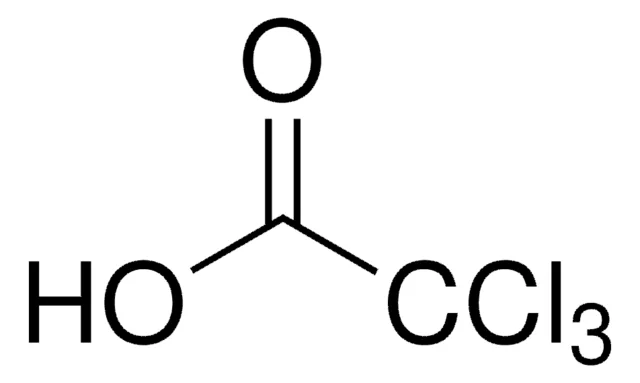
CAS Number76-03-9
SynonymsTrichloroacetic acid; MFCD00004177; 2,2,2-trichloroacetic acid; TCA; EINECS 200-927-2
Molecular FormulaCl3CCOOH
Molecular Weight163.39
Purity≥99.0%
Density1.62 g/mL at 25 °C(lit.)
Boiling Point196 °C (lit.)
Melting Point54-58 °C (lit.)
Appearancecrystalline
EINECS200-927-2
Symbol
Signal WordWarning
| Chemical & Physical Properties | |
|---|---|
| CAS Number | 76-03-9 |
| Catalog No. | 2A-9016006 |
| Chinese Name | 三氯乙酸 |
| Synonyms | Trichloroacetic acid; MFCD00004177; 2,2,2-trichloroacetic acid; TCA; EINECS 200-927-2 |
| Molecular Formula | Cl3CCOOH |
| Molecular Weight | 163.39 |
| Purity | ≥99.0 |
| Density | 1.62 g/mL at 25 °C(lit.) |
| Boiling Point | 196 °C (lit.) |
| Melting Point | 54-58 °C (lit.) |
| Appearance | crystalline |
| Water Solubility | 120 g/100 mL (20 ºC) |
| Storage Condition | Storage precautions: Store in a cool, ventilated w |
| Packaging | II |
| Application | Trichloroacetic acid is a commonly used chemical resurfacing agent for the face. Trichloroacetic acid is a metabolite of trichlorethylene and is thought to contribute to its liver cancer effects in mi |
| EINECS | 200-927-2 |
| HTC | 29154000 |
| PubChem ID | 24900373 |
| MDL Number | MFCD00004177 |
| SMILES | OC(=O)C(Cl)(Cl)Cl |
| InChI | 1S/C2HCl3O2/c3-2(4,5)1(6)7/h(H,6,7) |
| InChI Key | YNJBWRMUSHSURL-UHFFFAOYSA-N |
| Beilstein/REAXYS | 970119 |
| NACRES Code | NA.21 |
| UNSPSC | 12352100 |
| Hazard Symbols | 8 |
| MSDS | msds/16006_1_76_03_9.pdf |
| Bioactivity | Trichloroacetic acid is a commonly utilized agent for chemical resurfacing of the face. Trichloroacetic acid is a metabolite of trichloroethylene thought to contribute to its hepatocarcinogenic effects in mice[1][2]. Related Catalog Research Areas >> Cancer Target Human Endogenous Metabolite In Vitro Trichloroacetic acid (TCA) is a common drinking water disinfection byproduct that produces a spectrum of liver effects, including hepatomegaly and liver tumors, in mice. It is also an oxidative metabolite of trichloroethylene (TCE), a solvent used in degreasing with widespread environmental exposure, which also produces hepatomegaly and liver tumors in mice[3]. References [1]. Herbig K, et al. Combination Jessner's solution and trichloroacetic acid chemical peel: technique and outcomes. Plast Reconstr Surg. 2009;124(3):955-964. [2]. Stenner RD, et al. Enterohepatic recirculation of trichloroethanol glucuronide as a significant source of trichloroacetic acid. Metabolites of trichloroethylene. Drug Metab Dispos. 1997;25(5):529-535. [3]. Chiu WA. Trichloroacetic acid: updated estimates of its bioavailability and its contribution to trichloroethylene-induced mouse hepatomegaly. Toxicology. 2011;285(3):114-125. Chemical & Physical Properties Density 1.62 g/mL at 25 °C(lit.) Boiling Point 196 °C(lit.) Melting Point 54-58 °C(lit.) Molecular Formula C2HCl3O2 Molecular Weight 163.39 Flash Point 196°C Exact Mass 161.90400 PSA 37.30000 LogP 1.44120 Vapour density <1 (vs air) Vapour Pressure 1 mm Hg ( 51 °C) Index of Refraction n20/D 1.62(lit.) InChIKey YNJBWRMUSHSURL-UHFFFAOYSA-N SMILES O=C(O)C(Cl)(Cl)Cl Water Solubility 120 g/100 mL (20 ºC) |
| Use of | Trichloroacetic acid is a commonly utilized agent for chemical resurfacing of the face. Trichloroacetic acid is a metabolite of trichloroethylene thought to contribute to its hepatocarcinogenic effects in mice[1][2]. Properties Articles513 Name trichloroacetic acid Synonym More Synonyms Trichloroacetic acid Biological Activity Description Trichloroacetic acid is a commonly utilized agent for chemical resurfacing of the face. Trichloroacetic acid is a metabolite of trichloroethylene thought to contribute to its hepatocarcinogenic effects in mice[1][2]. Related Catalog Research Areas >> Cancer Human Endogenous Metabolite In Vitro Trichloroacetic acid (TCA) is a common drinking water disinfection byproduct that produces a spectrum of liver effects, including hepatomegaly and liver tumors, in mice. It is also an oxidative metabolite of trichloroethylene (TCE), a solvent used in degreasing with widespread environmental exposure, which also produces hepatomegaly and liver tumors in mice[3]. References [1]. Herbig K, et al. Combination Jessner's solution and trichloroacetic acid chemical peel: technique and outcomes. Plast Reconstr Surg. 2009;124(3):955-964. [2]. Stenner RD, et al. Enterohepatic recirculation of trichloroethanol glucuronide as a significant source of trichloroacetic acid. Metabolites of trichloroethylene. Drug Metab Dispos. 1997;25(5):529-535. [3]. Chiu WA. Trichloroacetic acid: updated estimates of its bioavailability and its contribution to trichloroethylene-induced mouse hepatomegaly. Toxicology. 2011;285(3):114-125. Chemical & Physical Properties Molecular Formula C2HCl3O2 Exact Mass 161.90400 PSA 37.30000 LogP 1.44120 Vapour density <1 (vs air) InChIKey YNJBWRMUSHSURL-UHFFFAOYSA-N SMILES O=C(O)C(Cl)(Cl)Cl |
| Related Products in Specialty Chemicals | ||
|---|---|---|
| Trans-1,2-dichloroethene | 156-60-5 | 2A-9016000 |
| Tri(hydroxymethyl)aminomethane | 77-86-1 | 2A-0200712 |
| tribenzylphosphine | 7650-89-7 | 2A-9016002 |
| Tributyl phosphate | 126-73-8 | 2A-9016003 |
| Tributylphosphine | 998-40-3 | 2A-0201772 |
| Trichloroacetonitrile | 545-06-2 | 2A-9016007 |
| Trichloroacetyl chloride | 76-02-8 | 2A-9016008 |
| Trichloroethylene | 79-01-6 | 2A-9016009 |
| Trichloroisocyanuric acid | 87-90-1 | 2A-9016010 |
| Tricresyl phosphate | 1330-78-5 | 2A-9016013 |
| Browse all Specialty Chemicals products » | ||
Phone:
630-322-8886
630-322-8887
Email:
Office Locations:
Chicago, IL, USA
San Francisco, CA, USA


 EN
EN


 SDS
SDS