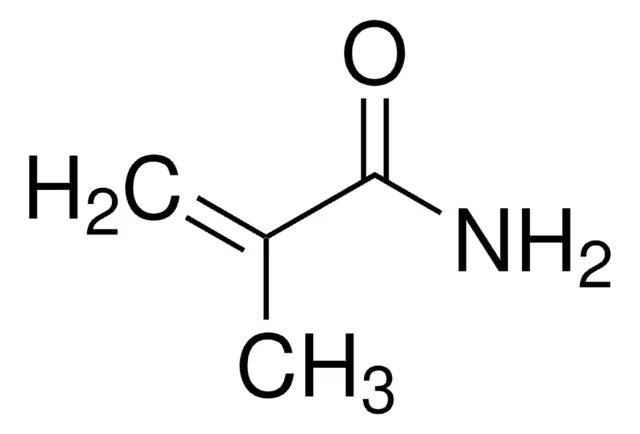
CAS Number79-39-0
SynonymsMethacrylamide; Methylacrylic amide; 2-Methylpropenamide; Methacryamide; EINECS 201-202-3; methylacrylamide; 2-methylprop-2-enamide; MFCD00008018; Methacrylic acid amide; 2-Propenamide,2-methyl; 2-Methylacrylamide; methacrylic amide; methylbisacrylamide; 2-Methyl-2-propenamide
Molecular FormulaH2C=C(CH3)CONH2
Molecular Weight85.10
Purity98%
Density0.9±0.1 g/cm3
Boiling Point211.5±13.0 °C at 760 mmHg
Melting Point106-110 °C (lit.)
Appearancesolid
EINECS201-202-3
Symbol
Signal WordWarning
| Chemical & Physical Properties | |
|---|---|
| CAS Number | 79-39-0 |
| Catalog No. | 2A-9014918 |
| Chinese Name | 甲基丙烯酰胺 |
| Synonyms | Methacrylamide; Methylacrylic amide; 2-Methylpropenamide; Methacryamide; EINECS 201-202-3; methylacrylamide; 2-methylprop-2-enamide; MFCD00008018; Methacrylic acid amide; 2-Propenamide,2-methyl; 2-Methylacrylamide; methacrylic amide; methylbisacrylamide; 2-Methyl-2-propenamide |
| Molecular Formula | H2C=C(CH3)CONH2 |
| Molecular Weight | 85.10 |
| Purity | 98 |
| Density | 0.9±0.1 g/cm3 |
| Boiling Point | 211.5±13.0 °C at 760 mmHg |
| Melting Point | 106-110 °C (lit.) |
| Appearance | solid |
| Water Solubility | 202 g/L (20 ºC) |
| Storage Condition | This product should be sealed and stored in a cool |
| Packaging | III |
| Application | Methacrylamide can be used as an excipient. Pharmaceutical excipients, or pharmaceutical excipients, refer to other chemical substances used in the pharmaceutical process in addition to drug ingredien |
| EINECS | 201-202-3 |
| HTC | 2924199090 |
| UN(IATA) | NA |
| PubChem ID | 24846926 |
| MDL Number | MFCD00008018 |
| SMILES | CC(=C)C(N)=O |
| InChI | 1S/C4H7NO/c1-3(2)4(5)6/h1H2,2H3,(H2,5,6) |
| InChI Key | FQPSGWSUVKBHSU-UHFFFAOYSA-N |
| Beilstein/REAXYS | 605397 |
| NACRES Code | NA.23 |
| UNSPSC | 12162002 |
| Hazard Symbols | 6.1(b) |
| MSDS | msds/14918_1_79_39_0.pdf |
| Bioactivity | Methacrylamide can be used as an excipient. Pharmaceutical excipients, or pharmaceutical auxiliaries, refer to other chemical substances used in the pharmaceutical process other than pharmaceutical ingredients. Pharmaceutical excipients generally refer to inactive ingredients in pharmaceutical preparations, which can improve the stability, solubility and processability of pharmaceutical preparations. Pharmaceutical excipients also affect the absorption, distribution, metabolism, and elimination (ADME) processes of co-administered drugs[1]. Related Catalog Research Areas >> Others Signaling Pathways >> Others >> Others References [1]. Elder DP, et al. Pharmaceutical excipients - quality, regulatory and biopharmaceutical considerations. Eur J Pharm Sci. 2016 May 25;87:88-99. Chemical & Physical Properties Density 0.9±0.1 g/cm3 Boiling Point 211.5±13.0 °C at 760 mmHg Melting Point 108 °C Molecular Formula C4H7NO Molecular Weight 85.10 Flash Point 81.7±19.8 °C Exact Mass 85.052765 PSA 43.09000 LogP -0.23 Vapour Pressure 0.2±0.4 mmHg at 25°C Index of Refraction 1.438 InChIKey FQPSGWSUVKBHSU-UHFFFAOYSA-N SMILES C=C(C)C(N)=O Water Solubility 202 g/L (20 ºC) |
| Use of | Methacrylamide can be used as an excipient. Pharmaceutical excipients, or pharmaceutical auxiliaries, refer to other chemical substances used in the pharmaceutical process other than pharmaceutical ingredients. Pharmaceutical excipients generally refer to inactive ingredients in pharmaceutical preparations, which can improve the stability, solubility and processability of pharmaceutical preparations. Pharmaceutical excipients also affect the absorption, distribution, metabolism, and elimination (ADME) processes of co-administered drugs[1]. Properties Articles33 Name methacrylamide Synonym More Synonyms Methacrylamide Biological Activity Description Methacrylamide can be used as an excipient. Pharmaceutical excipients, or pharmaceutical auxiliaries, refer to other chemical substances used in the pharmaceutical process other than pharmaceutical ingredients. Pharmaceutical excipients generally refer to inactive ingredients in pharmaceutical preparations, which can improve the stability, solubility and processability of pharmaceutical preparations. Pharmaceutical excipients also affect the absorption, distribution, metabolism, and elimination (ADME) processes of co-administered drugs[1]. Related Catalog Research Areas >> Others Signaling Pathways >> Others >> Others References [1]. Elder DP, et al. Pharmaceutical excipients - quality, regulatory and biopharmaceutical considerations. Eur J Pharm Sci. 2016 May 25;87:88-99. Chemical & Physical Properties Molecular Formula C4H7NO Exact Mass 85.052765 PSA 43.09000 LogP -0.23 Index of Refraction 1.438 InChIKey FQPSGWSUVKBHSU-UHFFFAOYSA-N SMILES C=C(C)C(N)=O |
| Tax Rebate | 13.0% |
| Supervision | None. MFN tariff: 6.5%. Ordinary tariff: 30.0% |
| Transport Info | Product name: Chemical name |
| Related Products in Specialty Chemicals | ||
|---|---|---|
| Mercury(I) fluoride | 13967-25-4 | 2A-9014913 |
| Mercury(I) sulfate | 7783-36-0 | 2A-9014914 |
| Mercury(II) fluoride | 7783-39-3 | 2A-9014915 |
| Mercury(II) telluride | 12068-90-5 | 2A-9014916 |
| meso-2,3-Dimercaptosuccinic acid | 304-55-2 | 2A-9014917 |
| Methacrylic acid | 79-41-4 | 2A-9014919 |
| Methallyl acetate | 820-71-3 | 2A-9014921 |
| Methane sulfonamide | 3144-09-0 | 2A-9014922 |
| Methanedisulfonic acid | 503-40-2 | 2A-9014923 |
| Methanesulfonic acid | 75-75-2 | 2A-9014924 |
| Browse all Specialty Chemicals products » | ||
Phone:
630-322-8886
630-322-8887
Email:
Office Locations:
Chicago, IL, USA
San Francisco, CA, USA


 EN
EN


 SDS
SDS