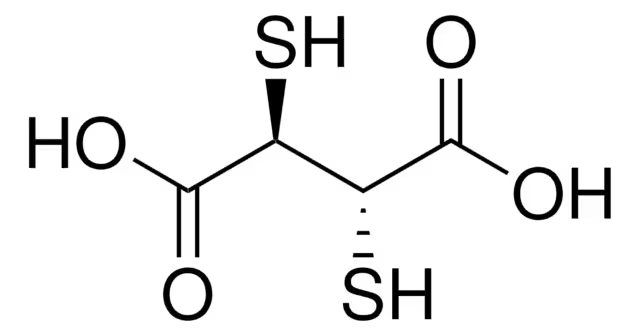
CAS Number304-55-2
Synonyms(2R,3S)-rel-2,3-Dimercaptosuccinic acid; meso-2,3-diisopropyl-succinic acid; 2,3-Disulfanylsuccinic acid; 3-dimercaptosuccinic acid; meso-2,3-Dimercaptosuccinic acid; meso-2,3-dimercapto succinic acid; Dimercaptosuccinic acid; meso-dimercaptosuccinic acid; 2,3-disulfanylbutanedioic acid; EINECS 206-155-2; MFCD00064799; meso-2,3-Diisopropyl-bernsteinsaeure; Succimer; 2,3-DIISOPROPYLSUCCINIC ACID; 2,3-Dithio-meso-tartaric acid
Molecular FormulaHO2CCH(SH)CH(SH)CO2H
Molecular Weight182.22
Purity~98%
Density1.6±0.1 g/cm3
Boiling Point267.6±40.0 °C at 760 mmHg
Melting Point196-198 °C (dec.) (lit.)
Appearancepowder
EINECS206-155-2
Symbol
Signal WordWarning
| Chemical & Physical Properties | |
|---|---|
| CAS Number | 304-55-2 |
| Catalog No. | 2A-9014917 |
| Chinese Name | 2,3-二巯基丁二酸 |
| Synonyms | (2R,3S)-rel-2,3-Dimercaptosuccinic acid; meso-2,3-diisopropyl-succinic acid; 2,3-Disulfanylsuccinic acid; 3-dimercaptosuccinic acid; meso-2,3-Dimercaptosuccinic acid; meso-2,3-dimercapto succinic acid; Dimercaptosuccinic acid; meso-dimercaptosuccinic acid; 2,3-disulfanylbutanedioic acid; EINECS 206-155-2; MFCD00064799; meso-2,3-Diisopropyl-bernsteinsaeure; Succimer; 2,3-DIISOPROPYLSUCCINIC ACID; 2,3-Dithio-meso-tartaric acid |
| Molecular Formula | HO2CCH(SH)CH(SH)CO2H |
| Molecular Weight | 182.22 |
| Purity | ~98 |
| Density | 1.6±0.1 g/cm3 |
| Boiling Point | 267.6±40.0 °C at 760 mmHg |
| Melting Point | 196-198 °C (dec.) (lit.) |
| Appearance | powder |
| Storage Condition | −20°C |
| Application | Succimer is a chelating agent widely used to treat lead poisoning. |
| EINECS | 206-155-2 |
| HTC | 2930909090 |
| PubChem ID | 57654130 |
| MDL Number | MFCD00064799 |
| SMILES | OC(=O)[C@@H](S)[C@@H](S)C(O)=O |
| InChI | 1S/C4H6O4S2/c5-3(6)1(9)2(10)4(7)8/h1-2,9-10H,(H,5,6)(H,7,8)/t1-,2+ |
| InChI Key | ACTRVOBWPAIOHC-XIXRPRMCSA-N |
| Beilstein/REAXYS | 1725150 |
| NACRES Code | NA.22 |
| UNSPSC | 12352100 |
| Hazard Symbols | Transport |
| MSDS | msds/14917_1_304_55_2.pdf |
| Bioactivity | Succimer is a widely used chelating agent for the treatment of Pb poisoning. Related Catalog Signaling Pathways >> Others >> Others Research Areas >> Others In Vivo Succimer is a widely used chelating agent for the treatment of Pb poisoning. Red blood cells (RBCs) from lead exposed animals treated with NAC or Succimer are shown to have significantly higher glutathione (GSH) levels and diminished malondialdehyde (MDA) levels when compare to the lead group. Succimer administration also results in decreased glucose 6-phosphate dehydrogenase (G6PD) activity in RBCs from lead exposed animals[1]. Succimer treatment produces a significant reduction in blood lead levels for both lead exposure conditions: the High Pb-succ group has blood lead levels that are 27% of the blood lead levels of the High Pb group at the end of treatment. Succimer is effective in substantially reducing brain lead, as brain lead levels in the High Pb-succ group are 37% of levels in the High Pb group[2]. Animal Admin All experiments are performed with Fisher 344 male rats weighing 75 to 100 g. The animals are randomized into four groups. Group I (n=11) serves as the control and is given only standard rat chow and water for 6 weeks. Group II (n=11) receives 2000 ppm lead acetate in its drinking water for 5 weeks and, during the 6th week, this group receives water. Group III (n=6) receives 2000 ppm lead acetate in its drinking water for 5 weeks and, during the 6th week, these animals receive 800 mg/kg/day NAC dissolved in water. Group IV (n=6) is treated like group III, except that it receives 90 mg/kg/day Succimer during the last week. At the end of the 6th week, after overnight fasting, the animals are anesthetized with metofane and blood samples are collected via intracardiac puncture using heparin as an anticoagulant. Plasma and the buffy coat are removed by centrifugation for 10 min at 3000 rpm. The RBCs are washed three times with an equal volume of cold saline[1]. References [1]. Gürer H, et al. Antioxidant effects of N-acetylcysteine and succimer in red blood cells from lead-exposed rats. Toxicology. 1998 Jul 17;128(3):181-9. [2]. Beaudin SA, et al. Succimer chelation normalizes reactivity to reward omission and errors in lead-exposed rats. Neurotoxicol Teratol. 2007 Mar-Apr;29(2):188-202. Chemical & Physical Properties Density 1.6±0.1 g/cm3 Boiling Point 267.6±40.0 °C at 760 mmHg Melting Point 196-198ºC (dec.) Molecular Formula C4H6O4S2 Molecular Weight 182.218 Flash Point 115.6±27.3 °C Exact Mass 181.970749 PSA 152.20000 LogP 1.93 Vapour Pressure 0.0±1.2 mmHg at 25°C Index of Refraction 1.617 InChIKey ACTRVOBWPAIOHC-XIXRPRMCSA-N SMILES O=C(O)C(S)C(S)C(=O)O Storage condition −20°C Stability Stable. Combustible. Incompatible with strong oxidizing agents. |
| Use of | Succimer is a widely used chelating agent for the treatment of Pb poisoning. Properties Articles99 Name succimer Synonym More Synonyms Succimer Biological Activity Description Succimer is a widely used chelating agent for the treatment of Pb poisoning. Related Catalog Signaling Pathways >> Others >> Others Research Areas >> Others In Vivo Succimer is a widely used chelating agent for the treatment of Pb poisoning. Red blood cells (RBCs) from lead exposed animals treated with NAC or Succimer are shown to have significantly higher glutathione (GSH) levels and diminished malondialdehyde (MDA) levels when compare to the lead group. Succimer administration also results in decreased glucose 6-phosphate dehydrogenase (G6PD) activity in RBCs from lead exposed animals[1]. Succimer treatment produces a significant reduction in blood lead levels for both lead exposure conditions: the High Pb-succ group has blood lead levels that are 27% of the blood lead levels of the High Pb group at the end of treatment. Succimer is effective in substantially reducing brain lead, as brain lead levels in the High Pb-succ group are 37% of levels in the High Pb group[2]. References [1]. Gürer H, et al. Antioxidant effects of N-acetylcysteine and succimer in red blood cells from lead-exposed rats. Toxicology. 1998 Jul 17;128(3):181-9. [2]. Beaudin SA, et al. Succimer chelation normalizes reactivity to reward omission and errors in lead-exposed rats. Neurotoxicol Teratol. 2007 Mar-Apr;29(2):188-202. Chemical & Physical Properties Molecular Formula C4H6O4S2 Exact Mass 181.970749 PSA 152.20000 Index of Refraction 1.617 InChIKey ACTRVOBWPAIOHC-XIXRPRMCSA-N SMILES O=C(O)C(S)C(S)C(=O)O Stability Stable. Combustible. Incompatible with strong oxidizing agents. |
| Tax Rebate | 13.0% |
| Supervision | None. MFN tariff: 6.5%. Ordinary tariff: 30.0% |
| Transport Info | Product name: Purity: 98.0% |
| MSDS Transport Info | Module 14. Shipping information 14.1 UN dangerous goods number European Land Transport Dangerous Regulations: -International Maritime Dangerous Regulations: -International Air Transport Dangerous Regulations: - 14.2 Names specified by the United Nations (UN) European Land Transport Dangerous Regulations: Non-dangerous goods IMDG Code: Non-dangerous goods International air transport dangerous goods regulations: non-dangerous goods 14.3 Transport hazard categories European Land Transport Dangerous Regulations: -International Maritime Dangerous Regulations: -International Air Transport Dangerous Regulations: - 14.4 Package group European Land Transport Dangerous Regulations: -International Maritime Dangerous Regulations: -International Air Transport Dangerous Regulations: - 14.5 Environmental hazards European Land Transport Dangerous Regulations: No International Maritime Transport Dangerous Regulations Maritime Pollutants: No International Air Transport Risk Regulations: No 14.6 Special reminder to users No data available |
| Related Products in Specialty Chemicals | ||
|---|---|---|
| Mercury(â ¡) bromide | 7789-47-1 | 2A-9014912 |
| Mercury(I) fluoride | 13967-25-4 | 2A-9014913 |
| Mercury(I) sulfate | 7783-36-0 | 2A-9014914 |
| Mercury(II) fluoride | 7783-39-3 | 2A-9014915 |
| Mercury(II) telluride | 12068-90-5 | 2A-9014916 |
| Methacrylamide | 79-39-0 | 2A-9014918 |
| Methacrylic acid | 79-41-4 | 2A-9014919 |
| Methallyl acetate | 820-71-3 | 2A-9014921 |
| Methane sulfonamide | 3144-09-0 | 2A-9014922 |
| Methanedisulfonic acid | 503-40-2 | 2A-9014923 |
| Browse all Specialty Chemicals products » | ||
Phone:
630-322-8886
630-322-8887
Email:
Office Locations:
Chicago, IL, USA
San Francisco, CA, USA


 EN
EN


 SDS
SDS