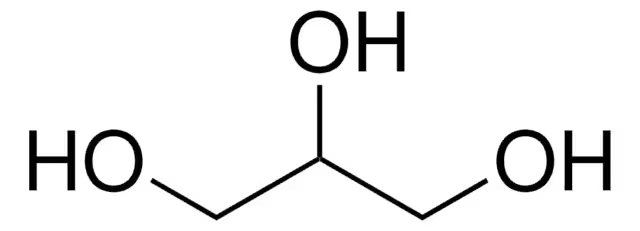
CAS Number56-81-5
SynonymsGlycerin; 1,2,3-propanetriol; MFCD00675440; EINECS 200-289-5; Glycerol; 1,2,3-trihydroxypropane
Molecular FormulaHOCH2CH(OH)CH2OH
Molecular Weight92.09
Purity≥99.5%
Density1.3±0.1 g/cm3
Boiling Point182 °C/20 mmHg (lit.)
Melting Point20 °C (lit.)
Appearanceviscous liquid
EINECS200-289-5
| Chemical & Physical Properties | |
|---|---|
| CAS Number | 56-81-5 |
| Catalog No. | 2A-9014519 |
| Chinese Name | 甘油 |
| Synonyms | Glycerin; 1,2,3-propanetriol; MFCD00675440; EINECS 200-289-5; Glycerol; 1,2,3-trihydroxypropane |
| Molecular Formula | HOCH2CH(OH)CH2OH |
| Molecular Weight | 92.09 |
| Purity | ≥99.5 |
| Density | 1.3±0.1 g/cm3 |
| Boiling Point | 182 °C/20 mmHg (lit.) |
| Melting Point | 20 °C (lit.) |
| Appearance | viscous liquid |
| Water Solubility | >500 g/L (20 ºC) |
| Storage Condition | 1. Store in a clean and dry place, pay attention t |
| Application | Glycerol is a clear, colorless, viscous, sweet liquid. Glycerol can be used for sample preparation and gel formation in polyacrylamide gel electrophoresis. |
| EINECS | 200-289-5 |
| HTC | 2905450000 |
| UN(IATA) | UN 无资料 |
| PubChem ID | 329799969 |
| MDL Number | MFCD00004722 |
| SMILES | OCC(O)CO |
| InChI | 1S/C3H8O3/c4-1-3(6)2-5/h3-6H,1-2H2 |
| InChI Key | PEDCQBHIVMGVHV-UHFFFAOYSA-N |
| Beilstein/REAXYS | 635685 |
| NACRES Code | NA.05 |
| UNSPSC | 12191502 |
| MSDS | msds/14519_1_56_81_5.pdf |
| Bioactivity | Glycerol is a clear, colourless, viscous, sweet-tasting liquid. Glycerol is used in sample preparation and gel formation for polyacrylamide gel electrophoresis. Related Catalog Research Areas >> Inflammation/Immunology Biochemical Assay Reagents Research Areas >> Cancer Research Areas >> Cardiovascular Disease Target Human Endogenous Metabolite In Vitro Glycerol is often included in polyacrylamide gels to prevent dissociation of nucleosomes and other protein-DNA complexes during electrophoresis. With glycerol included, fractionation seems to be largely based on particle mass and charge. The concentration of glycerol during electrophoresis strongly affects the separation characteristics of polyacrylamide gels[1]. Glycerol is an inevitable by-product of oils/fats processing, regardless of the pathway. Fermentative metabolism of glycerol has been studied in great detail in several species of the Enterobacteriaceae family, such as Citrobacter freundii and Klebsiella pneumoniae. The use of anaerobic fermentation to convert abundant and low-priced glycerol streams generated in the production of biodiesel into higher value products represents a promising route to achieve economic viability in the biofuels industry[2]. In Vivo Glycerol can induce acute renal failure in rat models. Acute renal failure induced by glycerol or uranyl nitrate reduces the hepato-biliary transport of some drugs, modulates the distribution of drugs into the central nervous system and affects the activity of various hepatic microsomal enzymes [3]. Animal Admin Rats: Experimental acute renal failure was induced in male Wistar rats 230-300 g by an injection of glycerol dissolved in saline (50% v/v, 10 mL/kg) into the leg muscle after a 24-h period of water deprivation[3]. References [1]. Pennings S, et al. Effect of glycerol on the separation of nucleosomes and bent DNA in low ionic strengthpolyacrylamide gel electrophoresis. Nucleic Acids Res. 1992 Dec 25;20(24):6667-72. [2]. Yazdani SS, et al. Anaerobic fermentation of glycerol: a path to economic viability for the biofuelsindustry. Curr Opin Biotechnol. 2007 Jun;18(3):213-9. [3]. Huang ZH, et al. Expression and function of P-glycoprotein in rats with glycerol-induced acute renal failure. Eur J Pharmacol. 2000 Oct 20;406(3):453-60. Chemical & Physical Properties Density 1.3±0.1 g/cm3 Boiling Point 290.0±0.0 °C at 760 mmHg Melting Point 20 °C(lit.) Molecular Formula C3H8O3 Molecular Weight 92.094 Flash Point 160.0±0.0 °C Exact Mass 92.047340 PSA 60.69000 LogP -2.32 Vapour density 3.1 (vs air) Vapour Pressure 0.0±1.3 mmHg at 25°C Index of Refraction 1.490 InChIKey PEDCQBHIVMGVHV-UHFFFAOYSA-N SMILES OCC(O)CO Stability Stable. Incompatible with perchloric acid, lead oxide, acetic anhydride, nitrobenzene, chlorine, peroxides, strong acids, strong bases. Combustible. Water Solubility >500 g/L (20 ºC) |
| Use of | Glycerol is a clear, colourless, viscous, sweet-tasting liquid. Glycerol is used in sample preparation and gel formation for polyacrylamide gel electrophoresis. Properties Articles3472 Name glycerol Synonym More Synonyms Glycerol Biological Activity Description Glycerol is a clear, colourless, viscous, sweet-tasting liquid. Glycerol is used in sample preparation and gel formation for polyacrylamide gel electrophoresis. Related Catalog Research Areas >> Inflammation/Immunology Biochemical Assay Reagents Research Areas >> Cancer Research Areas >> Cardiovascular Disease Human Endogenous Metabolite In Vitro Glycerol is often included in polyacrylamide gels to prevent dissociation of nucleosomes and other protein-DNA complexes during electrophoresis. With glycerol included, fractionation seems to be largely based on particle mass and charge. The concentration of glycerol during electrophoresis strongly affects the separation characteristics of polyacrylamide gels[1]. Glycerol is an inevitable by-product of oils/fats processing, regardless of the pathway. Fermentative metabolism of glycerol has been studied in great detail in several species of the Enterobacteriaceae family, such as Citrobacter freundii and Klebsiella pneumoniae. The use of anaerobic fermentation to convert abundant and low-priced glycerol streams generated in the production of biodiesel into higher value products represents a promising route to achieve economic viability in the biofuels industry[2]. In Vivo Glycerol can induce acute renal failure in rat models. Acute renal failure induced by glycerol or uranyl nitrate reduces the hepato-biliary transport of some drugs, modulates the distribution of drugs into the central nervous system and affects the activity of various hepatic microsomal enzymes [3]. References [1]. Pennings S, et al. Effect of glycerol on the separation of nucleosomes and bent DNA in low ionic strengthpolyacrylamide gel electrophoresis. Nucleic Acids Res. 1992 Dec 25;20(24):6667-72. [2]. Yazdani SS, et al. Anaerobic fermentation of glycerol: a path to economic viability for the biofuelsindustry. Curr Opin Biotechnol. 2007 Jun;18(3):213-9. [3]. Huang ZH, et al. Expression and function of P-glycoprotein in rats with glycerol-induced acute renal failure. Eur J Pharmacol. 2000 Oct 20;406(3):453-60. Chemical & Physical Properties Molecular Formula C3H8O3 Exact Mass 92.047340 PSA 60.69000 LogP -2.32 Vapour density 3.1 (vs air) Index of Refraction 1.490 InChIKey PEDCQBHIVMGVHV-UHFFFAOYSA-N SMILES OCC(O)CO Stability Stable. Incompatible with perchloric acid, lead oxide, acetic anhydride, nitrobenzene, chlorine, peroxides, strong acids, strong bases. Combustible. |
| Transport Info | Product name: Chemical name |
| Related Products in Specialty Chemicals | ||
|---|---|---|
| Germanium(IV) iodide | 13450-95-8 | 2A-9014514 |
| Germanium(IV) methoxide | 992-91-6 | 2A-9014515 |
| Germanium(IV) selenide | 12065-11-1 | 2A-9014516 |
| Germanium(IV) sulfide | 12025-34-2 | 2A-9014517 |
| Glutaric acid | 110-94-1 | 2A-9014518 |
| Glyceryl monooleate | 25496-72-4 | 2A-9014520 |
| Glyoxal | 107-22-2 | 2A-9014522 |
| Glyoxalic acid | 298-12-4 | 2A-9014523 |
| Gold (I) chloride | 10294-29-8 | 2A-9014524 |
| Gold monobromide | 10294-27-6 | 2A-9014525 |
| Browse all Specialty Chemicals products » | ||
Phone:
630-322-8886
630-322-8887
Email:
Office Locations:
Chicago, IL, USA
San Francisco, CA, USA


 EN
EN


 SDS
SDS