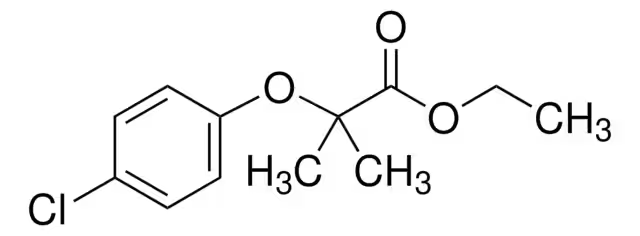
CAS Number637-07-0
Synonymsethyl 2-[(4-chlorophenyl)oxy]-2-methylpropanoate; MFCD00000615; Ethyl α-(p-chlorophenoxy)isobutyrate; Ethyl p-chlorophenoxyisobutyrate; Ethyl α-(4-chlorophenoxy)isobutyrate; Clofipront; Clofibric Acid, Ethyl Ester; 2-(p-chlorophenoxy)isobutyric acid ethyl ester; Ethyl α-(4-chlorophenoxy)-α-methylpropionate; clofibrate; Atromid; Anparton; Clofibrato; Chlorfenisate; Ethyl 2-(4-chlorophenoxy)-2-methylpropanoate; Ethyl α-(p-chlorophenoxy)-α-methylpropionate; Sklerolip; Arterioflexin; Antilipid; Fibralem; ethyl p-chlorophenoxy-isobutyrate; Angiokapsul; Regelan N; EINECS 211-277-4; Isobutyric acid, α-(p-chlorophenoxy)-, ethyl ester; Ethyl 2-(4-chlorophenoxy)isobutyrate; clofibric acid; Ethyl 2-(p-chlorophenoxy)-2-methylpropionate; Atromid-S; Propanoic acid, 2-(4-chlorophenoxy)-2-methyl-, ethyl e
Molecular FormulaC12H15ClO3
Molecular Weight242.70
Purity97%
Density1.1±0.1 g/cm3
Boiling Point274.8±0.0 °C at 760 mmHg
Appearanceliquid
EINECS211-277-4
Symbol
Signal WordWarning
| Chemical & Physical Properties | |
|---|---|
| CAS Number | 637-07-0 |
| Catalog No. | 2A-9001388 |
| Chinese Name | 氯贝特 |
| Synonyms | ethyl 2-[(4-chlorophenyl)oxy]-2-methylpropanoate; MFCD00000615; Ethyl α-(p-chlorophenoxy)isobutyrate; Ethyl p-chlorophenoxyisobutyrate; Ethyl α-(4-chlorophenoxy)isobutyrate; Clofipront; Clofibric Acid, Ethyl Ester; 2-(p-chlorophenoxy)isobutyric acid ethyl ester; Ethyl α-(4-chlorophenoxy)-α-methylpropionate; clofibrate; Atromid; Anparton; Clofibrato; Chlorfenisate; Ethyl 2-(4-chlorophenoxy)-2-methylpropanoate; Ethyl α-(p-chlorophenoxy)-α-methylpropionate; Sklerolip; Arterioflexin; Antilipid; Fibralem; ethyl p-chlorophenoxy-isobutyrate; Angiokapsul; Regelan N; EINECS 211-277-4; Isobutyric acid, α-(p-chlorophenoxy)-, ethyl ester; Ethyl 2-(4-chlorophenoxy)isobutyrate; clofibric acid; Ethyl 2-(p-chlorophenoxy)-2-methylpropionate; Atromid-S; Propanoic acid, 2-(4-chlorophenoxy)-2-methyl-, ethyl e |
| Molecular Formula | C12H15ClO3 |
| Molecular Weight | 242.70 |
| Purity | 97 |
| Density | 1.1±0.1 g/cm3 |
| Boiling Point | 274.8±0.0 °C at 760 mmHg |
| Appearance | liquid |
| Storage Condition | Store in an airtight container in a cool, dry plac |
| Application | Clofibrate is a PPAR agonist with EC50 values of 55 μM, ∼500 μM and 50 μM, ∼500 μM for human and mouse PPARα and PPARγ, respectively. |
| EINECS | 211-277-4 |
| HTC | 2918990090 |
| PubChem ID | 24278085 |
| MDL Number | MFCD00000615 |
| SMILES | CCOC(=O)C(C)(C)Oc1ccc(Cl)cc1 |
| InChI | 1S/C12H15ClO3/c1-4-15-11(14)12(2,3)16-10-7-5-9(13)6-8-10/h5-8H,4H2,1-3H3 |
| InChI Key | KNHUKKLJHYUCFP-UHFFFAOYSA-N |
| Beilstein/REAXYS | 1913459 |
| NACRES Code | NA.77 |
| UNSPSC | 12352200 |
| Hazard Symbols | Transport |
| MSDS | msds/1388_1_637_07_0.pdf |
| Bioactivity | Clofibrate is an agonist of PPAR, with EC50s of 50 μM, ∼500 μM for murine PPARα and PPARγ, and 55 μM, ∼500 μM for human PPARα and PPARγ, respectively. Related Catalog Research Areas >> Metabolic Disease Target PPARα:50 μM (EC50) PPARγ:500 μM (EC50) In Vitro Clofibrate is a PPAR agonist, with E50s of 50 μM, ∼500 μM for murine PPARα and PPARγ, and 55 μM, ∼500 μM for human PPARα and PPARγ, respectively[1]. Clofibrate (0.5, 1, 2 mM) increases FABP1 expression in two fatty acid (FA)-treated rat hepatoma cells. Clofibrate lowers ROS levels after early treatment, much more than late treatment in FA-treated cells[2]. In Vivo Clofibrate (0.5%) up-regulates serum concentrations and hepatic expression of FGF21 in fetuses, with a return to basal levels after Clofibrate administration withdrawal. Clofibrate administration-offspring have significantly higher expression of thermogenic genes (Ucp1, Cidea, Ppara Ppargc1a, Cpt1b) and UCP1 protein levels in response to HFD in inguinal fat, but not in retroperitoneal (combined with perirenal) or epididymal fat[3]. Cell Assay Cells are seeded at a density of 2.5 × 10⁴ cells/well (for WST-1, intracellular lipid droplet quantification and dichlorofluorescein (DCF) assay, 96-well plates) and 1 × 10⁵ cells/well (for Nile Red Staining, 12-well plates) in MEM/EBSS medium and incubated overnight for adherence. The next day cell culture medium is replaced with freshly prepared medium containing the fatty acid mixture oleate:palmitate (2:1) in presence of 3% fatty-acid-free bovine serum albumin. Cells are treated with 0, 0.5, 1, 2, and 3 mM fatty acid (FA) mixture for 24 and 48 hr at 37°C in a humidified incubator in an atmosphere of 95% air and 5% CO2. Clofibrate is used to increase levels of FABP1 in treated cell cultures. Clofibrate (500 μM) is dissolved in DMSOand later added to the medium (DMSO < 0.1% v/v in final volume). Control cells are incubated with DMSO alone. Four different cell treatments includ 1-day FA treatment, 2-day FA treatment, early clofibrate intervention and late clofibrate intervention[1]. Animal Admin Female and male C57BL/6JNarl mice are used for breeding. Females with parity from 1 to 5 are used. Pregnant females are fed either a control (C) or experimental (CF) diet from breeding to parturition. The C diet is based on an AIN-93M diet with a slight modification to contain 21 kcal% fat from soybean oil, whereas the CF diet is the C diet with addition of 0.5% clofibrate. Pregnancy is dated by the presence of a vaginal plug (defined as pregnancy day 1). After spontaneous parturition (pregnancy day 19.5 ± 0.5), all littermates are uniformly nursed by dams fed the C diet for 3 wk, with litter sizes adjusted to 8-10, weaned onto a nonpurified standard diet for 4 wk, and then switched to a HFD (51 kcal% fat, butter-based) for 5 wk. In this study, only male offspring are used and 2 groups of offspring are designated, according to their mother's diet (C or CF). All mice are kept in a room maintained at 23 ± 2°C, with a controlled 12-h-light:-dark cycle with ad libitum to feed and drinking water. Body weight and feed intake are recorded weekly[3]. References [1]. Willson TM, et al. The PPARs: from orphan receptors to drug discovery. J Med Chem. 2000 Feb 24;43(4):527-50. [2]. Chen Y, et al. Clofibrate Attenuates ROS Production by Lipid Overload in Cultured Rat Hepatoma Cells. J Pharm Pharm Sci. 2017;20(0):239-251. [3]. Chen SH, et al. Prenatal PPARα activation by clofibrate increases subcutaneous fat browning in male C57BL/6J mice fed a high-fat diet during adulthood. PLoS One. 2017 Nov 2;12(11):e0187507. Chemical & Physical Properties Density 1.1±0.1 g/cm3 Boiling Point 274.8±0.0 °C at 760 mmHg Molecular Formula C12H15ClO3 Molecular Weight 242.699 Flash Point 115.1±19.9 °C Exact Mass 242.070969 PSA 35.53000 LogP 3.32 Vapour Pressure 0.0±0.5 mmHg at 25°C Index of Refraction 1.505 InChIKey KNHUKKLJHYUCFP-UHFFFAOYSA-N SMILES CCOC(=O)C(C)(C)Oc1ccc(Cl)cc1 |
| Use of | Clofibrate is an agonist of PPAR, with EC50s of 50 μM, ∼500 μM for murine PPARα and PPARγ, and 55 μM, ∼500 μM for human PPARα and PPARγ, respectively. Properties Articles72 Name clofibrate Synonym More Synonyms clofibrate Biological Activity Description Clofibrate is an agonist of PPAR, with EC50s of 50 μM, ∼500 μM for murine PPARα and PPARγ, and 55 μM, ∼500 μM for human PPARα and PPARγ, respectively. Related Catalog Research Areas >> Metabolic Disease PPARα:50 μM (EC50) PPARγ:500 μM (EC50) In Vivo Clofibrate (0.5%) up-regulates serum concentrations and hepatic expression of FGF21 in fetuses, with a return to basal levels after Clofibrate administration withdrawal. Clofibrate administration-offspring have significantly higher expression of thermogenic genes (Ucp1, Cidea, Ppara Ppargc1a, Cpt1b) and UCP1 protein levels in response to HFD in inguinal fat, but not in retroperitoneal (combined with perirenal) or epididymal fat[3]. References [1]. Willson TM, et al. The PPARs: from orphan receptors to drug discovery. J Med Chem. 2000 Feb 24;43(4):527-50. [2]. Chen Y, et al. Clofibrate Attenuates ROS Production by Lipid Overload in Cultured Rat Hepatoma Cells. J Pharm Pharm Sci. 2017;20(0):239-251. [3]. Chen SH, et al. Prenatal PPARα activation by clofibrate increases subcutaneous fat browning in male C57BL/6J mice fed a high-fat diet during adulthood. PLoS One. 2017 Nov 2;12(11):e0187507. Chemical & Physical Properties Exact Mass 242.070969 PSA 35.53000 Index of Refraction 1.505 InChIKey KNHUKKLJHYUCFP-UHFFFAOYSA-N |
| Tax Rebate | 13.0% |
| Supervision | None. MFN tariff: 6.5%. Ordinary tariff: 30.0% |
| Transport Info | Product name: Purity: 98.0% |
| MSDS Transport Info | Module 14. Shipping information 14.1 UN dangerous goods number European Land Transport Danger Regulations: 3082 International Maritime Danger Regulations: 3082 International Air Transport Danger Regulations: 3082 14.2 Names specified by the United Nations (UN) European land transport hazard regulations: ENVIRONMENTALLY HAZARDOUS SUBSTANCE, LIQUID, N.O.S. (Clofibrate) IMDG: ENVIRONMENTALLY HAZARDOUS SUBSTANCE, LIQUID, N.O.S. (Clofibrate) International air transport hazard regulations: Environmentally hazardous substance, liquid, n.o.s. (Clofibrate) 14.3 Transport hazard categories European land transport Dangerous Regulations: 9 International sea transport Dangerous Regulations: 9 International air transport Dangerous Regulations: 9 14.4 Package group European Land Transport Danger Regulations: III International Maritime Transport Danger Regulations: III International Air Transport Danger Regulations: III 14.5 Environmental hazards European Land Transport Dangerous Regulations: Yes International Maritime Transport Dangerous Regulations Maritime Pollutants: Yes International Air Transport Dangerous Regulations: Yes 14.6 Special reminder to users further information Dangerous goods are individually packaged, with liquids exceeding 5 liters or solids exceeding 5 kilograms. The outer packaging of each independent package and the combined independent inner package must have EHS on it. Identification (according to European ADR Regulation 2.2.9.1.10, IMDG Regulation 2.10.3), |
| Related Products in Specialty Chemicals | ||
|---|---|---|
| 2-(4-Benzoylphenyl)-2-(4-fluorophenyl)acetonitrile | 446275-89-4 | 2A-9001376 |
| 2-(4-Biphenyl)ethylamine | 17027-51-9 | 2A-9001377 |
| 2-(4-Bromo-2,6-dimethylphenoxy)ethylamine | 499980-87-9 | 2A-9001378 |
| 2'-(4-Bromobenzyloxy)acetophenone | 2A-101384 | 2A-9001384 |
| 2-(4-Bromophenyl)-2-methylpropionic acid | 32454-35-6 | 2A-9001385 |
| 2-(4'-Chlorophenoxy)aniline | 2770-11-8 | 2A-9001390 |
| 2-(4-Chlorophenoxy)butane | 2A-101391 | 2A-9001391 |
| 2-(4-Chlorophenoxy)ethyl chloride | 13001-28-0 | 2A-9001392 |
| 2-(4-Chlorophenyl)thiazoline | 2A-101399 | 2A-9001399 |
| 2-(4-Fluorophenoxy)-1-{6-[1-(4-fluorophenoxy)ethyl]pyridin-3-yl}propan-1-one | 2A-101404 | 2A-9001404 |
| Browse all Specialty Chemicals products » | ||
Phone:
630-322-8886
630-322-8887
Email:
Office Locations:
Chicago, IL, USA
San Francisco, CA, USA


 EN
EN


 SDS
SDS