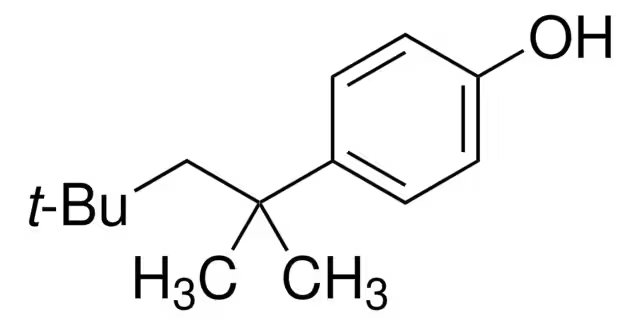
CAS Number140-66-9
Synonyms4-(tert-octyl)phenol; 4-tert-octyl phenol; 4-(2,4,4-trimethylpentan-2-yl)phenol; EINECS 205-426-2; 4-(1,1,3,3-TetraMethylbutyl)phenol; p-(Tert-octyl)-Phenol; p-tert-octylphenol; 4-(2,4,4-Trimethyl-2-pentanyl)phenol; p-(1,1,3,3-tetramethylbutyl)phenol; MFCD00002368; tert-octylphenol; t-octylphenol; 4-tert-octylphenol; para-tert-Octylphenol
Molecular Formula(CH3)3CCH2C(CH3)2C6H4OH
Molecular Weight206.32
Purity97%
Density0.9±0.1 g/cm3
Boiling Point175 °C/30 mmHg (lit.)
Melting Point79-82 °C (lit.)
Appearancewhite powder
EINECS205-426-2
Symbol
Signal WordWarning
| Chemical & Physical Properties | |
|---|---|
| CAS Number | 140-66-9 |
| Catalog No. | 2A-9013564 |
| Chinese Name | 对特辛基苯酚 |
| Synonyms | 4-(tert-octyl)phenol; 4-tert-octyl phenol; 4-(2,4,4-trimethylpentan-2-yl)phenol; EINECS 205-426-2; 4-(1,1,3,3-TetraMethylbutyl)phenol; p-(Tert-octyl)-Phenol; p-tert-octylphenol; 4-(2,4,4-Trimethyl-2-pentanyl)phenol; p-(1,1,3,3-tetramethylbutyl)phenol; MFCD00002368; tert-octylphenol; t-octylphenol; 4-tert-octylphenol; para-tert-Octylphenol |
| Molecular Formula | (CH3)3CCH2C(CH3)2C6H4OH |
| Molecular Weight | 206.32 |
| Purity | 97 |
| Density | 0.9±0.1 g/cm3 |
| Boiling Point | 175 °C/30 mmHg (lit.) |
| Melting Point | 79-82 °C (lit.) |
| Appearance | white powder |
| Storage Condition | Store in a dry and cool place. |
| Packaging | III |
| Application | 4-tert-octylphenol is an endocrine disruptor and an estrogen drug. 4-tert-octylphenol induces apoptosis in neural progenitor cells in the brain of offspring mice. 4-tert-octylphenol reduces bromodeoxy |
| EINECS | 205-426-2 |
| HTC | 29071300 |
| PubChem ID | 24857490 |
| MDL Number | MFCD00002368 |
| SMILES | CC(C)(C)CC(C)(C)c1ccc(O)cc1 |
| InChI | 1S/C14H22O/c1-13(2,3)10-14(4,5)11-6-8-12(15)9-7-11/h6-9,15H,10H2,1-5H3 |
| InChI Key | ISAVYTVYFVQUDY-UHFFFAOYSA-N |
| Beilstein/REAXYS | 513992 |
| NACRES Code | NA.22 |
| UNSPSC | 12352100 |
| Hazard Symbols | 8 |
| MSDS | msds/13564_1_140_66_9.pdf |
| Bioactivity | 4-tert-Octylphenol, a endocrine-disrupting chemical, is an estrogenic drug. 4-tert-Octylphenol induces apoptosis in neuronal progenitor cells in offspring mouse brain. 4-tert-Octylphenol reduces bromodeoxyuridine (BrdU), mitotic marker Ki67, and phospho-histone H3 (p-Histone-H3), resulting in a reduction of neuronal progenitor proliferation. 4-tert-Octylphenol disrupts brain development and behavior in mice[1]. Related Catalog Signaling Pathways >> Apoptosis >> Apoptosis Research Areas >> Endocrinology Research Areas >> Neurological Disease Target Human Endogenous Metabolite References [1]. Dinh Nam Tran, et al. 4-tert-Octylphenol Exposure Disrupts Brain Development and Subsequent Motor, Cognition, Social, and Behavioral Functions. Oxidative Medicine and Cellular Longevity, 2020. Chemical & Physical Properties Density 0.9±0.1 g/cm3 Boiling Point 282.3±0.0 °C at 760 mmHg Melting Point 79-82 °C(lit.) Molecular Formula C14H22O Molecular Weight 206.324 Flash Point 148.3±8.2 °C Exact Mass 206.167068 PSA 20.23000 LogP 4.93 Vapour Pressure 0.0±0.6 mmHg at 25°C Index of Refraction 1.501 InChIKey ISAVYTVYFVQUDY-UHFFFAOYSA-N SMILES CC(C)(C)CC(C)(C)c1ccc(O)cc1 Storage condition Refrigerator Stability Stable. Incompatible with strong oxidizing agents, strong bases. |
| Use of | 4-tert-Octylphenol, a endocrine-disrupting chemical, is an estrogenic drug. 4-tert-Octylphenol induces apoptosis in neuronal progenitor cells in offspring mouse brain. 4-tert-Octylphenol reduces bromodeoxyuridine (BrdU), mitotic marker Ki67, and phospho-histone H3 (p-Histone-H3), resulting in a reduction of neuronal progenitor proliferation. 4-tert-Octylphenol disrupts brain development and behavior in mice[1]. Properties Articles48 Name 4-tert-Octylphenol Synonym More Synonyms 4-tert-Octylphenol Biological Activity Description 4-tert-Octylphenol, a endocrine-disrupting chemical, is an estrogenic drug. 4-tert-Octylphenol induces apoptosis in neuronal progenitor cells in offspring mouse brain. 4-tert-Octylphenol reduces bromodeoxyuridine (BrdU), mitotic marker Ki67, and phospho-histone H3 (p-Histone-H3), resulting in a reduction of neuronal progenitor proliferation. 4-tert-Octylphenol disrupts brain development and behavior in mice[1]. Related Catalog Signaling Pathways >> Apoptosis >> Apoptosis Research Areas >> Endocrinology Research Areas >> Neurological Disease Human Endogenous Metabolite References [1]. Dinh Nam Tran, et al. 4-tert-Octylphenol Exposure Disrupts Brain Development and Subsequent Motor, Cognition, Social, and Behavioral Functions. Oxidative Medicine and Cellular Longevity, 2020. Chemical & Physical Properties Molecular Formula C14H22O Exact Mass 206.167068 PSA 20.23000 Index of Refraction 1.501 InChIKey ISAVYTVYFVQUDY-UHFFFAOYSA-N Storage condition Refrigerator Stability Stable. Incompatible with strong oxidizing agents, strong bases. |
| Tax Rebate | 9.0% |
| Supervision | none |
| Transport Info | Product name: Chemical name |
| Related Products in Specialty Chemicals | ||
|---|---|---|
| 4-Nitrophenyl chloroformate | 7693-46-1 | 2A-9013558 |
| 4-Nitrophenylacetic acid | 104-03-0 | 2A-9013559 |
| 4'-n-Pentylacetophenone | 37593-02-5 | 2A-9013561 |
| 4-Phenylphenol | 92-69-3 | 2A-9013562 |
| 4-tert-Butylbenzyl chloride | 19692-45-6 | 2A-9013563 |
| 5-acetamido-2-aminobenzenesulfonic acid | 96-78-6 | 2A-9013569 |
| 5-Acetyl-3-chloro-10,11-dihydro-5H-dibenz[b,f]azepine | 25961-11-9 | 2A-9013570 |
| 5-amino-2-methylbenzenesulfonic acid | 118-88-7 | 2A-9013572 |
| TRIBUTYLSTANNYLTRIMETHYLSILANE | 17955-46-3 | 2A-9013575 |
| 5-Nitroisophthalic acid | 618-88-2 | 2A-9013581 |
| Browse all Specialty Chemicals products » | ||
Phone:
630-322-8886
630-322-8887
Email:
Office Locations:
Chicago, IL, USA
San Francisco, CA, USA


 EN
EN


 SDS
SDS