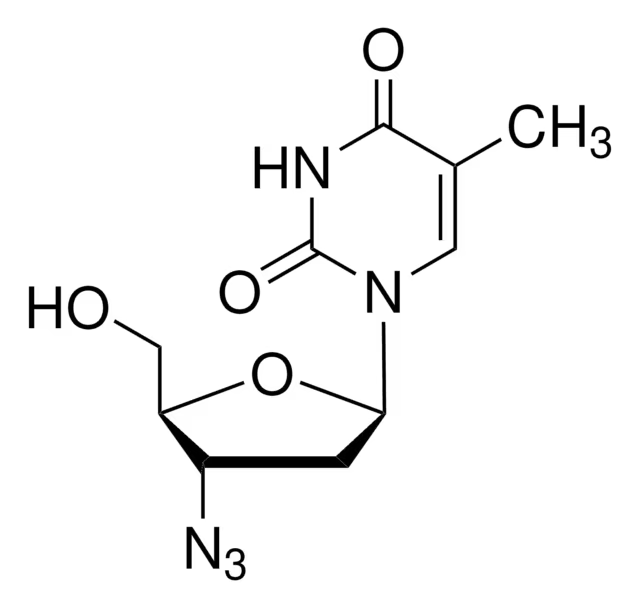
CAS Number30516-87-1
SynonymsRetrovis; bwa509u; Azitidin; BW-A509U; 1-(3-Azido-2,3-dideoxy-β-D-glycero-pentofuranosyl)-5-methylpyrimidine-2,4(1H,3H)-dione; 1-(3-Azido-2,3-dideoxy-β-D-ribofuranosyl)thymine; ZVD; 3'-azido-3'-droxythymidine; retrovir; Timazid; ZDV; 1-(3-Azido-2,3-Dideoxy-Beta-D-Ribofuranosyl)Thymine; BE-AS09U; Azidothymidine; 1-[(2R,4S,5S)-4-Azido-5-(hydroxymethyl)tetrahydrofuran-2-yl]-5-methylpyrimidin-2,4(1H,3H)-dion; 3'-Azido-3'-deoxythymidine; 1-[(2R,4S,5S)-4-azido-5-(hydroxyméthyl)tétrahydrofuran-2-yl]-5-méthylpyrimidine-2,4(1H,3H)-dione; AZT; MFCD00006536; Zidovudine
Molecular FormulaC10H13N5O4
Molecular Weight267.24
Purity≥98 (HPLC)%
Melting Point113-115 °C (lit.)
Appearancepowder
Symbol
Signal WordWarning
| Chemical & Physical Properties | |
|---|---|
| CAS Number | 30516-87-1 |
| Catalog No. | 2A-9012988 |
| Chinese Name | 齐多夫定 |
| Synonyms | Retrovis; bwa509u; Azitidin; BW-A509U; 1-(3-Azido-2,3-dideoxy-β-D-glycero-pentofuranosyl)-5-methylpyrimidine-2,4(1H,3H)-dione; 1-(3-Azido-2,3-dideoxy-β-D-ribofuranosyl)thymine; ZVD; 3'-azido-3'-droxythymidine; retrovir; Timazid; ZDV; 1-(3-Azido-2,3-Dideoxy-Beta-D-Ribofuranosyl)Thymine; BE-AS09U; Azidothymidine; 1-[(2R,4S,5S)-4-Azido-5-(hydroxymethyl)tetrahydrofuran-2-yl]-5-methylpyrimidin-2,4(1H,3H)-dion; 3'-Azido-3'-deoxythymidine; 1-[(2R,4S,5S)-4-azido-5-(hydroxyméthyl)tétrahydrofuran-2-yl]-5-méthylpyrimidine-2,4(1H,3H)-dione; AZT; MFCD00006536; Zidovudine |
| Molecular Formula | C10H13N5O4 |
| Molecular Weight | 267.24 |
| Purity | ≥98 (HPLC) |
| Melting Point | 113-115 °C (lit.) |
| Appearance | powder |
| Water Solubility | 1-5 g/100 mL at 17 ºC |
| Storage Condition | Seal and store at -20ºC |
| Packaging | 1g/foil bag |
| Application | Zidovudine is a nucleoside reverse transcriptase inhibitor (NRTI) widely used to treat HIV infection. Zidovudine enhances CRISPR/Cas9-regulated editing frequency. |
| HTC | 2933990090 |
| PubChem ID | 24278143 |
| MDL Number | MFCD00006536 |
| SMILES | CC1=CN([C@H]2C[C@H](N=[N+]=[N-])[C@@H](CO)O2)C(=O)NC1=O |
| InChI | 1S/C10H13N5O4/c1-5-3-15(10(18)12-9(5)17)8-2-6(13-14-11)7(4-16)19-8/h3,6-8,16H,2,4H2,1H3,(H,12,17,18)/t6-,7+,8+/m0/s1 |
| InChI Key | HBOMLICNUCNMMY-XLPZGREQSA-N |
| Beilstein/REAXYS | 3595791 |
| NACRES Code | NA.77 |
| UNSPSC | 12352200 |
| Hazard Symbols | Transport |
| MSDS | msds/12988_1_30516_87_1.pdf |
| Bioactivity | Zidovudine is a nucleoside reverse transcriptase inhibitor (NRTI), widely used to treat HIV infection. Zidovudine increases CRISPR/Cas9-mediated editing frequency. Related Catalog Signaling Pathways >> Cell Cycle/DNA Damage >> CRISPR/Cas9 Signaling Pathways >> Anti-infection >> HIV Research Areas >> Infection Target HIV-1 CRISPR/Cas9 In Vitro Zidovudine inhibits SVG, Primary human fetal astrocytes (PFA), peripheral blood mononuclear cells (PBMC), and monocyte-derived macrophages (MDM) with EC50 of 17, 1311, 8, and 5 nM, respectively. Zidovudine inhibits SVG, PFA, PBMC, and MDM with EC90 of 0.205 μM, 44.157 μM, 0.481 μM, and 0.219 μM, respectively[1]. Genome editing via CRISPR/Cas9 has become an efficient and reliable way to make precise, targeted changes to the genome of living cells. CXCR4 is a co-receptor for the human immunodeficiency virus type 1 (HIV-1) infection and has been considered as an important therapeutic target for AIDS. CXCR4 mediates viral entry into human CD4+ cells by binding to envelope protein, gp120. Human CXCR4 gene is efficiently disrupted by CRISPR/Cas9-mediated genome editing, leading to HIV-1 resistance of human primary CD4+ T cells. The Cas9-mediated ablation of CXCR4 demonstrated high specificity and negligible off-target effects without affecting cell division and propagation[2]. In Vivo Intravitrous injection of the NRTIs Lamivudine (3TC), Zidovudine (AZT), or Abacavir (ABC) suppresses the laser-induced choroidal neovascularization (CNV) in wild-type mice compared to PBS vehicle. The mean level of VEGF-A in the RPE/choroid, which peaks on day 3 after laser injury, is significantly reduced in 3TC-, AZT- and ABC-treated eyes compared with control eyes in wild-type mice, but not inP2rx7-/- mice[3]. Cell Assay Assays are performed in all cell types in the presence of titrating concentrations of ARV. 5,000 SVG, 2,500 PFA, 200,000 PBMC, or 50,000 MDM cells/well are seeded into triplicate wells of 96-well plates. Twenty-four hours later, the culture medium is removed and replaced with medium containing the ARV or DMSO (0.5% vol/vol), and equivalent TCID50 infectious units of luciferase reporter virus are added to the cells. After a 16 h incubation at 37°C, the initial viral inoculum is removed and replaced with culture medium containing the same antiretroviral drug (ARV) or DMSO (0.5% vol/vol) concentrations. At 72 h post infection, the medium is aspirated, the cells are lysed and HIV-1 infection measured using the Luciferase Assay System. Luminescence is measured using a FLUOStar Optima microplate reader. Inhibition curves and the 50% (EC50) and 90% (EC90) effective concentrations are determined by nonlinear regression analysis, using GraphPad Prism software[1]. Animal Admin Mice[3] C57BL/6J (wild-type) and P2rx7-/- mice are used. The Nlrp3-/- mice are used. The NRTIs 3TC, AZT, and ABC or the P2X7 antagonist A438079 hydrochloride are dissolved in PBS. For CNV, each group of mice is injected once with 1 μL of NRTIs (3TC, 125 ng/μL; ABC, 183 ng/μL; AZT, 146 ng/μL), 1 μL of A438079 hydrochloride (3, 30, or 300 ng/μL), or the same volume of vehicle (PBS) into the vitreous humor using a 33-gauge needle immediately after laser injury. Another group of mice is injected with 3TC (125 ng) in combination with an anti-mouse VEGF polyclonal antibody (10 ng). Goat whole IgG (10 ng) is used as a biological control for the anti-mouse VEGF antibody. References [1]. Gray LR, et al. The NRTIs lamivudine, stavudine and zidovudine have reduced HIV-1 inhibitory activity in astrocytes. PLoS One. 2013 Apr 16;8(4):e62196. [2]. Hou P, et al. Genome editing of CXCR4 by CRISPR/cas9 confers cells resistant to HIV-1 infection. Sci Rep. 2015 Oct 20;5:15577. [3]. Mizutani T, et al. Nucleoside Reverse Transcriptase Inhibitors Suppress Laser-Induced Choroidal Neovascularization in Mice. Invest Ophthalmol Vis Sci. 2015 Nov;56(12):7122-9. Chemical & Physical Properties Melting Point 113-115 °C(lit.) Molecular Formula C10H13N5O4 Molecular Weight 267.241 Exact Mass 267.096741 PSA 134.07000 LogP -0.53 Index of Refraction 47 ° (C=1, H2O) InChIKey HBOMLICNUCNMMY-XLPZGREQSA-N SMILES Cc1cn(C2CC(N=[N+]=[N-])C(CO)O2)c(=O)[nH]c1=O Water Solubility 1-5 g/100 mL at 17 ºC |
| Use of | Zidovudine is a nucleoside reverse transcriptase inhibitor (NRTI), widely used to treat HIV infection. Zidovudine increases CRISPR/Cas9-mediated editing frequency. Properties Articles123 Name zidovudine Synonym More Synonyms Zidovudine Biological Activity Description Zidovudine is a nucleoside reverse transcriptase inhibitor (NRTI), widely used to treat HIV infection. Zidovudine increases CRISPR/Cas9-mediated editing frequency. Related Catalog Signaling Pathways >> Cell Cycle/DNA Damage >> CRISPR/Cas9 Signaling Pathways >> Anti-infection >> HIV Research Areas >> Infection CRISPR/Cas9 In Vivo Intravitrous injection of the NRTIs Lamivudine (3TC), Zidovudine (AZT), or Abacavir (ABC) suppresses the laser-induced choroidal neovascularization (CNV) in wild-type mice compared to PBS vehicle. The mean level of VEGF-A in the RPE/choroid, which peaks on day 3 after laser injury, is significantly reduced in 3TC-, AZT- and ABC-treated eyes compared with control eyes in wild-type mice, but not inP2rx7-/- mice[3]. Animal Admin Mice[3] C57BL/6J (wild-type) and P2rx7-/- mice are used. The Nlrp3-/- mice are used. The NRTIs 3TC, AZT, and ABC or the P2X7 antagonist A438079 hydrochloride are dissolved in PBS. For CNV, each group of mice is injected once with 1 μL of NRTIs (3TC, 125 ng/μL; ABC, 183 ng/μL; AZT, 146 ng/μL), 1 μL of A438079 hydrochloride (3, 30, or 300 ng/μL), or the same volume of vehicle (PBS) into the vitreous humor using a 33-gauge needle immediately after laser injury. Another group of mice is injected with 3TC (125 ng) in combination with an anti-mouse VEGF polyclonal antibody (10 ng). Goat whole IgG (10 ng) is used as a biological control for the anti-mouse VEGF antibody. References [1]. Gray LR, et al. The NRTIs lamivudine, stavudine and zidovudine have reduced HIV-1 inhibitory activity in astrocytes. PLoS One. 2013 Apr 16;8(4):e62196. [3]. Mizutani T, et al. Nucleoside Reverse Transcriptase Inhibitors Suppress Laser-Induced Choroidal Neovascularization in Mice. Invest Ophthalmol Vis Sci. 2015 Nov;56(12):7122-9. Chemical & Physical Properties Molecular Formula C10H13N5O4 Exact Mass 267.096741 PSA 134.07000 LogP -0.53 InChIKey HBOMLICNUCNMMY-XLPZGREQSA-N |
| Tax Rebate | 13.0% |
| Supervision | None. MFN tariff: 6.5%. Ordinary tariff: 20.0% |
| Transport Info | Product name: Purity: 98.0% |
| MSDS Transport Info | Module 14. Shipping information 14.1 UN dangerous goods number European Land Transport Dangerous Regulations: -International Maritime Dangerous Regulations: -International Air Transport Dangerous Regulations: - 14.2 Names specified by the United Nations (UN) European Land Transport Dangerous Regulations: Non-dangerous goods IMDG Code: Non-dangerous goods International air transport dangerous goods regulations: non-dangerous goods 14.3 Transport hazard categories European Land Transport Dangerous Regulations: -International Maritime Dangerous Regulations: -International Air Transport Dangerous Regulations: - 14.4 Package group European Land Transport Dangerous Regulations: -International Maritime Dangerous Regulations: -International Air Transport Dangerous Regulations: - 14.5 Environmental hazards European Land Transport Dangerous Regulations: No International Maritime Transport Dangerous Regulations Maritime Pollutants: No International Air Transport Risk Regulations: No 14.6 Special reminder to users No data available |
| Location | in stock |
| Related Products in API & Advanced Intermediates | ||
|---|---|---|
| Vinorelbine bitartrate | 125317-39-7 | 2A-9012937 |
| Voriconazole | 137234-62-9 | 2A-9012956 |
| Warfarin sodium | 129-06-6 | 2A-9012957 |
| Zafirlukast | 107753-78-6 | 2A-9012979 |
| Zaleplon | 151319-34-5 | 2A-9012980 |
| Ziprasidone | 138982-67-9 | 2A-9012996 |
| Zolpidem tartrate | 99294-93-6 | 2A-9013004 |
| Alendronate Sodium (Fosamax) | 121268-17-5 | 2A-9013617 |
| Formoterol fumarate | 43229-80-7 | 2A-9014472 |
| Lithium carbonate | 554-13-2 | 2A-9014763 |
| Browse all API & Advanced Intermediates products » | ||
Phone:
630-322-8886
630-322-8887
Email:
Office Locations:
Chicago, IL, USA
San Francisco, CA, USA


 EN
EN


 SDS
SDS