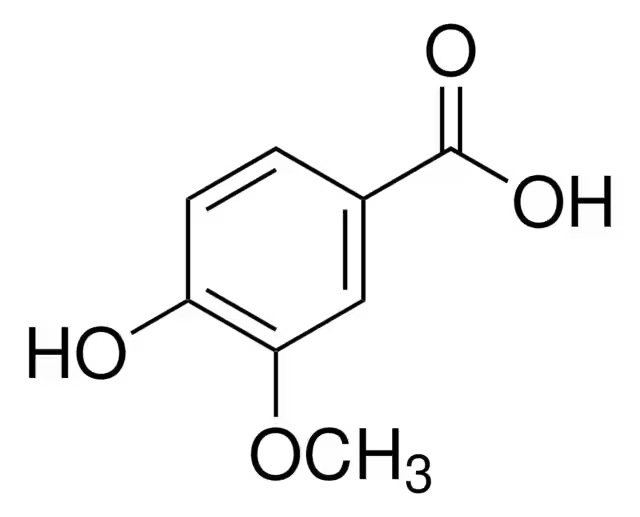
CAS Number121-34-6
Synonyms4-Hydroxy-3-methoxybenzoic acid; EINECS 204-466-8; 4-hydroxy-m-Anisic acid; 4-Hydroxy-3-methoxy-benzoic acid; Vanillic acid; MFCD00002551; Acid, Vanillic
Molecular FormulaHOC6H3(OCH3)CO2H
Molecular Weight168.15
Purity97%
Density1.4±0.1 g/cm3
Boiling Point353.4±27.0 °C at 760 mmHg
Melting Point208-210 °C (lit.)
AppearanceWhite odorless crystal or powder
EINECS204-466-8
| Chemical & Physical Properties | |
|---|---|
| CAS Number | 121-34-6 |
| Catalog No. | 2A-9012915 |
| Chinese Name | 香草酸 |
| Synonyms | 4-Hydroxy-3-methoxybenzoic acid; EINECS 204-466-8; 4-hydroxy-m-Anisic acid; 4-Hydroxy-3-methoxy-benzoic acid; Vanillic acid; MFCD00002551; Acid, Vanillic |
| Molecular Formula | HOC6H3(OCH3)CO2H |
| Molecular Weight | 168.15 |
| Purity | 97 |
| Density | 1.4±0.1 g/cm3 |
| Boiling Point | 353.4±27.0 °C at 760 mmHg |
| Melting Point | 208-210 °C (lit.) |
| Appearance | White odorless crystal or powder |
| Storage Condition | 2. Storage: Store sealed in a cool place |
| Application | Vanillic acid is a flavoring agent found in edible plants and fruits. Vanillic acid inhibits NF-κB activation. It has anti-inflammatory, antibacterial and other activities [1]. |
| EINECS | 204-466-8 |
| HTC | 2918990090 |
| PubChem ID | 24895581 |
| MDL Number | MFCD00002551 |
| SMILES | COc1cc(ccc1O)C(O)=O |
| InChI | 1S/C8H8O4/c1-12-7-4-5(8(10)11)2-3-6(7)9/h2-4,9H,1H3,(H,10,11) |
| InChI Key | WKOLLVMJNQIZCI-UHFFFAOYSA-N |
| Beilstein/REAXYS | 2208364 |
| NACRES Code | NA.22 |
| UNSPSC | 12352100 |
| MSDS | msds/12915_1_121_34_6.pdf |
| Bioactivity | Vanillic acid is a flavoring agent found in edible plants and fruits. Vanillic acid inhibits NF-κB activation. Anti-inflammatory, antibacterial, and chemopreventive effects[1]. Related Catalog Research Areas >> Infection Natural Products >> Acids and Aldehydes Research Areas >> Inflammation/Immunology Target p65 In Vitro Vanillic acid inhibited lipopolysaccharide (LPS)-induced phosphorylation of IκB (cytoplasmatic NF-κB inhibitor) in the cytoplasm extract and NF-κB p65 subunit expression in the nuclear extract of macrophages in vitro as determined by Western blot[1]. Vanillic acid treatment reverses the Aβ1-42-induced elevated expression of IKK-β/NF-κB and reduces the activity of IKKβ/NF-κB. Vanillic acid is non-toxic to HT22 cells at all three concentrations (50, 100 and 200 μM); Vanillic acid co-treatment with Aβ1-42 significantly increases (1.5-, 1.9- and 2-fold respectively) cell viability. Aβ1-42 (5 μM) treatment results in a significant increase (1.6-fold) in ROS levels compared with the control cells. In contrast, Vanillic acid treatment at all three different concentrations (50, 100 and 200 μM) reduces (1.1-, 1.3- and 1.4-fold respectively) ROS levels, indicating that Vanillic acid is a potent antioxidant[2]. In Vivo Vanillic acid (30 mg/kg, ip, 1 h) inhibits Carrageenan-induced NF-κB activation. Mice receive Vanillic acid (30 mg/kg, ip) 1 h before ipl injection of Carrageenan (300 μg/paw), and samples of the cutaneous plantar tissues are collected 3 h after stimulus injection. Carrageenan-induced activation of NF-κB is observed by a decrease in the ratio of total NF-κB/p-NF-κB, while treatment with Vanillic acid as well as the control drug Indomethacin (5 mg/kg, ip, diluted in Tris/HCl buffer, 40 min before stimulus) inhibits Carrageenan-induced activation of NF-κB[1]. Cell Assay The viability of HT22 cells is assessed with the MTT assay. Cells are cultured in 96-well plates at a density of 1 × 10⁴ cells per well in 100 μL of Dulbecco's modified Eagle's medium (DMEM). After 24 h, the medium is replaced with fresh medium containing Aβ1-42 (5 μM), with three different concentrations (50, 100 and 200 μM) of Vanillic acid either alone or in combination with Aβ1-42 (5 μM), and the cells are incubated for an additional 24 h. The control cells receive only DMEM. Following this, the cells are incubated with MTT solution for another 2-4 h at 37°C. Subsequently, the medium in each well is replaced with DMSO. Finally, the absorbance of the solution in each well at 570 nm is measured using an ApoTox instrument. All experiments are performed independently in triplicate[2]. Animal Admin Mice[1] During the experiments, Male Swiss mice (25-30 g) receive intraperitoneal (3, 10, or 30 mg/kg) treatment with Vanillic acid or vehicle (5% Tween 80 diluted in saline) 1 h before or 24 h after inflammatory stimuli injection[1]. References [1]. Calixto-Campos C, et al. Vanillic acid Inhibits Inflammatory Pain by Inhibiting Neutrophil Recruitment, Oxidative Stress, Cytokine Production, and NFκB Activation in Mice. J Nat Prod. 2015 Aug 28;78(8):1799-808. [2]. Amin FU, et al. Vanillic acid attenuates Aβ1-42-induced oxidative stress and cognitive impairment in mice. Sci Rep. 2017 Jan 18;7:40753. Chemical & Physical Properties Density 1.4±0.1 g/cm3 Boiling Point 353.4±27.0 °C at 760 mmHg Melting Point 208-210 °C(lit.) Molecular Formula C8H8O4 Molecular Weight 168.147 Flash Point 149.4±17.2 °C Exact Mass 168.042252 PSA 66.76000 LogP 1.33 Vapour Pressure 0.0±0.8 mmHg at 25°C Index of Refraction 1.586 InChIKey WKOLLVMJNQIZCI-UHFFFAOYSA-N SMILES COc1cc(C(=O)O)ccc1O Stability Stable. Combustible. Incompatible with strong oxidizing agents. |
| Use of | Vanillic acid is a flavoring agent found in edible plants and fruits. Vanillic acid inhibits NF-κB activation. Anti-inflammatory, antibacterial, and chemopreventive effects[1]. Properties Articles115 Name vanillic acid Synonym More Synonyms Vanillic acid Biological Activity Description Vanillic acid is a flavoring agent found in edible plants and fruits. Vanillic acid inhibits NF-κB activation. Anti-inflammatory, antibacterial, and chemopreventive effects[1]. Related Catalog Research Areas >> Infection Natural Products >> Acids and Aldehydes Research Areas >> Inflammation/Immunology References [1]. Calixto-Campos C, et al. Vanillic acid Inhibits Inflammatory Pain by Inhibiting Neutrophil Recruitment, Oxidative Stress, Cytokine Production, and NFκB Activation in Mice. J Nat Prod. 2015 Aug 28;78(8):1799-808. [2]. Amin FU, et al. Vanillic acid attenuates Aβ1-42-induced oxidative stress and cognitive impairment in mice. Sci Rep. 2017 Jan 18;7:40753. Chemical & Physical Properties Molecular Formula C8H8O4 Exact Mass 168.042252 PSA 66.76000 Index of Refraction 1.586 InChIKey WKOLLVMJNQIZCI-UHFFFAOYSA-N Stability Stable. Combustible. Incompatible with strong oxidizing agents. |
| Tax Rebate | 13.0% |
| Supervision | None. MFN tariff: 6.5%. Ordinary tariff: 30.0% |
| Transport Info | Product name: Purity: 0.0% |
| MSDS Transport Info | Module 14. Shipping information United Nations classification: inconsistent with United Nations classification standards UN number: not specified |
| Related Products in Specialty Chemicals | ||
|---|---|---|
| Valinomycin | 2001-95-8 | 2A-9012907 |
| Valproate pivoxil | 77372-61-3 | 2A-9012908 |
| Valrubicin | 56124-62-0 | 2A-9012909 |
| Valtrate | 18296-44-1 | 2A-9012912 |
| Vamidothion | 2275-23-2 | 2A-0201475 |
| Vapitadine dihydrochloride | 279253-83-7 | 2A-9012916 |
| Vasicinone | 486-64-6 | 2A-9012918 |
| Vatanidipine hydrochloride | 133743-71-2 | 2A-9012919 |
| Vedaclidine | 141575-50-0 | 2A-9012920 |
| Vedaprofen | 71109-09-6 | 2A-9012921 |
| Browse all Specialty Chemicals products » | ||
Phone:
630-322-8886
630-322-8887
Email:
Office Locations:
Chicago, IL, USA
San Francisco, CA, USA


 EN
EN


 SDS
SDS