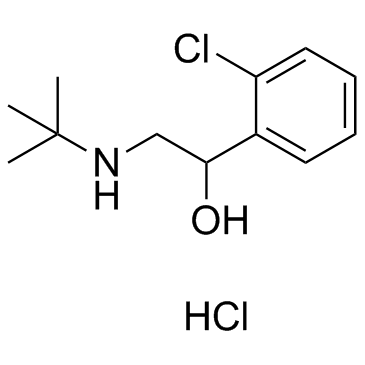
CAS Number56776-01-3
SynonymsBenzyl alcohol, α-((tert-butylamino)methyl)-o-chloro-, hydrochloride; 1-(2-Chlorophenyl)-2-[(2-methyl-2-propanyl)amino]ethanol hydrochloride (1:1); UNII:VNC12181T0; 2-(tert-butylamino)-1-(2-chlorophenyl)ethanol,hydrochloride; 2-(tert-Butylamino)-1-(2-chlorophenyl)ethanol hydrochloride (1:1); α-((tert-Butylamino)methyl)-o-chlorobenzyl alcohol hydrochloride; α-(tert-Butylamino)methyl-2-chlorobenzyl alcohol hydrochloride; Tulobuterol hydrochloride; MFCD00214398; Benzenemethanol, 2-chloro-α-[[(1,1-dimethylethyl)amino]methyl]-, hydrochloride (1:1); Benzyl alcohol, α-(tert-butylamino)methyl-2-chloro-, hydrochloride
Molecular FormulaC12H19Cl2NO
Molecular Weight264.191
Purity98%
Density1.098 g/cm3
Boiling Point338.2ºC at 760 mmHg
Melting Point163ºC
AppearanceWhite crystalline powder
Symbol
Signal WordWarning
| Chemical & Physical Properties | |
|---|---|
| CAS Number | 56776-01-3 |
| Catalog No. | 2A-9012876 |
| Chinese Name | 盐酸妥布特罗 |
| Synonyms | Benzyl alcohol, α-((tert-butylamino)methyl)-o-chloro-, hydrochloride; 1-(2-Chlorophenyl)-2-[(2-methyl-2-propanyl)amino]ethanol hydrochloride (1:1); UNII:VNC12181T0; 2-(tert-butylamino)-1-(2-chlorophenyl)ethanol,hydrochloride; 2-(tert-Butylamino)-1-(2-chlorophenyl)ethanol hydrochloride (1:1); α-((tert-Butylamino)methyl)-o-chlorobenzyl alcohol hydrochloride; α-(tert-Butylamino)methyl-2-chlorobenzyl alcohol hydrochloride; Tulobuterol hydrochloride; MFCD00214398; Benzenemethanol, 2-chloro-α-[[(1,1-dimethylethyl)amino]methyl]-, hydrochloride (1:1); Benzyl alcohol, α-(tert-butylamino)methyl-2-chloro-, hydrochloride |
| Molecular Formula | C12H19Cl2NO |
| Molecular Weight | 264.191 |
| Purity | 98 |
| Density | 1.098 g/cm3 |
| Boiling Point | 338.2ºC at 760 mmHg |
| Melting Point | 163ºC |
| Appearance | White crystalline powder |
| Storage Condition | The warehouse is ventilated and dried at low tempe |
| Application | Tulobuterol hydrochloride is a beta2-adrenoceptor agonist. |
| HTC | 2922199090 |
| SMILES | [H+].[Cl-].CC(C)(C)NCC(O)c1ccccc1Cl |
| InChI | InChI=1S/C12H18ClNO.ClH/c1-12(2,3)14-8-11(15)9-6-4-5-7-10(9)13;/h4-7,11,14-15H,8H2,1-3H3;1H |
| InChI Key | InChIKey=RSLNRVYIRDVHLY-UHFFFAOYSA-N |
| Hazard Symbols | Transport |
| MSDS | msds/12876_2_56776_01_3.pdf |
| Bioactivity | Tulobuterol hydrochloride is a β2-adrenoceptor agonist. Related Catalog Signaling Pathways >> GPCR/G Protein >> Adrenergic Receptor Research Areas >> Inflammation/Immunology Target β2-adrenoceptor[1] In Vitro Treatment of the cells with Tulobuterol (0.1 μM) significantly decreases the viral titers of RV14 in the supernatants from 12 h after infection compared with the titers in the cells treated with vehicle (0.001% ethanol). Tulobuterol reduces RV14 release in a concentration-dependent manner. Pretreatment of the cells with Tulobuterol reduces the viral titers of RV14 in the supernatants at concentrations of 0.1 μM or greater[2]. In Vivo Tulobuterol, a sympathomimetic drug used as a transdermal patch, increases normal diaphragm muscle strength. In vivo effect of Tulobuterol is examined the on the contractility of diaphragm muscles prepared from mice treated with Endotoxin. In the in vivo treatment, E0 and E4 diaphragm muscles are analyzed at 0, 12, and 24 h after transdermal Tulobuterol treatment. The force-frequency curves of E0 and E4 diaphragm muscles at three time points are not significantly changed each other, indicating that Tulobuterol patch restores the muscle contractility. Thus, diaphragm muscle contractility is maintained during 4 h of Endotoxin administration with Tulobuterol patch for over 24 h[3]. Cell Assay To examine the effects of Tulobuterol, cultured human tracheal epithelial cells from the same donors are treated with either Tulobuterol (0.1 μM) or the vehicle (0.001% ethanol) from 3 days (72 h) before RV14 infection until the end of the experiments after RV14 infection[2]. Animal Admin Mice[3] Experiments are performed on 50 BALB/c mice weighing 21.7±0.2 g, which are divided into 2 groups. In the transdermal Tulobuterol treatment group, a small piece (4×4 mm2) of a 0.5 mg Tulobuterol patch sheet (16×16 mm2) is affxed to the shaved back of each animal and covered with a small adhesive strip. To examine the effect of transdermal Tulobuterol treatment, the diaphragm muscles of mice immediately after E.coli Endotoxin (20 mg/kg) administration are dissected and measured for contractility at 0, 12, and 24 h (n=5 each) after patch affxation, termed T0E0, T12E0, and T24E0, respectively; to examine such effect 4 h after E.coli Endotoxin (20 mg/kg) injection, the diaphragm muscles of another group of mice are dissected and measured for contractility at 0+4,12+4,and 24+4 h (n=5 each) after patch affxation,termed T0E4, T12E4, and T24E4, respectively. References [1]. Ebihara S, et al. Cough and transdermal long-acting beta2 agonist in Japan. Respir Med. 2008 Oct;102(10):1497; author reply 1498. [2]. Yamaya M, et al. Tulobuterol inhibits rhinovirus infection in primary cultures of human tracheal epithelial cells. Physiol Rep. 2013 Aug;1(3):e00041. [3]. Shindoh C, et al. Tulobuterol patch maintains diaphragm muscle contractility for over twenty-four hours in a mouse model of sepsis. Tohoku J Exp Med. 2009 Aug;218(4):271-8. Chemical & Physical Properties Density 1.098 g/cm3 Boiling Point 338.2ºC at 760 mmHg Melting Point 163ºC Molecular Formula C12H19Cl2NO Molecular Weight 264.191 Flash Point 158.3ºC Exact Mass 263.084381 PSA 32.26000 LogP 3.95440 |
| Use of | Tulobuterol hydrochloride is a β2-adrenoceptor agonist. Properties Articles26 Name 2-(tert-Butylamino)-1-(2-chlorophenyl)ethanol hydrochloride Synonym More Synonyms Tulobuterol hydrochloride Biological Activity Description Tulobuterol hydrochloride is a β2-adrenoceptor agonist. Related Catalog Signaling Pathways >> GPCR/G Protein >> Adrenergic Receptor Research Areas >> Inflammation/Immunology β2-adrenoceptor[1] In Vitro Treatment of the cells with Tulobuterol (0.1 μM) significantly decreases the viral titers of RV14 in the supernatants from 12 h after infection compared with the titers in the cells treated with vehicle (0.001% ethanol). Tulobuterol reduces RV14 release in a concentration-dependent manner. Pretreatment of the cells with Tulobuterol reduces the viral titers of RV14 in the supernatants at concentrations of 0.1 μM or greater[2]. In Vivo Tulobuterol, a sympathomimetic drug used as a transdermal patch, increases normal diaphragm muscle strength. In vivo effect of Tulobuterol is examined the on the contractility of diaphragm muscles prepared from mice treated with Endotoxin. In the in vivo treatment, E0 and E4 diaphragm muscles are analyzed at 0, 12, and 24 h after transdermal Tulobuterol treatment. The force-frequency curves of E0 and E4 diaphragm muscles at three time points are not significantly changed each other, indicating that Tulobuterol patch restores the muscle contractility. Thus, diaphragm muscle contractility is maintained during 4 h of Endotoxin administration with Tulobuterol patch for over 24 h[3]. Cell Assay To examine the effects of Tulobuterol, cultured human tracheal epithelial cells from the same donors are treated with either Tulobuterol (0.1 μM) or the vehicle (0.001% ethanol) from 3 days (72 h) before RV14 infection until the end of the experiments after RV14 infection[2]. References [1]. Ebihara S, et al. Cough and transdermal long-acting beta2 agonist in Japan. Respir Med. 2008 Oct;102(10):1497; author reply 1498. [2]. Yamaya M, et al. Tulobuterol inhibits rhinovirus infection in primary cultures of human tracheal epithelial cells. Physiol Rep. 2013 Aug;1(3):e00041. [3]. Shindoh C, et al. Tulobuterol patch maintains diaphragm muscle contractility for over twenty-four hours in a mouse model of sepsis. Tohoku J Exp Med. 2009 Aug;218(4):271-8. Chemical & Physical Properties Exact Mass 263.084381 PSA 32.26000 LogP 3.95440 |
| Tax Rebate | 13.0% |
| Supervision | None. MFN tariff: 6.5%. Ordinary tariff: 30.0% |
| Transport Info | Shipping Name: UN |
| MSDS Transport Info | Module 14. Shipping information 14.1 UN dangerous goods number European Land Transport Dangerous Regulations: -International Maritime Dangerous Regulations: -International Air Transport Dangerous Regulations: - 14.2 United Nations shipping name European Land Transport Dangerous Regulations: Non-dangerous goods IMDG Code: Non-dangerous goods International air transport dangerous goods regulations: non-dangerous goods 14.3 Transport hazard categories European Land Transport Dangerous Regulations: -International Maritime Dangerous Regulations: -International Air Transport Dangerous Regulations: - 14.4 Package group European Land Transport Dangerous Regulations: -International Maritime Dangerous Regulations: -International Air Transport Dangerous Regulations: - 14.5 Environmental hazards European Land Transport Danger Regulations: No International Maritime Danger Regulations International Air Transport Danger Regulations: No Marine pollutants (yes/no): No 14.6 Special reminder to users No data available |
| Related Products in Specialty Chemicals | ||
|---|---|---|
| Troxypyrrolium tosilate | 6443-40-9 | 2A-9012871 |
| TTX | 4368-28-9 | 2A-9012872 |
| Tubeimoside A | 102040-03-9 | 2A-9012873 |
| Tubeimosides | 2A-303958 | 2A-9012874 |
| Tulobuterol | 41570-61-0 | 2A-9012875 |
| Tulopafant | 116289-53-3 | 2A-9012877 |
| Twotooth Achyranthes Root | 2A-303962 | 2A-9012878 |
| Tylosin | 1401-69-0 | 2A-9012879 |
| Tyloxapol | 25301-02-4 | 2A-9012880 |
| Tymazoline | 24243-97-8 | 2A-9012881 |
| Browse all Specialty Chemicals products » | ||
Phone:
630-322-8886
630-322-8887
Email:
Office Locations:
Chicago, IL, USA
San Francisco, CA, USA


 EN
EN


 SDS
SDS