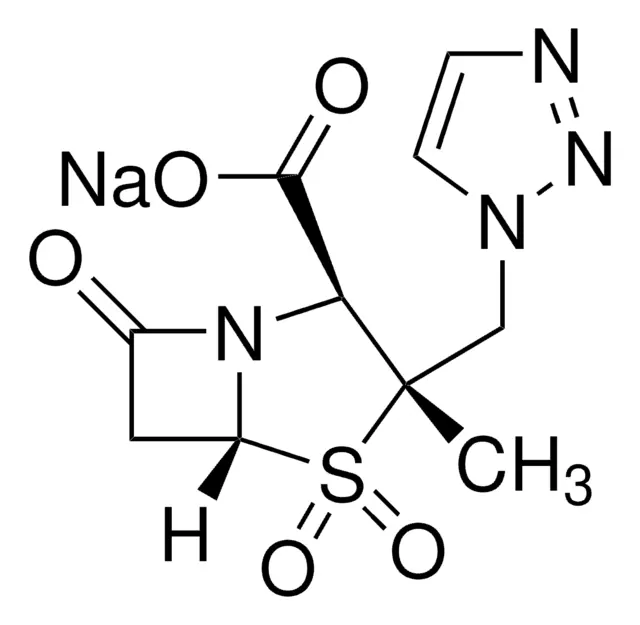
CAS Number89786-04-9
SynonymsMFCD00867002; YTR 830H; Tazobactam; T45 ANV ESWTJ F1 GVQ F1- AT5NNNJ &&(2S,3S,5R)- Form; TAZOBACTANACID; YTR-830H; 2b-[(1,2,3-triazol-1-yl)methyl]-2a-methylpenam-3a-carboxylic acid 1,1-dioxide; Tazobactan acid; 2-METHANESULFONYL-5-(TRIFLUOROMETHYL)-1,3,4-THIADIAZOLE
Molecular FormulaC10H12N4O5S
Molecular Weight322.27
Purity≥98.0 (HPLC)%
Density1.9±0.1 g/cm3
Boiling Point707.1±70.0 °C at 760 mmHg
Melting Point172 °C(dec.)
AppearanceWhite or off-white powder
Symbol
Signal WordWarning


Please Login or Create an Account to: See VlP prices and availability
US Stock: ship in 0-1 business day
Global Stock: ship in 5-7 days
| Chemical & Physical Properties | |
|---|---|
| CAS Number | 89786-04-9 |
| Catalog No. | 2A-9012591 |
| Chinese Name | 三唑巴坦 |
| Synonyms | MFCD00867002; YTR 830H; Tazobactam; T45 ANV ESWTJ F1 GVQ F1- AT5NNNJ &&(2S,3S,5R)- Form; TAZOBACTANACID; YTR-830H; 2b-[(1,2,3-triazol-1-yl)methyl]-2a-methylpenam-3a-carboxylic acid 1,1-dioxide; Tazobactan acid; 2-METHANESULFONYL-5-(TRIFLUOROMETHYL)-1,3,4-THIADIAZOLE |
| Molecular Formula | C10H12N4O5S |
| Molecular Weight | 322.27 |
| Purity | ≥98.0 (HPLC) |
| Density | 1.9±0.1 g/cm3 |
| Boiling Point | 707.1±70.0 °C at 760 mmHg |
| Melting Point | 172 °C(dec.) |
| Appearance | White or off-white powder |
| Water Solubility | Water solubility: Practically insoluble; Soluble i |
| Storage Condition | Store at?0-5°C |
| Packaging | II |
| Application | Tazobactam is a beta-lactamase inhibitor with antibacterial activity. |
| HTC | 29036990 |
| PubChem ID | 329760787 |
| MDL Number | MFCD00917472 |
| SMILES | [Na+].C[C@]2(Cn1ccnn1)[C@@H](N3[C@@H](CC3=O)S2(=O)=O)C([O-])=O |
| InChI | 1S/C10H12N4O5S.Na/c1-10(5-13-3-2-11-12-13)8(9(16)17)14-6(15)4-7(14)20(10,18)19;/h2-3,7-8H,4-5H2,1H3,(H,16,17);/q;+1/p-1/t7-,8+,10+;/m1./s1 |
| InChI Key | RFMIKMMOLPNEDG-QVUDESDKSA-M |
| NACRES Code | NA.24 |
| UNSPSC | 41116107 |
| Hazard Symbols | 8 |
| MSDS | msds/12591_1_89786_04_9.pdf |
| Use of | Tazobactam is a beta Lactamase Inhibitor with antibacterial activityTarget: AntibacterialTazobactam is a pharmaceutical drug that inhibits the action of bacterial β-lactamases, especially those belonging to the SHV-1 and TEM groups. It is commonly used as its sodium salt, Tazobactam sodium.Tazobactam is combined with the extended spectrum β-lactam antibiotic piperacillin in the drug piperacillin/Tazobactam, one of the preferred antibiotic treatments for nosocomial pneumonia caused by Pseudomonas aeruginosa. Tazobactam broadens the spectrum of piperacillin by making it effective against organisms that express β-lactamase and would normally degrade piperacillin. Tazobactam is derived from the penicillin nucleus and is a penicillinic acid sulfone. Properties Name tazobactam Synonym More Synonyms Tazobactam Biological Activity Description Tazobactam is a beta Lactamase Inhibitor with antibacterial activityTarget: AntibacterialTazobactam is a pharmaceutical drug that inhibits the action of bacterial β-lactamases, especially those belonging to the SHV-1 and TEM groups. It is commonly used as its sodium salt, Tazobactam sodium.Tazobactam is combined with the extended spectrum β-lactam antibiotic piperacillin in the drug piperacillin/Tazobactam, one of the preferred antibiotic treatments for nosocomial pneumonia caused by Pseudomonas aeruginosa. Tazobactam broadens the spectrum of piperacillin by making it effective against organisms that express β-lactamase and would normally degrade piperacillin. Tazobactam is derived from the penicillin nucleus and is a penicillinic acid sulfone. Related Catalog Signaling Pathways >> Anti-infection >> Bacterial Research Areas >> Infection Chemical & Physical Properties Molecular Formula C10H12N4O5S Exact Mass 300.052826 PSA 130.84000 LogP -1.70 Index of Refraction 1.818 InChIKey LPQZKKCYTLCDGQ-WEDXCCLWSA-N Toxicological Information CHEMICAL IDENTIFICATION RTECS NUMBER : CHEMICAL NAME : 4-Thia-1-azabicyclo(3.2.0)heptane-2-carboxylic acid, 3-methyl-7-oxo-3-(1H-1,2,3-triazol-1- ylmethyl)-, 4,4-dioxide, (2S-(2-alpha,3-beta,5-alpha))- CAS REGISTRY NUMBER : 89786-04-9 LAST UPDATED : DATA ITEMS CITED : MOLECULAR FORMULA : C10-H12-N4-O5-S MOLECULAR WEIGHT : HEALTH HAZARD DATA ACUTE TOXICITY DATA TYPE OF TEST : LD50 - Lethal dose, 50 percent kill ROUTE OF EXPOSURE : SPECIES OBSERVED : Rodent - rat DOSE/DURATION : TOXIC EFFECTS : Sense Organs and Special Senses (Olfaction) - effect, not otherwise specified Gastrointestinal - hypermotility, diarrhea REFERENCE : JTSCDR Journal of Toxicological Sciences. (Japanese Soc. of Toxicological Sciences, 4th Floor, Gakkai Center Bldg., 4-16, Yayoi 2-chome, Bunkyo-ku, Tokyo 113, Japan) V.1- 1976- Volume(issue)/page/year: 19(Suppl 2),145,1994 TYPE OF TEST : LD50 - Lethal dose, 50 percent kill ROUTE OF EXPOSURE : Intraperitoneal SPECIES OBSERVED : Rodent - rat DOSE/DURATION : TOXIC EFFECTS : Behavioral - somnolence (general depressed activity) Lungs, Thorax, or Respiration - respiratory depression Gastrointestinal - hypermotility, diarrhea REFERENCE : JTSCDR Journal of Toxicological Sciences. (Japanese Soc. of Toxicological Sciences, 4th Floor, Gakkai Center Bldg., 4-16, Yayoi 2-chome, Bunkyo-ku, Tokyo 113, Japan) V.1- 1976- Volume(issue)/page/year: 19(Suppl 2),145,1994 TYPE OF TEST : LD50 - Lethal dose, 50 percent kill ROUTE OF EXPOSURE : Subcutaneous SPECIES OBSERVED : Rodent - rat DOSE/DURATION : TOXIC EFFECTS : Sense Organs and Special Senses (Eye) - ptosis Behavioral - somnolence (general depressed activity) Skin and Appendages - dermatitis, other (after systemic exposure) REFERENCE : JTSCDR Journal of Toxicological Sciences. (Japanese Soc. of Toxicological Sciences, 4th Floor, Gakkai Center Bldg., 4-16, Yayoi 2-chome, Bunkyo-ku, Tokyo 113, Japan) V.1- 1976- Volume(issue)/page/year: 19(Suppl 2),145,1994 TYPE OF TEST : LD50 - Lethal dose, 50 percent kill ROUTE OF EXPOSURE : Intravenous SPECIES OBSERVED : Rodent - rat DOSE/DURATION : TOXIC EFFECTS : Sense Organs and Special Senses (Eye) - ptosis Behavioral - somnolence (general depressed activity) Lungs, Thorax, or Respiration - respiratory depression REFERENCE : JTSCDR Journal of Toxicological Sciences. (Japanese Soc. of Toxicological Sciences, 4th Floor, Gakkai Center Bldg., 4-16, Yayoi 2-chome, Bunkyo-ku, Tokyo 113, Japan) V.1- 1976- Volume(issue)/page/year: 19(Suppl 2),145,1994 TYPE OF TEST : LD50 - Lethal dose, 50 percent kill ROUTE OF EXPOSURE : SPECIES OBSERVED : Rodent - mouse DOSE/DURATION : TOXIC EFFECTS : Behavioral - somnolence (general depressed activity) REFERENCE : JTSCDR Journal of Toxicological Sciences. (Japanese Soc. of Toxicological Sciences, 4th Floor, Gakkai Center Bldg., 4-16, Yayoi 2-chome, Bunkyo-ku, Tokyo 113, Japan) V.1- 1976- Volume(issue)/page/year: 19(Suppl 2),145,1994 TYPE OF TEST : LD50 - Lethal dose, 50 percent kill ROUTE OF EXPOSURE : Intraperitoneal SPECIES OBSERVED : Rodent - mouse DOSE/DURATION : TOXIC EFFECTS : Sense Organs and Special Senses (Eye) - ptosis Behavioral - somnolence (general depressed activity) Lungs, Thorax, or Respiration - respiratory depression REFERENCE : JTSCDR Journal of Toxicological Sciences. (Japanese Soc. of Toxicological Sciences, 4th Floor, Gakkai Center Bldg., 4-16, Yayoi 2-chome, Bunkyo-ku, Tokyo 113, Japan) V.1- 1976- Volume(issue)/page/year: 19(Suppl 2),145,1994 TYPE OF TEST : LD50 - Lethal dose, 50 percent kill ROUTE OF EXPOSURE : Subcutaneous SPECIES OBSERVED : Rodent - mouse DOSE/DURATION : TOXIC EFFECTS : Behavioral - somnolence (general depressed activity) Skin and Appendages - dermatitis, other (after systemic exposure) REFERENCE : JTSCDR Journal of Toxicological Sciences. (Japanese Soc. of Toxicological Sciences, 4th Floor, Gakkai Center Bldg., 4-16, Yayoi 2-chome, Bunkyo-ku, Tokyo 113, Japan) V.1- 1976- Volume(issue)/page/year: 19(Suppl 2),145,1994 TYPE OF TEST : LD50 - Lethal dose, 50 percent kill ROUTE OF EXPOSURE : Intravenous SPECIES OBSERVED : Rodent - mouse DOSE/DURATION : TOXIC EFFECTS : Behavioral - somnolence (general depressed activity) Lungs, Thorax, or Respiration - respiratory depression Nutritional and Gross Metabolic - body temperature decrease REFERENCE : JTSCDR Journal of Toxicological Sciences. (Japanese Soc. of Toxicological Sciences, 4th Floor, Gakkai Center Bldg., 4-16, Yayoi 2-chome, Bunkyo-ku, Tokyo 113, Japan) V.1- 1976- Volume(issue)/page/year: 19(Suppl 2),145,1994 TYPE OF TEST : LD50 - Lethal dose, 50 percent kill ROUTE OF EXPOSURE : Intravenous SPECIES OBSERVED : Mammal - dog DOSE/DURATION : TOXIC EFFECTS : Lungs, Thorax, or Respiration - dyspnea Gastrointestinal - hypermotility, diarrhea Kidney, Ureter, Bladder - hematuria REFERENCE : JTSCDR Journal of Toxicological Sciences. (Japanese Soc. of Toxicological Sciences, 4th Floor, Gakkai Center Bldg., 4-16, Yayoi 2-chome, Bunkyo-ku, Tokyo 113, Japan) V.1- 1976- Volume(issue)/page/year: 19(Suppl 2),145,1994 ** OTHER MULTIPLE DOSE TOXICITY DATA ** TYPE OF TEST : TDLo - Lowest published toxic dose ROUTE OF EXPOSURE : Intraperitoneal SPECIES OBSERVED : Rodent - rat DOSE/DURATION : TOXIC EFFECTS : Liver - changes in liver weight Blood - pigmented or nucleated red blood cells Blood - changes in erythrocyte (RBC) count REFERENCE : JTSCDR Journal of Toxicological Sciences. (Japanese Soc. of Toxicological Sciences, 4th Floor, Gakkai Center Bldg., 4-16, Yayoi 2-chome, Bunkyo-ku, Tokyo 113, Japan) V.1- 1976- Volume(issue)/page/year: 19(Suppl 2),155,1994 TYPE OF TEST : TDLo - Lowest published toxic dose ROUTE OF EXPOSURE : Intravenous SPECIES OBSERVED : Mammal - dog DOSE/DURATION : TOXIC EFFECTS : Biochemical - Metabolism (Intermediary) - other proteins Related to Chronic Data - changes in ovarian weight Related to Chronic Data - changes in uterine weight REFERENCE : JTSCDR Journal of Toxicological Sciences. (Japanese Soc. of Toxicological Sciences, 4th Floor, Gakkai Center Bldg., 4-16, Yayoi 2-chome, Bunkyo-ku, Tokyo 113, Japan) V.1- 1976- Volume(issue)/page/year: 19(Suppl 2),177,1994 ** REPRODUCTIVE DATA ** TYPE OF TEST : TDLo - Lowest published toxic dose ROUTE OF EXPOSURE : Intraperitoneal SEX/DURATION : female 17-21 day(s) after conception lactating female 21 day(s) post-birth TOXIC EFFECTS : Reproductive - Effects on Newborn - stillbirth REFERENCE : JTSCDR Journal of Toxicological Sciences. (Japanese Soc. of Toxicological Sciences, 4th Floor, Gakkai Center Bldg., 4-16, Yayoi 2-chome, Bunkyo-ku, Tokyo 113, Japan) V.1- 1976- Volume(issue)/page/year: 19(Suppl 2),233,1994 Safety Information Hazard Codes Xi: Irritant; WGK Germany 3 Packaging Group II Hazard Class 8 HS Code 29036990 Synthetic Route [2S-(2alpha,5al... CAS#:24138-28-1 Tazobactam CAS#:89786-04-9 Literature: Synthesis, , # 3 art. no. F11904SS, p. 442 - 446 6-Aminopenicill... CAS#:551-16-6 Tazobactam CAS#:89786-04-9 Literature: Synthesis, , # 3 art. no. F11904SS, p. 442 - 446 benzhydryl-3-me... CAS#:122661-93-2 Tazobactam CAS#:89786-04-9 Literature: Synthesis, , # 3 art. no. F11904SS, p. 442 - 446 Precursor & DownStream Precursor 6 CAS#:551-16-6 6-Aminopenicill... CAS#:122661-93-2 benzhydryl-3-me... CAS#:85573-72-4 2-oxo-4-(benzot... CAS#:74189-25-6 diphenylmethyl ... DownStream 2 CAS#:59703-84-3 Piperacillin Sodium CAS#:89785-84-2 Tazobactam Sodi... |
| Transport Info | Product name: Tazobactam acid |
| Related Products in Specialty Chemicals | ||
|---|---|---|
| Taurosteine | 124066-33-7 | 2A-9012584 |
| Taurultam | 38668-01-8 | 2A-9012585 |
| Tavron | 20057-31-2 | 2A-9012586 |
| Tazanolast | 82989-25-1 | 2A-9012588 |
| Tazasubrate | 79071-15-1 | 2A-9012590 |
| Tazobactam sodium | 61477-96-1 | 2A-9012592 |
| Tazobactam sodium salt | 89785-84-2 | 2A-9012593 |
| Tazolol | 39832-48-9 | 2A-9012594 |
| Tea Ployphenols | 2A-303680 | 2A-9012596 |
| Tea Polysaccharide | 2A-303681 | 2A-9012597 |
| Browse all Specialty Chemicals products » | ||
Phone:
630-322-8886
630-322-8887
Email:
Office Locations:
Chicago, IL, USA
San Francisco, CA, USA


 EN
EN

 SDS
SDS