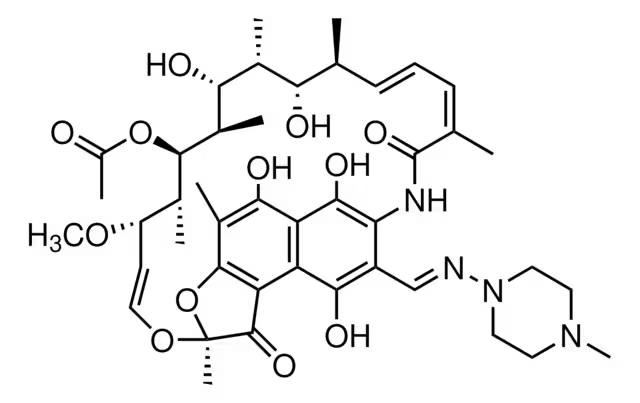
CAS Number13292-46-1
Synonymsrifobac; Rimactane; arficin; Rifampicin; FaMcin; rifinah; Eremfat; Rimactan; rifagen; MFCD00151389; Rifamycin AMP; 3-[[(4-Methyl-1-piperazinyl)imino]methyl]rifamycin; Rifadine; RIF; 3-(4-Methylpiperazinyliminomethyl)rifamycin SV,Rifampin,Rifamycin AMP; Rifa; UNII-VJT6J7R4TR; EINECS 236-312-0; Abrifam; Rifampin; RIFADIN
Molecular FormulaC43H58N4O12
Molecular Weight822.94
Purity≥95 (HPLC)%
Density1.3±0.1 g/cm3
Boiling Point1004.4±65.0 °C at 760 mmHg
Melting Point183ºC (dec.)
Appearancepowder or crystals
EINECS236-312-0
Symbol
Signal WordWarning
| Chemical & Physical Properties | |
|---|---|
| CAS Number | 13292-46-1 |
| Catalog No. | 2A-9012301 |
| Chinese Name | 利福平 |
| Synonyms | rifobac; Rimactane; arficin; Rifampicin; FaMcin; rifinah; Eremfat; Rimactan; rifagen; MFCD00151389; Rifamycin AMP; 3-[[(4-Methyl-1-piperazinyl)imino]methyl]rifamycin; Rifadine; RIF; 3-(4-Methylpiperazinyliminomethyl)rifamycin SV,Rifampin,Rifamycin AMP; Rifa; UNII-VJT6J7R4TR; EINECS 236-312-0; Abrifam; Rifampin; RIFADIN |
| Molecular Formula | C43H58N4O12 |
| Molecular Weight | 822.94 |
| Purity | ≥95 (HPLC) |
| Density | 1.3±0.1 g/cm3 |
| Boiling Point | 1004.4±65.0 °C at 760 mmHg |
| Melting Point | 183ºC (dec.) |
| Appearance | powder or crystals |
| Water Solubility | chloroform: soluble50mg/mL, clear |
| Storage Condition | Packed in barrels, sealed and stored in a cool, dr |
| Application | Rifampicin is a potent broad-spectrum antibiotic that fights bacterial pathogens. |
| EINECS | 236-312-0 |
| HTC | 2941903000 |
| PubChem ID | 57654590 |
| MDL Number | MFCD00151389 |
| SMILES | CO[C@H]1\C=C\O[C@@]2(C)Oc3c(C)c(O)c4c(O)c(NC(=O)C(C)=C\C=C\[C@H](C)[C@H](O)[C@@H](C)[C@@H](O)[C@@H](C)[C@H](OC(C)=O)[C@@H]1C)c(\C=N\N5CCN(C)CC5)c(O)c4c3C2=O |
| InChI | 1S/C43H58N4O12/c1-21-12-11-13-22(2)42(55)45-33-28(20-44-47-17-15-46(9)16-18-47)37(52)30-31(38(33)53)36(51)26(6)40-32(30)41(54)43(8,59-40)57-19-14-29(56-10)23(3)39(58-27(7)48)25(5)35(50)24(4)34(21)49/h11-14,19-21,23-25,29,34-35,39,49-53H,15-18H2,1-10H3,(H,45,55)/b12-11+,19-14+,22-13-,44-20+/t21-,23+,24+,25+,29-,34-,35+,39+,43-/m0/s1 |
| InChI Key | JQXXHWHPUNPDRT-WLSIYKJHSA-N |
| Beilstein/REAXYS | 5723476 |
| NACRES Code | NA.76 |
| UNSPSC | 51283601 |
| Hazard Symbols | Transport |
| MSDS | msds/12301_1_13292_46_1.pdf |
| Bioactivity | Rifampicin is a potent and broad spectrum antibiotic against bacterial pathogens. Related Catalog Signaling Pathways >> Anti-infection >> Bacterial Research Areas >> Infection In Vitro Rifampicin (100 mg/mL) can block the functional activity of P-glycoprotein. Rifampicin is not a substract for P-glycoprotein. The mechanism of rifampicin resistance is unassociated with the functional activity of P-glycoprotein[3]. In Vivo Rifampicin (200, 400 mg/kg) can induce fatty liver at high concentration[1]. Rifampicin (30 mg/kg, i.p.) treatment of S464P biofilms in vivo results in a slight decline, but earlier rebinds in bioluminescence from these catheters compared with the parental signal, whereas rifampicin has no affect on bioluminescence in mice infected with mutant H481Y[2]. Animal Admin Briefly, 1 cm Teflon catheter (14-gauge) carrying 104 cfu S. aureus, either the parental strain Xen 29 or the RifR mutants S464P or H481Y, are implanted subcutaneously in groups of nine mice per strain. One catheter segment is inserted on each side of each animal. Six days after the implantation of the catheters, five mice from each group are treated with rifampicin at 30 mg/kg intraperitoneally in 0.1 mL saline, twice daily for four consecutive days. The remaining four mice in each group are left untreated as controls. At various time points during the infection, the mice are anaesthetized using a constant flow of 1.5% isoflurane from the IVIS® manifold, and imaged using an IVIS® Image System 100 Series. The bioluminescent signals (photons/s) emitted from the mice are analysed using LivingImage® software and plotted over the course of infection. The mice are sacrificed 20 days after infection (11 days after final rifampicin treatment). The catheters are surgically removed and the bacteria are detached by sonication for determination of bacterial burdens on the catheters. References [1]. Piriou A, et al. Fatty liver induced by high doses of rifampicin in the rat: possible relation with an inhibition of RNA polymerases in eukariotic cells. Arch Toxicol Suppl. 1979;(2):333-7. [2]. Yu J, et al. Monitoring in vivo fitness of rifampicin-resistant Staphylococcus aureus mutants in a mouse biofilm infection model. J Antimicrob Chemother. 2005 Apr;55(4):528-34. Epub 2005 Mar 2. [3]. Erokhina MV, et al. [In vitro development of rifampicin resistance in the epithelial cells]. Probl Tuberk Bolezn Legk. 2006;(8):58-61. Chemical & Physical Properties Density 1.3±0.1 g/cm3 Boiling Point 1004.4±65.0 °C at 760 mmHg Melting Point 183ºC (dec.) Molecular Formula C43H58N4O12 Molecular Weight 822.940 Flash Point 561.3±34.3 °C Exact Mass 822.405151 PSA 220.15000 LogP 1.09 Vapour Pressure 0.0±0.3 mmHg at 25°C Index of Refraction 1.613 InChIKey JQXXHWHPUNPDRT-WACSZCHISA-N SMILES COC1C=COC2(C)Oc3c(C)c(O)c4c(O)c(c(C=NN5CCN(C)CC5)c(O)c4c3C2=O)NC(=O)C(C)=CC=CC(C)C(O)C(C)C(O)C(C)C(OC(C)=O)C1C Storage condition 2-8°C Water Solubility chloroform: soluble50mg/mL, clear |
| Use of | Rifampicin is a potent and broad spectrum antibiotic against bacterial pathogens. Properties Articles624 Name rifampicin Synonym More Synonyms Rifampicin Biological Activity Description Rifampicin is a potent and broad spectrum antibiotic against bacterial pathogens. Related Catalog Signaling Pathways >> Anti-infection >> Bacterial Research Areas >> Infection References [1]. Piriou A, et al. Fatty liver induced by high doses of rifampicin in the rat: possible relation with an inhibition of RNA polymerases in eukariotic cells. Arch Toxicol Suppl. 1979;(2):333-7. [2]. Yu J, et al. Monitoring in vivo fitness of rifampicin-resistant Staphylococcus aureus mutants in a mouse biofilm infection model. J Antimicrob Chemother. 2005 Apr;55(4):528-34. Epub 2005 Mar 2. [3]. Erokhina MV, et al. [In vitro development of rifampicin resistance in the epithelial cells]. Probl Tuberk Bolezn Legk. 2006;(8):58-61. Chemical & Physical Properties Molecular Formula C43H58N4O12 Exact Mass 822.405151 PSA 220.15000 Index of Refraction 1.613 InChIKey JQXXHWHPUNPDRT-WACSZCHISA-N |
| Transport Info | Shipping Name: UN |
| MSDS Transport Info | Module 14. Shipping information 14.1 UN dangerous goods number European Land Transport Dangerous Regulations: -International Maritime Dangerous Regulations: -International Air Transport Dangerous Regulations: - 14.2 United Nations shipping name European Land Transport Dangerous Regulations: Non-dangerous goods IMDG Code: Non-dangerous goods International air transport dangerous goods regulations: non-dangerous goods 14.3 Transport hazard categories European Land Transport Dangerous Regulations: -International Maritime Dangerous Regulations: -International Air Transport Dangerous Regulations: - 14.4 Package group European Land Transport Dangerous Regulations: -International Maritime Dangerous Regulations: -International Air Transport Dangerous Regulations: - 14.5 Environmental hazards European Land Transport Danger Regulations: No International Maritime Danger Regulations International Air Transport Danger Regulations: No Marine pollutants (yes/no): No 14.6 Special reminder to users No data available |
| Related Products in Specialty Chemicals | ||
|---|---|---|
| Revizinone | 133718-29-3 | 2A-9012294 |
| Rhaponticin | 155-58-8 | 2A-9012295 |
| Rhoeadine | 2718-25-4 | 2A-9012296 |
| Ridazolol | 83395-21-5 | 2A-9012298 |
| Rifalazil | 129791-92-0 | 2A-9012300 |
| Rifamycin O | 14487-05-9 | 2A-9012302 |
| Rifamycin sodium salt | 14897-39-3 | 2A-9012303 |
| Rifaximin | 80621-81-4 | 2A-0200228 |
| Rilmakalim | 132014-21-2 | 2A-9012305 |
| Rilmenidine | 54187-04-1 | 2A-9012306 |
| Browse all Specialty Chemicals products » | ||
Phone:
630-322-8886
630-322-8887
Email:
Office Locations:
Chicago, IL, USA
San Francisco, CA, USA


 EN
EN


 SDS
SDS