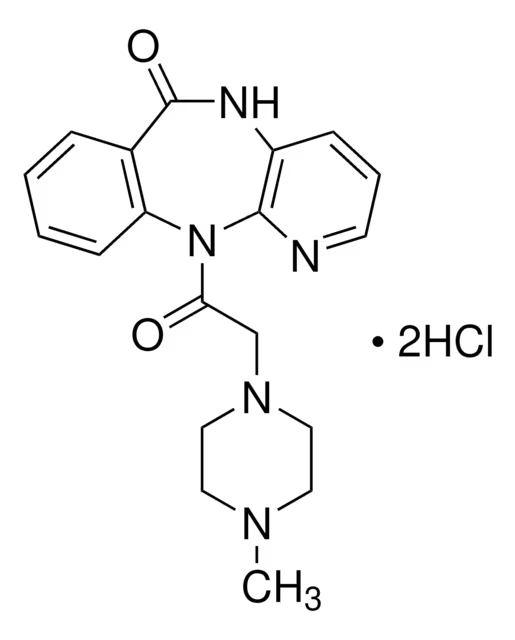
CAS Number29868-97-1
SynonymsPirenzepine dihydrochloride; EINECS 249-907-5; Gastrozepin; Leblon; Maghen; MFCD00055214; Pirenzepine hydrochloride; Gasteril; pircfar; Pirenzepine dihydrochloride monohydrate; Tabe; LS 519-C12; Ulcosan; LS 519 dihydrochloride; Pirenzepine (dihydrochloride)
Molecular FormulaC19H23Cl2N5O2
Molecular Weight424.32
Purity≥98 (TLC)%
Boiling Point541.7ºC at 760 mmHg
Melting Point248-250°C
Appearancepowder
EINECS249-907-5
Symbol
Signal WordWarning
| Chemical & Physical Properties | |
|---|---|
| CAS Number | 29868-97-1 |
| Catalog No. | 2A-9012041 |
| Chinese Name | 盐酸哌仑西平 |
| Synonyms | Pirenzepine dihydrochloride; EINECS 249-907-5; Gastrozepin; Leblon; Maghen; MFCD00055214; Pirenzepine hydrochloride; Gasteril; pircfar; Pirenzepine dihydrochloride monohydrate; Tabe; LS 519-C12; Ulcosan; LS 519 dihydrochloride; Pirenzepine (dihydrochloride) |
| Molecular Formula | C19H23Cl2N5O2 |
| Molecular Weight | 424.32 |
| Purity | ≥98 (TLC) |
| Boiling Point | 541.7ºC at 760 mmHg |
| Melting Point | 248-250°C |
| Appearance | powder |
| Water Solubility | H2O: 50 mg/mL |
| Storage Condition | Keep the receptacle sealed, stored in a cool, dry |
| Application | Pirenzepine dihydrochloride (LS519) is a selective M1-type muscarinic receptor antagonist. |
| EINECS | 249-907-5 |
| PubChem ID | 24277863 |
| MDL Number | MFCD00055214 |
| SMILES | Cl[H].Cl[H].CN1CCN(CC1)CC(=O)N2c3ccccc3C(=O)Nc4cccnc24 |
| InChI | 1S/C19H21N5O2.2ClH/c1-22-9-11-23(12-10-22)13-17(25)24-16-7-3-2-5-14(16)19(26)21-15-6-4-8-20-18(15)24;;/h2-8H,9-13H2,1H3,(H,21,26);2*1H |
| InChI Key | FFNMBRCFFADNAO-UHFFFAOYSA-N |
| NACRES Code | NA.77 |
| UNSPSC | 12352200 |
| Hazard Symbols | Transport |
| MSDS | msds/12041_1_29868_97_1.pdf |
| Bioactivity | Pirenzepine dihydrochloride (LS519) is a selective M1 muscarinic receptor antagonist. Related Catalog Signaling Pathways >> GPCR/G Protein >> mAChR Signaling Pathways >> Neuronal Signaling >> mAChR Research Areas >> Inflammation/Immunology Research Areas >> Neurological Disease In Vitro The antisecretory properties of pirenzepine on gastric acid and pepsin secretion may be attributed to the antagonistic activity of the drug on muscarinic M1 receptors of gastric intramural plexuses, whereas the effect on parietal muscarinic M2 receptors seems of less importance. Additional inhibitory mechanisms on gastric secretion may be represented by pirenzepine-induced increase in somatostatin release from gastrointestinal system. Significant cytoprotective properties of pirenzepinehave been observed on a variety of experimentally induced peptic ulcerations[1]. Pirenzepine (5-500 μg/mL) inhibits agonist-(acetylcholine-, carbachol- or nicotine-) induced contractions of the toad isolated rectus abdominis muscle, and depresses electrically provoked twitches of the rat phrenic nerve-hemidiaphragm muscle preparation[2]. In Vivo Pirenzepine is potent in impairing learning of an avoidance; much higher doses are required to antagonize other central muscarinic effects. Pirenzepine is found to impair passive avoidance learning when given i.c.v. 20 min pre-training. The median latencies in pirenzepine-treated animals are 79.5, 11, 27 and 25.5 seconds with doses of 0.03, 0.1, 0.3 and 1 μg per mouse respectively[3]. Acid and pepsin secretion stimulated by either bethanechol or the vagus are inhibited in a dose-responsive manner by pirenzepine[4]. Pirenzepine (5-25 mg/kg i.v.) depresses indirect electrical stimulation-evoked twitches of the cat tibialis anterior and soleus muscle preparations[2]. Animal Admin Dogs: In three of the Dogs, gastric secretion also is stimulated by bethanechol infused i.v. at the rate of 80 μg (0.4 μM)/kg.hr for 3 hr. Atropine (1.4, 2.8, 5.6 and 11.2 nM/kg) or pirenzepine (6, 12 and 24 nM/kg) are injected at 15-mm intervals, beginning 1 hr after initiation of bethanechol infusion. Heart rate is measured every 7.5 mm during infusion of the drugs and for 75 mins thereafter[4]. References [1]. Del Tacca M, et al. A selective antimuscarinic agent: pirenzepine. Review of its pharmacologic and clinical properties. Minerva Dietol Gastroenterol. 1989 Jul-Sep;35(3):175-89. [2]. Ojewole JA, et al. Effects of pirenzepine (Gastrozepin) on skeletal muscle contractility. Methods Find Exp Clin Pharmacol. 1983 Nov;5(9):619-23. [3]. Caulfield MP, et al. Central administration of the muscarinic receptor subtype-selective antagonist pirenzepine selectively impairs passiveavoidance learning in the mouse. J Pharm Pharmacol. 1983 Feb;35(2):131-2. [4]. Hirschowitz BI, et al. Effects of pirenzepine and atropine on vagal and cholinergic gastric secretion and gastrin release and on heart rate in the dog. J Pharmacol Exp Ther. 1983 May;225(2):263-8. Chemical & Physical Properties Boiling Point 541.7ºC at 760 mmHg Melting Point 248-250°C Molecular Formula C19H23Cl2N5O2 Molecular Weight 424.324 Flash Point 281.4ºC Exact Mass 423.122894 PSA 74.23000 LogP 2.80740 InChIKey FFNMBRCFFADNAO-UHFFFAOYSA-N SMILES CN1CCN(CC(=O)N2c3ccccc3C(=O)Nc3cccnc32)CC1.Cl.Cl Storage condition -20?C Freezer Water Solubility H2O: 50 mg/mL |
| Use of | Properties Articles14 Name Pirenzepine, Dihydrochloride Synonym More Synonyms Pirenzepine, Dihydrochloride Biological Activity Related Catalog Signaling Pathways >> GPCR/G Protein >> mAChR Signaling Pathways >> Neuronal Signaling >> mAChR Research Areas >> Inflammation/Immunology Research Areas >> Neurological Disease In Vitro The antisecretory properties of pirenzepine on gastric acid and pepsin secretion may be attributed to the antagonistic activity of the drug on muscarinic M1 receptors of gastric intramural plexuses, whereas the effect on parietal muscarinic M2 receptors seems of less importance. Additional inhibitory mechanisms on gastric secretion may be represented by pirenzepine-induced increase in somatostatin release from gastrointestinal system. Significant cytoprotective properties of pirenzepinehave been observed on a variety of experimentally induced peptic ulcerations[1]. Pirenzepine (5-500 μg/mL) inhibits agonist-(acetylcholine-, carbachol- or nicotine-) induced contractions of the toad isolated rectus abdominis muscle, and depresses electrically provoked twitches of the rat phrenic nerve-hemidiaphragm muscle preparation[2]. References [1]. Del Tacca M, et al. A selective antimuscarinic agent: pirenzepine. Review of its pharmacologic and clinical properties. Minerva Dietol Gastroenterol. 1989 Jul-Sep;35(3):175-89. [2]. Ojewole JA, et al. Effects of pirenzepine (Gastrozepin) on skeletal muscle contractility. Methods Find Exp Clin Pharmacol. 1983 Nov;5(9):619-23. [3]. Caulfield MP, et al. Central administration of the muscarinic receptor subtype-selective antagonist pirenzepine selectively impairs passiveavoidance learning in the mouse. J Pharm Pharmacol. 1983 Feb;35(2):131-2. [4]. Hirschowitz BI, et al. Effects of pirenzepine and atropine on vagal and cholinergic gastric secretion and gastrin release and on heart rate in the dog. J Pharmacol Exp Ther. 1983 May;225(2):263-8. Chemical & Physical Properties Exact Mass 423.122894 PSA 74.23000 LogP 2.80740 InChIKey FFNMBRCFFADNAO-UHFFFAOYSA-N Storage condition -20?C Freezer |
| Transport Info | Shipping Name: UN |
| MSDS Transport Info | Module 14. Shipping information 14.1 UN dangerous goods number European Land Transport Dangerous Regulations: -International Maritime Dangerous Regulations: -International Air Transport Dangerous Regulations: - 14.2 United Nations shipping name European Land Transport Dangerous Regulations: Non-dangerous goods IMDG Code: Non-dangerous goods International air transport dangerous goods regulations: non-dangerous goods 14.3 Transport hazard categories European Land Transport Dangerous Regulations: -International Maritime Dangerous Regulations: -International Air Transport Dangerous Regulations: - 14.4 Package group European Land Transport Dangerous Regulations: -International Maritime Dangerous Regulations: -International Air Transport Dangerous Regulations: - 14.5 Environmental hazards European Land Transport Danger Regulations: No International Maritime Danger Regulations International Air Transport Danger Regulations: No Marine pollutants (yes/no): No 14.6 Special reminder to users No data available |
| Related Products in Specialty Chemicals | ||
|---|---|---|
| Pipoxizine | 55837-21-3 | 2A-9012036 |
| Pipratecol | 15534-05-1 | 2A-9012037 |
| Pirarubicin | 72496-41-4 | 2A-9012038 |
| Piraxelate | 82209-39-0 | 2A-9012039 |
| Pirenoxine sodium | 51410-30-1 | 2A-9012040 |
| Pirepolol | 69479-26-1 | 2A-9012042 |
| Piretanide | 55837-27-9 | 2A-9012043 |
| Piribedil | 3605-01-4 | 2A-9012044 |
| Piridoxilate | 24340-35-0 | 2A-9012045 |
| Pirifibrate | 55285-45-5 | 2A-9012046 |
| Browse all Specialty Chemicals products » | ||
Phone:
630-322-8886
630-322-8887
Email:
Office Locations:
Chicago, IL, USA
San Francisco, CA, USA


 EN
EN


 SDS
SDS