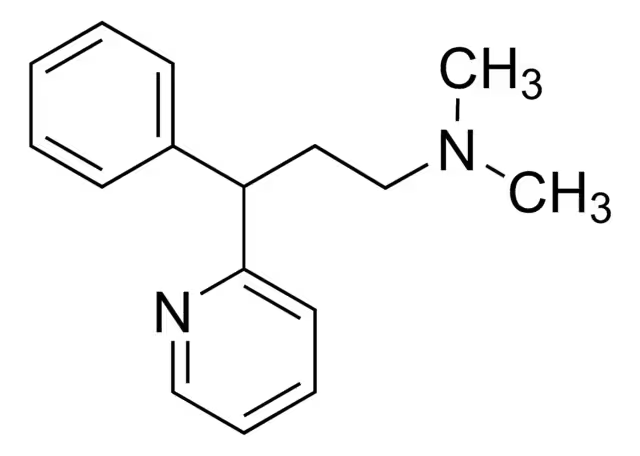
CAS Number86-21-5
SynonymsHistapyridamine; Avil; Propheniramine; Feniramine; pheniramine; N,N-dimethyl-3-phenyl-3-pyridin-2-yl-propan-1-amine; EINECS 201-656-2; Trimeton; Prophenpyridamine; Pyriton; Tripoton; Metron; MFCD00865659
Molecular FormulaC16H20N2
Molecular Weight240.34
Purity98%
Density1.018 g/cm3
Boiling Point84 °C20 mm Hg(lit.)
Melting Point30-34 °C(lit.)
Appearanceliquid
Symbol
Signal WordWarning
| Chemical & Physical Properties | |
|---|---|
| CAS Number | 86-21-5 |
| Catalog No. | 2A-9011962 |
| Chinese Name | 非尼拉敏 |
| Synonyms | Histapyridamine; Avil; Propheniramine; Feniramine; pheniramine; N,N-dimethyl-3-phenyl-3-pyridin-2-yl-propan-1-amine; EINECS 201-656-2; Trimeton; Prophenpyridamine; Pyriton; Tripoton; Metron; MFCD00865659 |
| Molecular Formula | C16H20N2 |
| Molecular Weight | 240.34 |
| Purity | 98 |
| Density | 1.018 g/cm3 |
| Boiling Point | 84 °C20 mm Hg(lit.) |
| Melting Point | 30-34 °C(lit.) |
| Appearance | liquid |
| Storage Condition | ?20°C |
| Packaging | III |
| Application | Pheniramine is a first-generation histamine H1 receptor antagonist that acts on the central nervous system (CNS) and has sedative and hypnotic effects. Pheniramine has anti-tumor effects and induces a |
| HTC | 2933399090 |
| PubChem ID | 329820038 |
| MDL Number | MFCD00865659 |
| SMILES | CN(C)CCC(c1ccccc1)c2ccccn2 |
| InChI | 1S/C16H20N2/c1-18(2)13-11-15(14-8-4-3-5-9-14)16-10-6-7-12-17-16/h3-10,12,15H,11,13H2,1-2H3 |
| InChI Key | IJHNSHDBIRRJRN-UHFFFAOYSA-N |
| NACRES Code | NA.24 |
| UNSPSC | 41116107 |
| Hazard Symbols | 8 |
| MSDS | msds/11962_1_86_21_5.pdf |
| Bioactivity | Pheniramine (Prophenpyridamine;Tripoton) is a first-generation histamine H1 receptor antagonist, acts on the central nervous system (CNS) with sedative and hypnotic effect. Pheniramine displays antitumor effect and induces leukemia cells apoptosis. Pheniramine is also a safe and effective local anesthetic, with antipruritic effects[1][2][3][4]. Related Catalog Signaling Pathways >> Apoptosis >> Apoptosis Research Areas >> Cancer Signaling Pathways >> Immunology/Inflammation >> Histamine Receptor Research Areas >> Inflammation/Immunology Signaling Pathways >> GPCR/G Protein >> Histamine Receptor Target H1 Receptor:1.01 mM (IC50) In Vitro Pheniramine inhibits CYP2D6, the specific P450-isozymes, to delay metabolic time and prolong antihistaminic effects[1]. Pheniramine inhibits Ca2+ influx into BC3H-1 cells by inhibiting histamine with an IC50 value of 1.01 mM and regulates cellular Ca2+ transmembrane action[2]. Pheniramine (0.5, 1.0 mM; 24 h) induces cell apoptosis in human T-cell acute lymphoblastic leukemia cell lines[3]. Pheniramine (1 μM-1 mM; 12-48 h) inhibits cell proliferation in a time-dependent manner and shows inhibitory concentration IC50s of 550 μM (CCRF-CEM cells) and 420 μM (Jurkat cells), respectively[3]. Apoptosis Analysis[3] Cell Line: Human T-cell acute lymphoblastic leukemia cell lines: CCRF-CEM and Jurkat ALL Concentration: 0.5, 1.0 mM Incubation Time: 24 hours Result: Induced cells apoptosis with chromatin condenses and marginalizes, and nuclear debris spreaded into the cytoplasm. Cell Viability Assay[3] Cell Line: Human T-cell acute lymphoblastic leukemia cell lines: CCRF-CEM and Jurkat ALL Concentration: 1 μM-1 mM Incubation Time: 12, 24, 48 hours Result: Inhibited cell proliferation and survival in a time- and dose-dependent manner. In Vivo Pheniramine (1.75 μM; i.t.) exerts local anesthesia effect and results spinal block in rats[4]. Animal Model: Sprague-Dawley rats (300-350 g; male)[4] Dosage: 0.30, 0.60, 0.90, 1.50, 1.75 μM Administration: Intrathecal injection; one time Result: Resulted the spinal block and displayed dose-dependent effect. Showed 100% blockades in motor function, proprioception, and nociception, with full recoveryduration of action about 41, 56, and 88 min, respectively, at 1.75 μM. References [1]. Sharma A, et al. Classic histamine H1 receptor antagonists: a critical review of their metabolic and pharmacokinetic fate from a bird's eye view. Curr Drug Metab. 2003 Apr;4(2):105-29. [2]. Brown RD, et al. Alpha 1-adrenergic and H1-histamine receptor control of intracellular Ca2+ in a muscle cell line: the influence of prior agonist exposure on receptor responsiveness. Mol Pharmacol. 1986 Jun;29(6):531-9. [3]. Jangi SM, et al. Apoptosis of human T-cell acute lymphoblastic leukemia cells by diphenhydramine, an H1 histamine receptor antagonist. Oncol Res. 2004;14(7-8):363-72. [4]. Hung CH, et al. Spinal anesthesia with diphenhydramine and pheniramine in rats. Eur J Pharmacol. 2011 Dec 30;673(1-3):20-4. Chemical & Physical Properties Density 1.018 g/cm3 Boiling Point 84 °C20 mm Hg(lit.) Melting Point 30-34 °C(lit.) Molecular Formula C16H20N2 Molecular Weight 240.34300 Flash Point 179 °F Exact Mass 240.16300 PSA 16.13000 LogP 3.16520 Index of Refraction 1.556 InChIKey IJHNSHDBIRRJRN-UHFFFAOYSA-N SMILES CN(C)CCC(c1ccccc1)c1ccccn1 Storage condition ?20°C |
| Use of | Pheniramine (Prophenpyridamine;Tripoton) is a first-generation histamine H1 receptor antagonist, acts on the central nervous system (CNS) with sedative and hypnotic effect. Pheniramine displays antitumor effect and induces leukemia cells apoptosis. Pheniramine is also a safe and effective local anesthetic, with antipruritic effects[1][2][3][4]. Properties Articles25 Name N,N-dimethyl-3-phenyl-3-pyridin-2-ylpropan-1-amine Synonym More Synonyms Pheniramine Biological Activity Description Pheniramine (Prophenpyridamine;Tripoton) is a first-generation histamine H1 receptor antagonist, acts on the central nervous system (CNS) with sedative and hypnotic effect. Pheniramine displays antitumor effect and induces leukemia cells apoptosis. Pheniramine is also a safe and effective local anesthetic, with antipruritic effects[1][2][3][4]. Related Catalog Signaling Pathways >> Apoptosis >> Apoptosis Research Areas >> Cancer Signaling Pathways >> Immunology/Inflammation >> Histamine Receptor Research Areas >> Inflammation/Immunology Signaling Pathways >> GPCR/G Protein >> Histamine Receptor References [1]. Sharma A, et al. Classic histamine H1 receptor antagonists: a critical review of their metabolic and pharmacokinetic fate from a bird's eye view. Curr Drug Metab. 2003 Apr;4(2):105-29. [2]. Brown RD, et al. Alpha 1-adrenergic and H1-histamine receptor control of intracellular Ca2+ in a muscle cell line: the influence of prior agonist exposure on receptor responsiveness. Mol Pharmacol. 1986 Jun;29(6):531-9. [3]. Jangi SM, et al. Apoptosis of human T-cell acute lymphoblastic leukemia cells by diphenhydramine, an H1 histamine receptor antagonist. Oncol Res. 2004;14(7-8):363-72. [4]. Hung CH, et al. Spinal anesthesia with diphenhydramine and pheniramine in rats. Eur J Pharmacol. 2011 Dec 30;673(1-3):20-4. Chemical & Physical Properties Molecular Formula C16H20N2 Exact Mass 240.16300 PSA 16.13000 LogP 3.16520 Index of Refraction 1.556 InChIKey IJHNSHDBIRRJRN-UHFFFAOYSA-N |
| Tax Rebate | 13.0% |
| Supervision | None. MFN tariff: 6.5%. Ordinary tariff: 20.0% |
| Transport Info | Shipping Name: UN |
| MSDS Transport Info | Module 14. Shipping information 14.1 UN dangerous goods number European Land Transport Danger Regulations: 1230 International Maritime Transport Danger Regulations: 1230 International Air Transport Danger Regulations: 1230 14.2 United Nations shipping name European Land Transport Dangerous Regulations: METHANOL, solution IMDG Code: METHANOL, solution IFRS: Methanol, solution 14.3 Transport hazard categories European land transport risk code: 3 (6.1) International sea transport risk code: 3 (6.1) International air transport risk code: 3 (6.1) 14.4 Package group European Dangerous Regulations for land transport: II International Dangerous Regulations for sea transport: II International Dangerous Regulations for air transport: II 14.5 Environmental hazards European Land Transport Danger Regulations: No International Maritime Danger Regulations International Air Transport Danger Regulations: No Marine pollutants (yes/no): No 14.6 Special reminder to users No data available |
| Related Products in Specialty Chemicals | ||
|---|---|---|
| Phencyclidine hydrochloride | 956-90-1 | 2A-9011957 |
| Phendimetrazine | 634-03-7 | 2A-9011958 |
| Phenethicillin | 147-55-7 | 2A-9011959 |
| Phenformin hydrochloride | 834-28-6 | 2A-9011960 |
| Pheniodol sodium | 7009-60-1 | 2A-9011961 |
| Pheniramine maleate | 132-20-7 | 2A-9011963 |
| Phenkapton | 2275-14-1 | 2A-9011964 |
| Phenmedipham | 13684-63-4 | 2A-9011965 |
| Phenobarbital sodium | 57-30-7 | 2A-9011966 |
| Phenobutiodil | 554-24-5 | 2A-9011967 |
| Browse all Specialty Chemicals products » | ||
Phone:
630-322-8886
630-322-8887
Email:
Office Locations:
Chicago, IL, USA
San Francisco, CA, USA


 EN
EN


 SDS
SDS