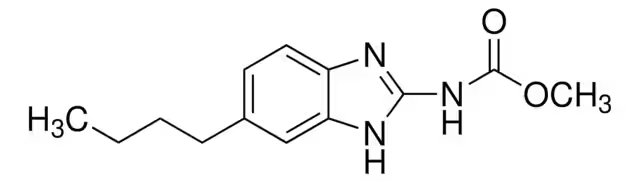
CAS Number14255-87-9
Synonymsmethyl5-butyl-2-benzimidazolecarbamate; SKandF 29044; TCMDC-131798; Methyl (5-butyl-1H-benzimidazol-2-yl)carbamate; Carbamic acid, N-(5-butyl-1H-benzimidazol-2-yl)-, methyl ester; EINECS 238-133-3; SK&F 29044; 5-butyl-2-benzimidazolecarbamicacimethylester; Methyl (5-butyl-1H-benzoimidazol-2-yl)carbamate; helmatac; pbdz; Methyl (5-butyl-1H-benzo[d]imidazol-2-yl)carbamate; Parbendazole; verminum
Molecular FormulaC13H17N3O2
Molecular Weight247.29
Purity98%
Density1.2±0.1 g/cm3
Melting Point255-257°C
Appearancesolid
| Chemical & Physical Properties | |
|---|---|
| CAS Number | 14255-87-9 |
| Catalog No. | 2A-9011878 |
| Chinese Name | 帕苯达唑 |
| Synonyms | methyl5-butyl-2-benzimidazolecarbamate; SKandF 29044; TCMDC-131798; Methyl (5-butyl-1H-benzimidazol-2-yl)carbamate; Carbamic acid, N-(5-butyl-1H-benzimidazol-2-yl)-, methyl ester; EINECS 238-133-3; SK&F 29044; 5-butyl-2-benzimidazolecarbamicacimethylester; Methyl (5-butyl-1H-benzoimidazol-2-yl)carbamate; helmatac; pbdz; Methyl (5-butyl-1H-benzo[d]imidazol-2-yl)carbamate; Parbendazole; verminum |
| Molecular Formula | C13H17N3O2 |
| Molecular Weight | 247.29 |
| Purity | 98 |
| Density | 1.2±0.1 g/cm3 |
| Melting Point | 255-257°C |
| Appearance | solid |
| Water Solubility | <0.1 g/100 mL at 18 ºC |
| Storage Condition | Warehouse Ventilation Low Temperature Drying |
| Application | Parbendazole is a potent microtubule recombination inhibitor that disrupts tubulin with an EC50 value of 8.79 nM and broad-spectrum anthelmintic effects. |
| HTC | 2933990090 |
| PubChem ID | 329750671 |
| MDL Number | MFCD18910864 |
| SMILES | CCCCc1ccc2nc(NC(=O)OC)[nH]c2c1 |
| InChI | 1S/C13H17N3O2/c1-3-4-5-9-6-7-10-11(8-9)15-12(14-10)16-13(17)18-2/h6-8H,3-5H2,1-2H3,(H2,14,15,16,17) |
| InChI Key | YRWLZFXJFBZBEY-UHFFFAOYSA-N |
| NACRES Code | NA.24 |
| UNSPSC | 41116107 |
| MSDS | msds/11878_1_14255_87_9.pdf |
| Bioactivity | Parbendazole is a potent inhibitor of microtubule assembly, destabilizes tubulin, with an EC50 of 8.79 nM, and exhibits a broad-spectrum anthelmintic activity. Related Catalog Signaling Pathways >> Cell Cycle/DNA Damage >> Microtubule/Tubulin Signaling Pathways >> Cytoskeleton >> Microtubule/Tubulin Research Areas >> Infection Target EC50: 8.79 nM (tubulin)[1] In Vitro Parbendazole is a tubulin destabilizer, with an EC50 of 8.79 nM, and can induce DNA damage[1]. Parbendazole (2-10 μM) inhibits the assembly of microtubules dose-dependently, with an IC50 of 3 μM. Parbendazole (2-20 μM)-treated cells show an complete absence of microtubules in Vero cells[2]. Parbendazole (up to 10 μM) inhibits the growth of CLd-AXE myxamoebae. Parbendazole (2-5 μM) potently inhibits tubulin purified from the wild-type myxamoebae[3]. Kinase Assay Pure tubulin is obtained from sheep brain by 2 cycles of assembly and disassembly in vitro. Immediately prior to use the protein is centrifuged at 130000 g for 30 min to remove any aggregates. It is used at a protein concentration of 0-2 mg/mL in 0.025 M Pipes buffer, 0-5 mM EGTA, 0-25 mM Mg2SOsup>4, 0.1 mM GTP. Drug binding is determined by equilibrium dialysis using concentrations of parbendazole between 0.1 μM and 4 μM, and 2% (v/v) DMF (dimethyl formamide) as a carrier. Equilibrium is achieved by constant stirring for 2 h at 26°C, bovine serum albumin being used as a standard. 200 μL aliquots are counted in PCS in a 25-200B liquid scintillation counter[2]. Cell Assay Vero cells, an established cell line derived from monkey kidney are seeded in DMEM supplemented with 10% (v/v) foetal calf serum onto glass coverslips in multiwell dishes. They are allowed to settle, and spread for 2-5 h in a humid atmosphere at 37°C. After this time the medium is changed to DMEM containing 2, 10 or 20 μM parbendazole and 1% (v/v) DMSO controls contained 1 % (v/v) DMSO or had no additions[2]. References [1]. Lo YC, et al. Computational Cell Cycle Profiling of Cancer Cells for Prioritizing FDA-Approved Drugs with Repurposing Potential. Sci Rep. 2017 Sep 12;7(1):11261. [2]. Lo YC, et al. Computational Cell Cycle Profiling of Cancer Cells for Prioritizing FDA-Approved Drugs with Repurposing Potential. Sci Rep. 2017 Sep 12;7(1):11261. [3]. Havercroft JC, et al. Binding of parbendazole to tubulin and its influence on microtubules in tissue-culture cells as revealed by immunofluorescence microscopy. J Cell Sci. 1981 Jun;49:195-204. [4]. Havercroft JC, et al. Binding of parbendazole to tubulin and its influence on microtubules in tissue-culture cells as revealed by immunofluorescence microscopy. J Cell Sci. 1981 Jun;49:195-204. [5]. Foster KE, et al. A mutant beta-tubulin confers resistance to the action of benzimidazole-carbamate microtubule inhibitors both in vivo and in vitro. Eur J Biochem. 1987 Mar 16;163(3):449-55. [6]. Foster KE, et al. A mutant beta-tubulin confers resistance to the action of benzimidazole-carbamate microtubule inhibitors both in vivo and in vitro. Eur J Biochem. 1987 Mar 16;163(3):449-55. Chemical & Physical Properties Density 1.2±0.1 g/cm3 Melting Point 255-257°C Molecular Formula C13H17N3O2 Molecular Weight 247.293 Exact Mass 247.132080 PSA 67.01000 LogP 3.57 Index of Refraction 1.632 InChIKey YRWLZFXJFBZBEY-UHFFFAOYSA-N SMILES CCCCc1ccc2nc(NC(=O)OC)[nH]c2c1 Stability Stable. Incompatible with strong oxidizing agents. Water Solubility <0.1 g/100 mL at 18 ºC |
| Use of | Parbendazole is a potent inhibitor of microtubule assembly, destabilizes tubulin, with an EC50 of 8.79 nM, and exhibits a broad-spectrum anthelmintic activity. Properties Articles26 Name Parbendazole Synonym More Synonyms Parbendazole Biological Activity Description Parbendazole is a potent inhibitor of microtubule assembly, destabilizes tubulin, with an EC50 of 8.79 nM, and exhibits a broad-spectrum anthelmintic activity. Related Catalog Signaling Pathways >> Cell Cycle/DNA Damage >> Microtubule/Tubulin Signaling Pathways >> Cytoskeleton >> Microtubule/Tubulin Research Areas >> Infection EC50: 8.79 nM (tubulin)[1] In Vitro Parbendazole is a tubulin destabilizer, with an EC50 of 8.79 nM, and can induce DNA damage[1]. Parbendazole (2-10 μM) inhibits the assembly of microtubules dose-dependently, with an IC50 of 3 μM. Parbendazole (2-20 μM)-treated cells show an complete absence of microtubules in Vero cells[2]. Parbendazole (up to 10 μM) inhibits the growth of CLd-AXE myxamoebae. Parbendazole (2-5 μM) potently inhibits tubulin purified from the wild-type myxamoebae[3]. References [1]. Lo YC, et al. Computational Cell Cycle Profiling of Cancer Cells for Prioritizing FDA-Approved Drugs with Repurposing Potential. Sci Rep. 2017 Sep 12;7(1):11261. [2]. Lo YC, et al. Computational Cell Cycle Profiling of Cancer Cells for Prioritizing FDA-Approved Drugs with Repurposing Potential. Sci Rep. 2017 Sep 12;7(1):11261. [3]. Havercroft JC, et al. Binding of parbendazole to tubulin and its influence on microtubules in tissue-culture cells as revealed by immunofluorescence microscopy. J Cell Sci. 1981 Jun;49:195-204. [4]. Havercroft JC, et al. Binding of parbendazole to tubulin and its influence on microtubules in tissue-culture cells as revealed by immunofluorescence microscopy. J Cell Sci. 1981 Jun;49:195-204. [5]. Foster KE, et al. A mutant beta-tubulin confers resistance to the action of benzimidazole-carbamate microtubule inhibitors both in vivo and in vitro. Eur J Biochem. 1987 Mar 16;163(3):449-55. [6]. Foster KE, et al. A mutant beta-tubulin confers resistance to the action of benzimidazole-carbamate microtubule inhibitors both in vivo and in vitro. Eur J Biochem. 1987 Mar 16;163(3):449-55. Chemical & Physical Properties Molecular Formula C13H17N3O2 Exact Mass 247.132080 PSA 67.01000 Index of Refraction 1.632 InChIKey YRWLZFXJFBZBEY-UHFFFAOYSA-N Stability Stable. Incompatible with strong oxidizing agents. |
| Tax Rebate | 13.0% |
| Supervision | None. MFN tariff: 6.5%. Ordinary tariff: 20.0% |
| Transport Info | Product name: Summary 2933990090. heterocyclic compounds with nitrogen hetero-atom(s) only. VAT:17.0%. Tax rebate rate:13.0%. . MFN tariff:6.5%. General tariff:20.0% |
| Related Products in Specialty Chemicals | ||
|---|---|---|
| Panipenem | 87726-17-8 | 2A-9011869 |
| Pantenicate | 96922-80-4 | 2A-9011870 |
| Papaveroline | 574-77-6 | 2A-9011873 |
| Paramethasone | 53-33-8 | 2A-9011874 |
| Paraoxon | 311-45-5 | 2A-9011875 |
| Pargolol | 47082-97-3 | 2A-9011879 |
| Pariphyllin | 2A-302963 | 2A-9011880 |
| Parodilol | 103238-56-8 | 2A-9011881 |
| Paxamate | 5579-05-5 | 2A-9011885 |
| Paxilline | 57186-25-1 | 2A-9011886 |
| Browse all Specialty Chemicals products » | ||
Phone:
630-322-8886
630-322-8887
Email:
Office Locations:
Chicago, IL, USA
San Francisco, CA, USA


 EN
EN


 SDS
SDS