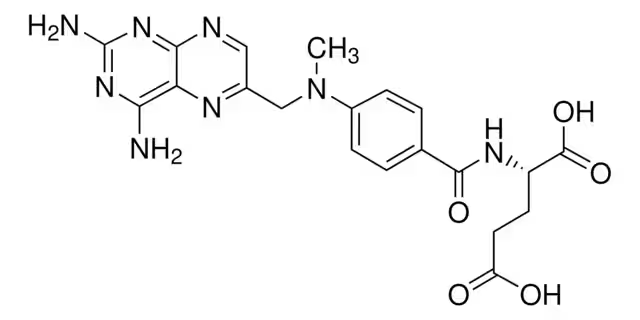
CAS Number59-05-2
SynonymsR 9985; MFCD00064370; EINECS 200-413-8; Amethopterine; N-(4-{[(2,4-Diaminopteridin-6-yl)methyl](methyl)amino}benzoyl)-L-glutamic acid; N-(4-{[(2,4-Diamino-6-pteridinyl)methyl](methyl)amino}benzoyl)-L-glutamic acid; (2S)-2-{[(4-{[(2,4-diaminopteridin-6-yl)methyl](methyl)amino}phenyl)carbonyl]amino}pentanedioic acid; X 133; L-Amethopterin; TCMDC-125858; MTX; Hdmtx; α-Methopterin; L-A-methopterin; (+)-Amethopterin; 4-Amino-N10-methylfolic Acid; 4-amino-4-deoxy-10-methylpteroyl-L-glutamic acid; Methotrexate; L-(+)-N-[p-[[(2,4-Diamino-6-pteridinyl)methyl]methylamino]benzoyl]glutamic Acid; L-Methotrexate; Mexate; 4-Amino-N10-methylpteroylglutamic Acid
Molecular FormulaC20H22N8O5
Molecular Weight454.44
Purity98.00%
Density1.4080
Boiling Point561.26°C
Melting Point195°C
Appearancepowder
EINECS200-413-8
Symbol
Signal WordWarning
| Chemical & Physical Properties | |
|---|---|
| CAS Number | 59-05-2 |
| Catalog No. | 2A-9011386 |
| Chinese Name | 甲氨蝶呤 |
| Synonyms | R 9985; MFCD00064370; EINECS 200-413-8; Amethopterine; N-(4-{[(2,4-Diaminopteridin-6-yl)methyl](methyl)amino}benzoyl)-L-glutamic acid; N-(4-{[(2,4-Diamino-6-pteridinyl)methyl](methyl)amino}benzoyl)-L-glutamic acid; (2S)-2-{[(4-{[(2,4-diaminopteridin-6-yl)methyl](methyl)amino}phenyl)carbonyl]amino}pentanedioic acid; X 133; L-Amethopterin; TCMDC-125858; MTX; Hdmtx; α-Methopterin; L-A-methopterin; (+)-Amethopterin; 4-Amino-N10-methylfolic Acid; 4-amino-4-deoxy-10-methylpteroyl-L-glutamic acid; Methotrexate; L-(+)-N-[p-[[(2,4-Diamino-6-pteridinyl)methyl]methylamino]benzoyl]glutamic Acid; L-Methotrexate; Mexate; 4-Amino-N10-methylpteroylglutamic Acid |
| Molecular Formula | C20H22N8O5 |
| Molecular Weight | 454.44 |
| Purity | 98.00 |
| Density | 1.4080 |
| Boiling Point | 561.26°C |
| Melting Point | 195°C |
| Appearance | powder |
| Water Solubility | Insoluble. <0.1 g/100 mL at 19 ºC |
| Storage Condition | Sealed and stored dry at 4°C. |
| Packaging | III |
| Application | Methotrexate is a folate antagonist with an IC50 of 78 nM in vitro. |
| EINECS | 200-413-8 |
| HTC | 2933990090 |
| MDL Number | MFCD00064370 |
| SMILES | CN(Cc1cnc2nc(N)nc(N)c2n1)c3ccc(cc3)C(=O)N[C@@H](CCC(O)=O)C(O)=O |
| InChI | 1S/C20H22N8O5/c1-28(9-11-8-23-17-15(24-11)16(21)26-20(22)27-17)12-4-2-10(3-5-12)18(31)25-13(19(32)33)6-7-14(29)30/h2-5,8,13H,6-7,9H2,1H3,(H,25,31)(H,29,30)(H,32,33)(H4,21,22,23,26,27)/t13-/m0/s1 |
| InChI Key | FBOZXECLQNJBKD-ZDUSSCGKSA-N |
| Beilstein/REAXYS | 70669 |
| NACRES Code | NA.21 |
| UNSPSC | 41116107 |
| Hazard Symbols | 6.1(b) |
| MSDS | msds/11386_1_59_05_2.pdf |
| Bioactivity | Methotrexate is a folate antagonist, with median IC50 of 78 nM in in vitro assay. Related Catalog Signaling Pathways >> Antibody-drug Conjugate >> ADC Cytotoxin Signaling Pathways >> Cell Cycle/DNA Damage >> Antifolate Research Areas >> Cancer Target Antifolate[1] In Vitro Methotrexate (MTX), which has a more predictable toxicity profile than aminopterin, has become a cornerstone of the treatment for childhood acute lymphoblastic leukemia (ALL) and for non-Hodgkins lymphoma[1]. In Vivo Methotrexate (MTX) exposure reduces thymus and spleen indices of mice. Methotrexate markedly decreases white blood cells, thymic and splenic lymphocytes at dose ≥5 mg/kg. However, there is a significant difference between the treatment plus control group and the model group (p<0.01). The combination of grape seed proanthocyanidins and Siberian ginseng eleutherosides obviously diminishes the effects of Methotrexate exposure on indices of thymus and spleens in mice[2]. Cell Assay Each cell line is studied in growth inhibition experiments using 96-well microtiter plates. As antifols are schedule dependent, preliminary experiments are aimed at defining the longest duration of exposure that would allow for continuous logarithmic phase growth of cells without changing of the culture media while maintaining a linear relationship between SRB optical density and cell number. Twenty-four hours after cell plating, the cell lines are exposed to the antifol for 120 h (three replicates per experiment). To ensure that a complete sigmoidal survival-concentration curve could be observed, the following drug concentrations are studied: Methotrexate (0.002-5 μM), AMT (0.0001-1 μM), PXD (0.0003-10 μM), TLX (0.0002-0.5 μM). Experiments are repeated at least twice[1]. Animal Admin Mice[2] The combination of bioactive phytochemicals is administered one week prior to the Methotrexate exposure. Treatment group I: mice are given a combination of green tea polyphenols and eleutherosides from Siberian ginseng (0.2 mL/10 g, i.g. once daily) for 15 days, and a single dose of Methotrexate (2 mg/kg, i.p. once daily) is added on the 8th day. Treatment group II: mice are given a combination of grape seed proanthocyanidins and eleutherosides from Siberian ginseng for 15 days, and Methotrexate is administered on the 8th day in a similar manner. Model group: animals received distilled water instead of bioactive phytochemicals combinations for 15 days and the same Methotrexate protocol applied to this group on the 8th day. Control group: mice are given distilled water through 15 days and physiological saline instead of Methotrexate is administered on the 8th day in a similar manner. Twelve hours after the final doses, the animals are euthanized by cervical dislocation. References [1]. Norris RE, et al. Clinical potency of methotrexate, aminopterin, talotrexin and pemetrexed in childhood leukemias. Cancer Chemother Pharmacol. 2010 May;65(6):1125-30. [2]. Gu S, et al. Screening of cytoprotectors against methotrexate-induced cytogenotoxicity from bioactive phytochemicals. PeerJ. 2016 May 11;4:e1983. Chemical & Physical Properties Density 1.4080 Boiling Point 561.26°C Melting Point 195°C Molecular Formula C20H22N8O5 Molecular Weight 454.439 Flash Point 11℃ Exact Mass 454.171326 PSA 210.54000 LogP -0.24 Index of Refraction 1.6910 InChIKey FBOZXECLQNJBKD-ZDUSSCGKSA-N SMILES CN(Cc1cnc2nc(N)nc(N)c2n1)c1ccc(C(=O)NC(CCC(=O)O)C(=O)O)cc1 Storage condition Keep in dark place,Inert atmosphere,Store in freezer, under -20°C Stability Stable, but light sensitive and hygroscopic. Incompatible with strong acids, strong oxidizing agents. Store at -15C or below. Water Solubility Insoluble. <0.1 g/100 mL at 19 ºC |
| Use of | Methotrexate is a folate antagonist, with median IC50 of 78 nM in in vitro assay. Properties Articles253 Name methotrexate Synonym More Synonyms Methotrexate Biological Activity Description Methotrexate is a folate antagonist, with median IC50 of 78 nM in in vitro assay. Related Catalog Signaling Pathways >> Antibody-drug Conjugate >> ADC Cytotoxin Signaling Pathways >> Cell Cycle/DNA Damage >> Antifolate Research Areas >> Cancer Antifolate[1] In Vitro Methotrexate (MTX), which has a more predictable toxicity profile than aminopterin, has become a cornerstone of the treatment for childhood acute lymphoblastic leukemia (ALL) and for non-Hodgkins lymphoma[1]. Cell Assay Each cell line is studied in growth inhibition experiments using 96-well microtiter plates. As antifols are schedule dependent, preliminary experiments are aimed at defining the longest duration of exposure that would allow for continuous logarithmic phase growth of cells without changing of the culture media while maintaining a linear relationship between SRB optical density and cell number. Twenty-four hours after cell plating, the cell lines are exposed to the antifol for 120 h (three replicates per experiment). To ensure that a complete sigmoidal survival-concentration curve could be observed, the following drug concentrations are studied: Methotrexate (0.002-5 μM), AMT (0.0001-1 μM), PXD (0.0003-10 μM), TLX (0.0002-0.5 μM). Experiments are repeated at least twice[1]. References [1]. Norris RE, et al. Clinical potency of methotrexate, aminopterin, talotrexin and pemetrexed in childhood leukemias. Cancer Chemother Pharmacol. 2010 May;65(6):1125-30. [2]. Gu S, et al. Screening of cytoprotectors against methotrexate-induced cytogenotoxicity from bioactive phytochemicals. PeerJ. 2016 May 11;4:e1983. Chemical & Physical Properties Molecular Formula C20H22N8O5 Exact Mass 454.171326 PSA 210.54000 LogP -0.24 Index of Refraction 1.6910 InChIKey FBOZXECLQNJBKD-ZDUSSCGKSA-N |
| Tax Rebate | 13.0% |
| Supervision | None. MFN tariff: 6.5%. Ordinary tariff: 20.0% |
| Transport Info | Product name: Purity: 98.0% |
| MSDS Transport Info | Module 14. Shipping information United Nations classification: Item 1 Poisons. UN number: 2811 Proper Shipping Name: Toxic Solid, Organic, Not Otherwise Specified Packing grade: III |
| Related Products in API & Advanced Intermediates | ||
|---|---|---|
| Melphalan | 148-82-3 | 2A-9011330 |
| Meropenem | 96036-03-2 | 2A-9011349 |
| Meropenem | 119478-56-7 | 2A-9011350 |
| Methotrexate | 51865-79-3 | 2A-9011384 |
| Methotrexate | 91431-42-4 | 2A-9011385 |
| Methyldigoxin; beta-Methyldigoxin | 30685-43-9 | 2A-9011396 |
| Methyldihydromorphine | 509-56-8 | 2A-9011397 |
| Methylphenidate hydrochloride | 298-59-9 | 2A-9011401 |
| Methylprednisolone aceponate | 86401-95-8 | 2A-9011402 |
| Metoclopramide | 7232-21-5 | 2A-9011409 |
| Browse all API & Advanced Intermediates products » | ||
Phone:
630-322-8886
630-322-8887
Email:
Office Locations:
Chicago, IL, USA
San Francisco, CA, USA


 EN
EN


 SDS
SDS