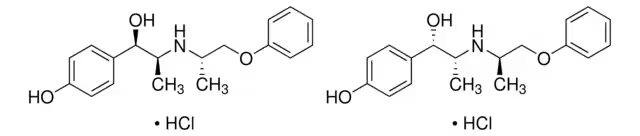
CAS Number579-56-6
SynonymsDilavase; suprilent; vasoplex; Vadosilan; Vasotran; Divadilan; EINECS 209-443-6; Isoxsuprin-hydrochlorid; vasodilan; isoxsuprine*HCl; chlorhydrate d'isoxsuprine; Navilox; MFCD00058069; Duvadilan; isolait
Molecular FormulaC18H24ClNO3
Molecular Weight337.84
Purity98%
Density1.146g/cm3
Boiling Point484.2ºC at 760mmHg
Melting Point203-204°
EINECS209-443-6
Symbol
Signal WordWarning
| Chemical & Physical Properties | |
|---|---|
| CAS Number | 579-56-6 |
| Catalog No. | 2A-9011070 |
| Chinese Name | 盐酸苯氧丙酚胺 |
| Synonyms | Dilavase; suprilent; vasoplex; Vadosilan; Vasotran; Divadilan; EINECS 209-443-6; Isoxsuprin-hydrochlorid; vasodilan; isoxsuprine*HCl; chlorhydrate d'isoxsuprine; Navilox; MFCD00058069; Duvadilan; isolait |
| Molecular Formula | C18H24ClNO3 |
| Molecular Weight | 337.84 |
| Purity | 98 |
| Density | 1.146g/cm3 |
| Boiling Point | 484.2ºC at 760mmHg |
| Melting Point | 203-204° |
| Storage Condition | 2-8°C |
| Application | Isoxsuprine hydrochloride is a β-adrenergic receptor agonist with Ki values of 13.65 μM and 3.48 μM for β-adrenergic receptors in the myometrium and placenta, respectively. Isoxsuprine hydrochloride |
| EINECS | 209-443-6 |
| PubChem ID | 329815328 |
| MDL Number | MFCD00058069 |
| SMILES | OC(C(NC(COC1=CC=CC=C1)C)C)C2=CC=C(O)C=C2.Cl |
| InChI | 1S/C18H23NO3.ClH/c1-13(12-22-17-6-4-3-5-7-17)19-14(2)18(21)15-8-10-16(20)11-9-15;/h3-11,13-14,18-21H,12H2,1-2H3;1H |
| InChI Key | QVPSGVSNYPRFAS-UHFFFAOYSA-N |
| NACRES Code | NA.24 |
| UNSPSC | 41116107 |
| Hazard Symbols | Transport |
| MSDS | msds/11070_1_579_56_6.pdf |
| Bioactivity | Isoxsuprine hydrochloride is a beta-adrenergic receptor agonist with Kis of 13.65 μΜ and 3.48 μΜ for myometrial and placcntal beta-adrenergic receptor, respectively. Isoxsuprine hydrochloride is also a NMDA receptor antagonist. Related Catalog Signaling Pathways >> Neuronal Signaling >> iGluR Research Areas >> Endocrinology Signaling Pathways >> GPCR/G Protein >> Adrenergic Receptor Research Areas >> Neurological Disease Signaling Pathways >> Membrane Transporter/Ion Channel >> iGluR Target Ki: 13.65 μΜ (myometrial beta-adrenergic receptor), 3.48 μΜ (placcntal beta-adrenergic receptor)[1] NMDA receptor[3] In Vitro Results show that Isoxsuprine hydrochloride inhibits circular chemorepellent induced defect (CCID) formation dose dependently (5 to 60 μM) and also inhibits 12(S)-HETE synthesis. Furthermore, Isoxsuprine hydrochloride is the only drug inhibiting the induction of all three mobility markers (MLC2, MYPT and paxillin)[2]. In Vivo Total infarct volume in vehicle-treated animals is 279±25 mm3 compare to 137±18 mm3 in Isoxsuprine hydrochloride-treated animals[3]. Cell Assay MCF-7ALOX12 cells are seeded in 3.5-cm dishes and grown in 2.5 mL complete MEM medium without selection pressure. The next day, the medium is changed to serum-free medium and cells are kept at 37°C for 24 h. Then, cells are treated with 10 μM arachidonic acid and simultaneously with different concentrations of Isoxsuprine hydrochloride for 4 h when the supernatants are aspirated, centrifuged at 2000, r.p.m. at 4°C for 5 min, collected in cryo-tubes, flash frozen and stored at -80 °C until analysis[2]. Animal Admin Male spontaneously hypertensive rats (SHR) weighing 290 to 300 g are used in this study. At reperfusion, animals receive 0.5 mL of vehicle (0.6% DMSO in normal saline) or 1 mg/kg Isoxsuprine hydrochloride by intravenous (IV) injection through the lateral tail vein. All animals receive 3 mL of subcutaneous saline after surgery to prevent dehydration. After 24 hours reperfusion, animals are sacrificed, brains are sectioned into 4 mm-thick quadrants, and infarcted tissue is identified by 2,3,5-triphenyltetrazolium chloride (TTC) staining. Edema-corrected infarct volume is calculated by subtracting the area of non-infarcted tissue in the ipsilateral hemisphere from the total volume of the contralateral hemisphere. Infarct volume is quantified using Image J software[3]. References [1]. Falkay G, et al. Affinity of tocolytic agents on human placental and myometrial beta-adrenergic receptors. J Perinat Med. 1986;14(2):109-13. [2]. Kretschy N, et al. In vitro inhibition of breast cancer spheroid-induced lymphendothelial defects resembling intravasation into the lymphatic vasculature by acetohexamide, isoxsuprine, nifedipin and proadifen. Br J Cancer. 2013 Feb 19;108(3):570-8. [3]. Hill JW, et al. Identification of isoxsuprine hydrochloride as a neuroprotectant in ischemic stroke through cell-based high-throughput screening. PLoS One. 2014 May 7;9(5):e96761. Chemical & Physical Properties Density 1.146g/cm3 Boiling Point 484.2ºC at 760mmHg Melting Point 203-204° Molecular Formula C18H24ClNO3 Molecular Weight 337.84100 Flash Point 246.6ºC Exact Mass 337.14400 PSA 61.72000 LogP 4.06410 InChIKey QVPSGVSNYPRFAS-UHFFFAOYSA-N SMILES CC(COc1ccccc1)NC(C)C(O)c1ccc(O)cc1.Cl Storage condition 2-8°C |
| Use of | Isoxsuprine hydrochloride is a beta-adrenergic receptor agonist with Kis of 13.65 μΜ and 3.48 μΜ for myometrial and placcntal beta-adrenergic receptor, respectively. Isoxsuprine hydrochloride is also a NMDA receptor antagonist. Properties Name isoxsuprine hydrochloride Synonym More Synonyms Isoxsuprine hydrochloride Biological Activity Description Isoxsuprine hydrochloride is a beta-adrenergic receptor agonist with Kis of 13.65 μΜ and 3.48 μΜ for myometrial and placcntal beta-adrenergic receptor, respectively. Isoxsuprine hydrochloride is also a NMDA receptor antagonist. Related Catalog Signaling Pathways >> Neuronal Signaling >> iGluR Research Areas >> Endocrinology Signaling Pathways >> GPCR/G Protein >> Adrenergic Receptor Research Areas >> Neurological Disease Signaling Pathways >> Membrane Transporter/Ion Channel >> iGluR Ki: 13.65 μΜ (myometrial beta-adrenergic receptor), 3.48 μΜ (placcntal beta-adrenergic receptor)[1] NMDA receptor[3] In Vitro Results show that Isoxsuprine hydrochloride inhibits circular chemorepellent induced defect (CCID) formation dose dependently (5 to 60 μM) and also inhibits 12(S)-HETE synthesis. Furthermore, Isoxsuprine hydrochloride is the only drug inhibiting the induction of all three mobility markers (MLC2, MYPT and paxillin)[2]. References [1]. Falkay G, et al. Affinity of tocolytic agents on human placental and myometrial beta-adrenergic receptors. J Perinat Med. 1986;14(2):109-13. [2]. Kretschy N, et al. In vitro inhibition of breast cancer spheroid-induced lymphendothelial defects resembling intravasation into the lymphatic vasculature by acetohexamide, isoxsuprine, nifedipin and proadifen. Br J Cancer. 2013 Feb 19;108(3):570-8. [3]. Hill JW, et al. Identification of isoxsuprine hydrochloride as a neuroprotectant in ischemic stroke through cell-based high-throughput screening. PLoS One. 2014 May 7;9(5):e96761. Chemical & Physical Properties Exact Mass 337.14400 PSA 61.72000 LogP 4.06410 InChIKey QVPSGVSNYPRFAS-UHFFFAOYSA-N |
| Transport Info | Shipping Name: UN |
| MSDS Transport Info | Module 14. Shipping information 14.1 UN dangerous goods number European Land Transport Danger Regulations: 3077 International Maritime Transport Danger Regulations: 3077 International Air Transport Danger Regulations: 3077 14.2 United Nations shipping name European land transport hazard regulations: ENVIRONMENTALLY HAZARDOUS SUBSTANCE, SOLID, N.O.S. (Isoxsuprine hydrochloride) IMDG Code: ENVIRONMENTALLY HAZARDOUS SUBSTANCE, SOLID, N.O.S. (Isoxsuprine hydrochloride) International air transport hazard regulations: Environmentally hazardous substance, solid, n.o.s. (Isoxsuprine hydrochloride) 14.3 Transport hazard categories European land transport Dangerous Regulations: 9 International sea transport Dangerous Regulations: 9 International air transport Dangerous Regulations: 9 14.4 Package group European Land Transport Danger Regulations: III International Maritime Transport Danger Regulations: III International Air Transport Danger Regulations: III 14.5 Environmental hazards European Land Transport Dangerous Regulations: Yes International Maritime Transport Dangerous Regulations International Air Transport Dangerous Regulations: Yes Marine Pollutants (Yes/No): Yes 14.6 Special reminder to users further information Dangerous goods are individually packaged, with liquids exceeding 5 liters or solids exceeding 5 kilograms. The outer packaging of each independent package and the combined independent inner package must have EHS on it. Identification (according to European ADR Regulation 2.2.9.1.10, IMDG Regulation 2.10.3), |
| Related Products in Specialty Chemicals | ||
|---|---|---|
| Isovelleral | 37841-91-1 | 2A-9011064 |
| Isoxaben | 82558-50-7 | 2A-9011065 |
| Isoxaprolol | 75949-60-9 | 2A-9011066 |
| Isoxathion | 18854-01-8 | 2A-9011067 |
| Isoxisuprine | 2A-302152 | 2A-9011069 |
| Isoxyl | 910-86-1 | 2A-9011071 |
| Isradipine | 75695-93-1 | 2A-9011072 |
| Itanoxone | 58182-63-1 | 2A-9011073 |
| Itazigrel | 70529-35-0 | 2A-9011074 |
| Itopride hydrochloride | 122892-31-3 | 2A-9011076 |
| Browse all Specialty Chemicals products » | ||
Phone:
630-322-8886
630-322-8887
Email:
Office Locations:
Chicago, IL, USA
San Francisco, CA, USA


 EN
EN


 SDS
SDS