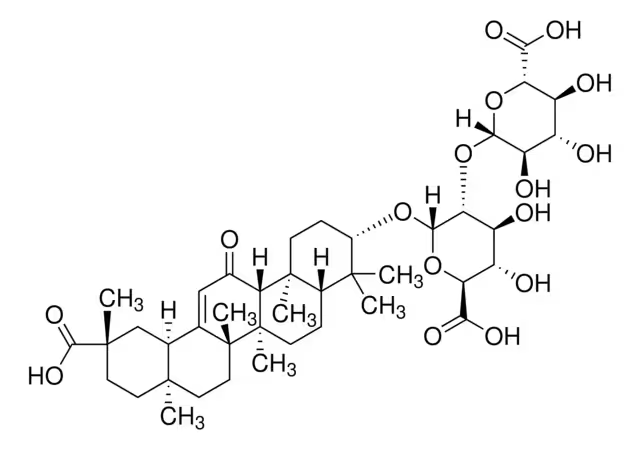
CAS Number1405-86-3
SynonymsGlycyrrhizin; Potenlini; Glycyrrhizate; glycyron; DerMacrin; MFCD00167400; 20b-Carboxy-11-oxo-30-norolean-12-en-3b-yl-2-O-b-D-glucopyranuronosyl-a-D-glucopyranosiduronic Acid; (3β)-30-Hydroxy-11,30-dioxoolean-12-en-3-yl 2-O-β-D-glucopyranuronosyl-α-D-glucopyranosiduronic acid; Glycyrrhizic acid; Glycyrrhizine; liquorice; 30-Noroleanane, α-D-glucopyranosiduronic acid deriv; glycyrrhizinic acid; glycyrrhetinic acid glycoside; Glycyrrhitin; Glycyrrhizic; EINECS 258-887-7
Molecular FormulaC42H62O16
Molecular Weight822.93
Purity98%
Density1.4±0.1 g/cm3
Boiling Point971.4±65.0 °C at 760 mmHg
Melting Point220ºC decomposes
Appearancecrystal
| Chemical & Physical Properties | |
|---|---|
| CAS Number | 1405-86-3 |
| Catalog No. | 2A-9010771 |
| Chinese Name | 甘草酸 |
| Synonyms | Glycyrrhizin; Potenlini; Glycyrrhizate; glycyron; DerMacrin; MFCD00167400; 20b-Carboxy-11-oxo-30-norolean-12-en-3b-yl-2-O-b-D-glucopyranuronosyl-a-D-glucopyranosiduronic Acid; (3β)-30-Hydroxy-11,30-dioxoolean-12-en-3-yl 2-O-β-D-glucopyranuronosyl-α-D-glucopyranosiduronic acid; Glycyrrhizic acid; Glycyrrhizine; liquorice; 30-Noroleanane, α-D-glucopyranosiduronic acid deriv; glycyrrhizinic acid; glycyrrhetinic acid glycoside; Glycyrrhitin; Glycyrrhizic; EINECS 258-887-7 |
| Molecular Formula | C42H62O16 |
| Molecular Weight | 822.93 |
| Purity | 98 |
| Density | 1.4±0.1 g/cm3 |
| Boiling Point | 971.4±65.0 °C at 760 mmHg |
| Melting Point | 220ºC decomposes |
| Appearance | crystal |
| Water Solubility | Easily soluble in: alcohol; insoluble in: ether |
| Storage Condition | Food grade plastic bag coated with kraft paper bag |
| Application | Glycyrrhizic acid is the active ingredient triterpenoid saponin in licorice. It is an antagonist of HMGB1 and has anti-tumor, anti-diabetic and other effects. |
| HTC | 1211903600 |
| MDL Number | MFCD00065194 |
| SMILES | C[C@]1(C(O)=O)CC[C@@](CC[C@]([C@@]2(C)[C@@]3([H])[C@]4(C)[C@@](C(C)(C)[C@@H](O[C@@]5([H])O[C@H](C(O)=O)[C@@H](O)[C@H](O)[C@H]5O[C@@]6([H])[C@H](O)[C@@H](O)[C@H](O)[C@@H](C(O)=O)O6)CC4)([H])CC2)(C)C7=CC3=O)(C)[C@@]7([H])C1 |
| InChI | 1S/C42H62O16/c1-37(2)21-8-11-42(7)31(20(43)16-18-19-17-39(4,36(53)54)13-12-38(19,3)14-15-41(18,42)6)40(21,5)10-9-22(37)55-35-30(26(47)25(46)29(57-35)33(51)52)58-34-27(48)23(44)24(45)28(56-34)32(49)50/h16,19,21-31,34-35,44-48H,8-15,17H2,1-7H3,(H,49,50)(H,51,52)(H,53,54)/t19-,21-,22-,23-,24-,25-,26-,27+,28-,29-,30+,31+,34-,35-,38+,39-,40-,41+,42+/m0/s1 |
| InChI Key | LPLVUJXQOOQHMX-QWBHMCJMSA-N |
| NACRES Code | NA.24 |
| UNSPSC | 41116107 |
| MSDS | msds/10771_1_1405_86_3.pdf |
| Bioactivity | Glycyrrhizic acid is a triterpenoid saponinl, acting as a direct HMGB1 antagonist, with anti-tumor, anti-diabetic activities. Related Catalog Signaling Pathways >> Others >> Others Research Areas >> Metabolic Disease Natural Products >> Terpenoids and Glycosides Research Areas >> Cancer In Vitro Glycyrrhizic acid shows a series of anti-cancer-related pharmacological activities, such as broad-spectrum anti-cancer ability, resistance to the tissue toxicity caused by chemotherapy and radiation, drug absorption enhancing effects and anti-multidrug resistance (MDR) mechanisms, as a carrier material in drug delivery systems[1]. In intestinal NCI-H716 cells that secretes GLP-1, Glycyrrhizic acid promotes GLP-1 secretion with a marked elevation of calcium levels. Glycyrrhizic acid can enhance GLP-1 secretion through TGR5 activation[2]. In Vivo In type 1-like diabetic rats induced by streptozotocin (STZ-treated rats), Glycyrrhizic acid increases the level of plasma GLP-1, which is blocked by triamterene at a dose sufficient to inhibit Takeda G-protein-coupled receptor 5 (TGR5)[1]. Glycyrrhizic acid (Glycyrrhizic acid; 50 mg/kg, i.p.) significantly decreases the levels of TgAb, HMGB1, TNF-α, IL-6, IL-1β in mice[3]. Animal Admin Mice[3] NOD.H-2h4 mice are fed in the animal house until 4 weeks of age. A total of 24 male mice are then randomly separated into three different groups (n=8 per group). Mice in the control group are given sterile water without supplement. Mice in the iodine supplement (NaI) group are given 0.005% NaI in the drinking water. Mice in the NaI+Glycyrrhizic acid group are treated with 50 mg/kg Glycyrrhizic acid once daily for 4 weeks, administered via intraperitoneal injection after 8 weeks of iodine supplementation. Thyroid tissues are removed surgically under anesthesia, washed with cold saline, blotted on filter paper and weighed using an electronic balance. The thyroid gland tissues are then stored at -80°C until use[3]. References [1]. Su X, et al. Glycyrrhizic acid: A promising carrier material for anticancer therapy. Biomed Pharmacother. 2017 Sep 5;95:670-678 [2]. Wang LY, et al. Glycyrrhizic acid increases glucagon like peptide-1 secretion via TGR5 activation in type 1-like diabetic rats. Biomed Pharmacother. 2017 Sep 4;95:599-604. [3]. Li C, et al. Glycyrrhizin, a Direct HMGB1 Antagonist, Ameliorates Inflammatory Infiltration in a Model of Autoimmune Thyroiditis via Inhibition of TLR2-HMGB1 Signaling. Thyroid. 2017 May;27(5):722-731. Chemical & Physical Properties Density 1.4±0.1 g/cm3 Boiling Point 971.4±65.0 °C at 760 mmHg Melting Point 220ºC decomposes Molecular Formula C42H62O16 Molecular Weight 822.932 Flash Point 288.1±27.8 °C Exact Mass 822.403809 PSA 267.04000 LogP 4.64 Vapour Pressure 0.0±0.6 mmHg at 25°C Index of Refraction 1.621 InChIKey LPLVUJXQOOQHMX-QWBHMCJMSA-N SMILES CC1(C(=O)O)CCC2(C)CCC3(C)C(=CC(=O)C4C5(C)CCC(OC6OC(C(=O)O)C(O)C(O)C6OC6OC(C(=O)O)C(O)C(O)C6O)C(C)(C)C5CCC43C)C2C1 |
| Use of | Glycyrrhizic acid is a triterpenoid saponinl, acting as a direct HMGB1 antagonist, with anti-tumor, anti-diabetic activities. Properties Name glycyrrhizinic acid Synonym More Synonyms Glycyrrhizic acid Biological Activity Description Glycyrrhizic acid is a triterpenoid saponinl, acting as a direct HMGB1 antagonist, with anti-tumor, anti-diabetic activities. Related Catalog Signaling Pathways >> Others >> Others Research Areas >> Metabolic Disease Natural Products >> Terpenoids and Glycosides Research Areas >> Cancer References [1]. Su X, et al. Glycyrrhizic acid: A promising carrier material for anticancer therapy. Biomed Pharmacother. 2017 Sep 5;95:670-678 [2]. Wang LY, et al. Glycyrrhizic acid increases glucagon like peptide-1 secretion via TGR5 activation in type 1-like diabetic rats. Biomed Pharmacother. 2017 Sep 4;95:599-604. [3]. Li C, et al. Glycyrrhizin, a Direct HMGB1 Antagonist, Ameliorates Inflammatory Infiltration in a Model of Autoimmune Thyroiditis via Inhibition of TLR2-HMGB1 Signaling. Thyroid. 2017 May;27(5):722-731. Chemical & Physical Properties Molecular Formula C42H62O16 Exact Mass 822.403809 PSA 267.04000 Index of Refraction 1.621 InChIKey LPLVUJXQOOQHMX-QWBHMCJMSA-N |
| Transport Info | Product name: Glycyrrhizic acid |
| Related Products in Botanical Reference Standards | ||
|---|---|---|
| Ginsenoside Rg3 | 14197-60-5 | 2A-9010739 |
| Ginsenoside Rh1 | 63223-86-9 | 2A-9010740 |
| Ginsenoside Rh2 | 78214-33-2 | 2A-9010741 |
| Ginsenoside X | 2A-301825 | 2A-9010742 |
| Glucocheirolin | 15592-36-6 | 2A-9010761 |
| Gomisin N | 69176-52-9 | 2A-9010773 |
| Homoorientin | 4261-42-1 | 2A-9010857 |
| Hyperoside | 482-36-0 | 2A-9010877 |
| Icariin | 489-32-7 | 2A-9010885 |
| Imperatorin | 482-44-0 | 2A-9010933 |
| Browse all Botanical Reference Standards products » | ||
Phone:
630-322-8886
630-322-8887
Email:
Office Locations:
Chicago, IL, USA
San Francisco, CA, USA


 EN
EN


 SDS
SDS