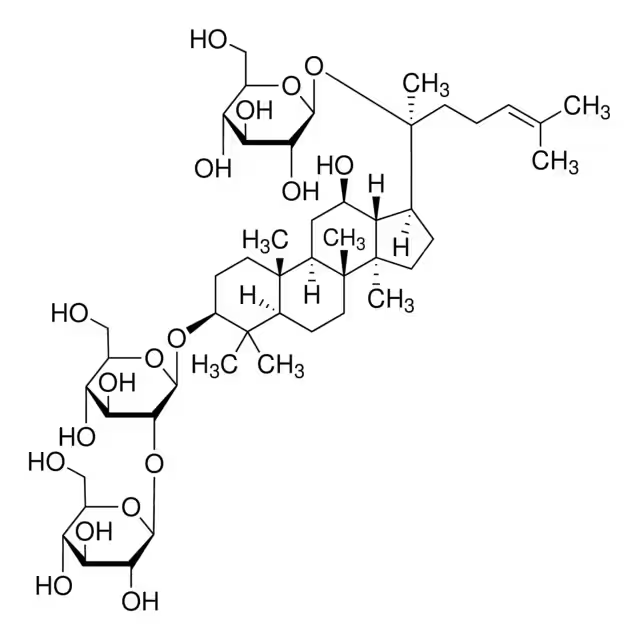
CAS Number52705-93-8
SynonymsGINSENOOSIDERD; ginsenoside Rd; Herba Gynostemmatis Pentaphylli; Gypenoside VIII; GinsenosideRd; EINECS 258-118-5; ginsenoside--Rd standard; MFCD00210508
Molecular FormulaC48H82O18
Molecular Weight947.15
Purity≥90.0 (HPLC)%
Density1.4±0.1 g/cm3
Boiling Point1015.6±65.0 °C at 760 mmHg
Melting Point207 °C(dec.)
AppearanceSolid;White to Almost white powder to crystal
Symbol
Signal WordWarning


Please Login or Create an Account to: See VlP prices and availability
US Stock: ship in 0-1 business day
Global Stock: ship in 5-7 days
| Chemical & Physical Properties | |
|---|---|
| CAS Number | 52705-93-8 |
| Catalog No. | 2A-9010730 |
| Chinese Name | 人参皂苷Rd |
| Synonyms | GINSENOOSIDERD; ginsenoside Rd; Herba Gynostemmatis Pentaphylli; Gypenoside VIII; GinsenosideRd; EINECS 258-118-5; ginsenoside--Rd standard; MFCD00210508 |
| Molecular Formula | C48H82O18 |
| Molecular Weight | 947.15 |
| Purity | ≥90.0 (HPLC) |
| Density | 1.4±0.1 g/cm3 |
| Boiling Point | 1015.6±65.0 °C at 760 mmHg |
| Melting Point | 207 °C(dec.) |
| Appearance | Solid;White to Almost white powder to crystal |
| Storage Condition | 2-8°C |
| Application | Ginsenoside Rd inhibits TNFα-induced NF-κB transcriptional activity with an IC50 of 12.05±0.82 μM. Ginsenoside Rd inhibits the expression of COX-2 and iNOS mRNA. Ginsenoside Rd also inhibits Ca2+ infl |
| SMILES | C\C(C)=C/CC[C@](C)(O[C@@H]1O[C@H](CO)[C@@H](O)[C@H](O)[C@H]1O)[C@H]2CC[C@]3(C)[C@@H]2[C@H](O)C[C@@H]4[C@@]5(C)CC[C@H](O[C@@H]6O[C@H](CO)[C@@H](O)[C@H](O)[C@H]6O[C@@H]7O[C@H](CO)[C@@H](O)[C@H](O)[C@H]7O)C(C)(C)[C@@H]5CC[C@@]34C |
| InChI | 1S/C48H82O18/c1-21(2)15-22(3)17-48(8,66-43-40(60)37(57)34(54)28(19-50)62-43)24-11-13-47(7)23-9-10-30-45(4,5)31(12-14-46(30,6)25(23)16-26(52)32(24)47)64-44-41(38(58)35(55)29(20-51)63-44)65-42-39(59)36(56)33(53)27(18-49)61-42/h15,22-44,49-60H,9-14,16-20H2,1-8H3/t22?,23?,24-,25?,26-,27+,28+,29+,30?,31?,32+,33+,34+,35+,36-,37-,38-,39+,40+,41+,42-,43-,44-,46+,47+,48-/m0/s1 |
| InChI Key | IRBVCFDYIGGFFY-ADSMOORZSA-N |
| NACRES Code | NA.24 |
| UNSPSC | 41116107 |
| Hazard Symbols | Transport |
| MSDS | msds/10730_1_52705_93_8.pdf |
| Bioactivity | Ginsenoside Rd inhibits TNFα-induced NF-κB transcriptional activity with an IC50 of 12.05±0.82 μM in HepG2 cells. Ginsenoside Rd inhibits expression of COX-2 and iNOS mRNA. Ginsenoside Rd also inhibits Ca2+ influx. Ginsenoside Rd inhibits CYP2D6, CYP1A2, CYP3A4, and CYP2C9, with IC50s of 58.0±4.5 μM, 78.4±5.3 μM, 81.7±2.6 μM, and 85.1±9.1 μM, respectively. Related Catalog Signaling Pathways >> Membrane Transporter/Ion Channel >> Calcium Channel Signaling Pathways >> Metabolic Enzyme/Protease >> Cytochrome P450 Research Areas >> Cardiovascular Disease Research Areas >> Inflammation/Immunology Natural Products >> Terpenoids and Glycosides Target NF-κB:12.05 μM (IC50, in HepG2 cells) COX-2 L-type calcium channel CYP2D6:58 μM (IC50) CYP1A2:78.4 μM (IC50) CYP3A4:81.7 μM (IC50) CYP2C9:85.1 μM (IC50) In Vitro Ginsenoside Rd is one of the most abundant ingredients of Panax ginseng. Ginsenoside Rd significantly inhibits TNF-α-induced NF-κB transcriptional activity with an IC50 of 12.05±0.82 in HepG2 cells. Ginsenoside Rd also inhibits expression of COX-2 and iNOS mRNA and iNOS promoter activity in a dose-dependent manner. To determine nontoxic concentrations, HepG2 cells are treated with various concentrations (0.1, 1, and 10 μM) of compounds (e.g., Ginsenoside Rd) and cell viability is measured using an MTS assay. No compounds are significantly cytotoxic at up to 10 μM, indicating that NF-κB inhibition is not due to cell toxicity[1]. Ginsenoside Rd is one of the most abundant ingredients of Panax ginseng, protects the heart via multiple mechanisms including the inhibition of Ca2+ influx. Ginsenoside Rd reduces ICa,L peak amplitude in a concentration-dependent manner (IC50=32.4±7.1 μM)[2]. Ginsenoside Rd exhibits an inhibition against the activity of CYP2D6 in human liver microsomes with an IC50 of 58.0±4.5 μM, a weak inhibition against the activity of CYP1A2, CYP3A4, and CYP2C9 in human liver microsomes with IC50s of 78.4±5.3, 81.7±2.6, and 85.1±9.1, respectively, and an even weaker inhibition against the activity of CYP2A6 in human liver microsomes with an IC50 value of more than 100 μM[4]. In Vivo Ginsenosides Rd is a major compound isolated from Gynostemma pentaphyllum that holistically improves gut microenvironment and induces anti-polyposis in ApcMin/+ mice. Six-weeks-old mice are subjected to Ginsenoside Rd treatment, before the appearance of the intestinal polyps. All the mice are monitored for food intake, water consumption, and weight changes. Throughout the experiment, no Rb3/ Ginsenoside Rd-associated weight loss in mice is observed. In addition, none of the treated mice show variations in food and water consumption. Whereas, the number and size of the polyps are effectively reduced by Ginsenoside Rd treatments[3]. Cell Assay An MTS assay is used to analyze the effects of the compounds on cell viability. HepG2 cells are cultured overnight in a 96-well plate (1×10⁴ cells/well). Cell viability is assessed after adding the compounds (e.g., Ginsenoside Rd; 0.1, 1, and 10 μM) for 24 h. The number of viable cells is determined by the A490nm of the dissolved formazan product, after addition of MTS for 30 min[1]. Animal Admin Mice[3] Heterozygous male ApcMin/+ (C57BL/6J-ApcMin/+) mice are used. Total 32 male ApcMin/+ mice (aged 6 weeks) are divided into three groups; 10 mice in the control group and 22 mice equally divided for Rb3 and Rd treatments. The mice are daily gavage with a single dose of Ginsenoside Rb3 or Ginsenoside Rd at 20 mg/kg, or solvent control. The treatments are carried out for 8 consecutive weeks. References [1]. Song SB, et al. Inhibition of TNF-α-mediated NF-κB Transcriptional Activity in HepG2 Cells by Dammarane-type Saponins from Panax ginseng Leaves. J Ginseng Res. 2012 Apr;36(2):146-52. [2]. Lu C, et al. Inhibition of L-type Ca2+ current by ginsenoside Rd in rat ventricular myocytes. J Ginseng Res. 2015 Apr;39(2):169-77. [3]. Huang G, et al. Ginsenosides Rb3 and Rd reduce polyps formation while reinstate the dysbiotic gut microbiota and the intestinal microenvironment in ApcMin/+ mice. Sci Rep. 2017 Oct 2;7(1):12552. [4]. Liu Y, et al. Ginsenoside metabolites, rather than naturally occurring ginsenosides, lead to inhibition of human cytochrome P450 enzymes. Toxicol Sci. 2006 Jun;91(2):356-64. Chemical & Physical Properties Density 1.4±0.1 g/cm3 Boiling Point 1015.6±65.0 °C at 760 mmHg Melting Point 207 °C(dec.) Molecular Formula C48H82O18 Molecular Weight 947.154 Flash Point 568.0±34.3 °C Exact Mass 946.550110 PSA 298.14000 LogP 3.24 Vapour Pressure 0.0±0.6 mmHg at 25°C Index of Refraction 1.611 InChIKey RLDVZILFNVRJTL-IWFVLDDISA-N SMILES CC(C)=CCCC(C)(OC1OC(CO)C(O)C(O)C1O)C1CCC2(C)C1C(O)CC1C3(C)CCC(OC4OC(CO)C(O)C(O)C4OC4OC(CO)C(O)C(O)C4O)C(C)(C)C3CCC12C Storage condition 2-8°C |
| Use of | Properties Articles29 Name ginsenoside Rd Synonym More Synonyms ginsenoside Rd Biological Activity Related Catalog Signaling Pathways >> Membrane Transporter/Ion Channel >> Calcium Channel Signaling Pathways >> Metabolic Enzyme/Protease >> Cytochrome P450 Research Areas >> Cardiovascular Disease Research Areas >> Inflammation/Immunology Natural Products >> Terpenoids and Glycosides L-type calcium channel CYP2D6:58 μM (IC50) CYP1A2:78.4 μM (IC50) CYP3A4:81.7 μM (IC50) References [2]. Lu C, et al. Inhibition of L-type Ca2+ current by ginsenoside Rd in rat ventricular myocytes. J Ginseng Res. 2015 Apr;39(2):169-77. [3]. Huang G, et al. Ginsenosides Rb3 and Rd reduce polyps formation while reinstate the dysbiotic gut microbiota and the intestinal microenvironment in ApcMin/+ mice. Sci Rep. 2017 Oct 2;7(1):12552. [4]. Liu Y, et al. Ginsenoside metabolites, rather than naturally occurring ginsenosides, lead to inhibition of human cytochrome P450 enzymes. Toxicol Sci. 2006 Jun;91(2):356-64. Chemical & Physical Properties Molecular Formula C48H82O18 Exact Mass 946.550110 PSA 298.14000 Index of Refraction 1.611 InChIKey RLDVZILFNVRJTL-IWFVLDDISA-N |
| Transport Info | Product name: Purity: 98.0% |
| MSDS Transport Info | Module 14. Shipping information 14.1 UN dangerous goods number European Land Transport Dangerous Regulations: -International Maritime Dangerous Regulations: -International Air Transport Dangerous Regulations: - 14.2 Names specified by the United Nations (UN) European Land Transport Dangerous Regulations: Non-dangerous goods IMDG Code: Non-dangerous goods International air transport dangerous goods regulations: non-dangerous goods 14.3 Transport hazard categories European Land Transport Dangerous Regulations: -International Maritime Dangerous Regulations: -International Air Transport Dangerous Regulations: - 14.4 Package group European Land Transport Dangerous Regulations: -International Maritime Dangerous Regulations: -International Air Transport Dangerous Regulations: - 14.5 Environmental hazards European Land Transport Dangerous Regulations: No International Maritime Transport Dangerous Regulations Maritime Pollutants: No International Air Transport Risk Regulations: No 14.6 Special reminder to users No data available |
| Related Products in Specialty Chemicals | ||
|---|---|---|
| Gestonorone caproate | 1253-28-7 | 2A-9010721 |
| Ginkgo biloba | 90045-36-6 | 2A-9010723 |
| Ginkgolic acid (13:0) | 2A-301807 | 2A-9010724 |
| Ginkgolic acid (15:1) | 2A-301808 | 2A-9010725 |
| Ginkgolide J | 107438-79-9 | 2A-9010729 |
| Giractide | 24870-04-0 | 2A-9010743 |
| Gitalin | 1405-76-1 | 2A-9010744 |
| Gitaloxin | 3261-53-8 | 2A-9010745 |
| Gitoformate | 10176-39-3 | 2A-9010746 |
| Gitoxigenin | 545-26-6 | 2A-9010747 |
| Browse all Specialty Chemicals products » | ||
Phone:
630-322-8886
630-322-8887
Email:
Office Locations:
Chicago, IL, USA
San Francisco, CA, USA


 EN
EN

 SDS
SDS