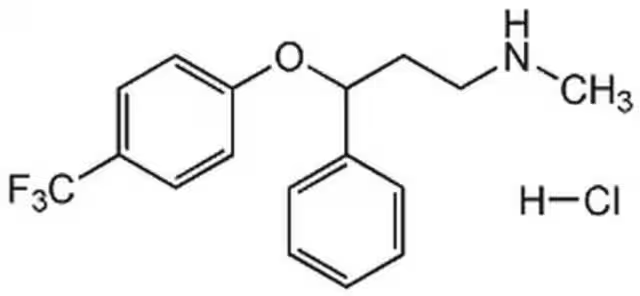
CAS Number56296-78-7
Synonyms(±)-N-Methyl-3-phenyl-3-[(a,a,a-trifluoro-p-tolyl)oxy]propylamine Hydrochloride; Lovan-d; Lovan-d5; Sarafem; N-Methyl-3-phenyl-3-[4-(trifluoromethyl)phenoxy]-1-propanamine hydrochloride (1:1); Prozac; fluoxetine hydrogen chloride; (±)-N-Methyl-g-[4-(trifluoromethyl)phenoxy]benzenepropanamine Hydrochloride; Foxetin-d5; EINECS 260-101-2; N-méthyl-3-phényl-3-[4-(trifluorométhyl)phénoxy]propan-1-amine chlorhydrate; Benzenepropanamine, N-methyl-γ-[4-(trifluoromethyl)phenoxy]-, hydrochloride (1:1); fontex; (±)-N-Methyl-γ-[4-(trifluoromethyl)phenoxy]benzenepropanamine hydrochloride; N-Methyl-3-phenyl-3-[4-(trifluoromethyl)phenoxy]propan-1-amine hydrochloride (1:1); Ansilan-d5; N-Methyl-3-phenyl-3-[4-(trifluormethyl)phenoxy]propan-1-aminhydrochlorid; Adofen-d5; Fontex-d5; Fluctin-d5; N-methyl-3-ph
Molecular FormulaC17H19ClF3NO
Molecular Weight309.33
Purity≥98 (HPLC)%
Boiling Point395.1ºC at 760mmHg
Melting Point158-159°C
Appearancesolid
Symbol
Signal WordWarning
| Chemical & Physical Properties | |
|---|---|
| CAS Number | 56296-78-7 |
| Catalog No. | 2A-9010571 |
| Chinese Name | 盐酸氟西汀 |
| Synonyms | (±)-N-Methyl-3-phenyl-3-[(a,a,a-trifluoro-p-tolyl)oxy]propylamine Hydrochloride; Lovan-d; Lovan-d5; Sarafem; N-Methyl-3-phenyl-3-[4-(trifluoromethyl)phenoxy]-1-propanamine hydrochloride (1:1); Prozac; fluoxetine hydrogen chloride; (±)-N-Methyl-g-[4-(trifluoromethyl)phenoxy]benzenepropanamine Hydrochloride; Foxetin-d5; EINECS 260-101-2; N-méthyl-3-phényl-3-[4-(trifluorométhyl)phénoxy]propan-1-amine chlorhydrate; Benzenepropanamine, N-methyl-γ-[4-(trifluoromethyl)phenoxy]-, hydrochloride (1:1); fontex; (±)-N-Methyl-γ-[4-(trifluoromethyl)phenoxy]benzenepropanamine hydrochloride; N-Methyl-3-phenyl-3-[4-(trifluoromethyl)phenoxy]propan-1-amine hydrochloride (1:1); Ansilan-d5; N-Methyl-3-phenyl-3-[4-(trifluormethyl)phenoxy]propan-1-aminhydrochlorid; Adofen-d5; Fontex-d5; Fluctin-d5; N-methyl-3-ph |
| Molecular Formula | C17H19ClF3NO |
| Molecular Weight | 309.33 |
| Purity | ≥98 (HPLC) |
| Boiling Point | 395.1ºC at 760mmHg |
| Melting Point | 158-159°C |
| Appearance | solid |
| Water Solubility | Water solubility: soluble |
| Storage Condition | Keep the receptacle sealed, stored in a cool, dry |
| Packaging | III |
| Application | Fluoxetine hydrochloride is an antidepressant and selective serotonin reuptake inhibitor. |
| HTC | 2922199090 |
| MDL Number | MFCD00214288 |
| SMILES | FC(F)(F)c1ccc(cc1)OC(CCNC)c2ccccc2.[Cl-].[H+] |
| InChI | 1S/C17H18F3NO.ClH/c1-21-12-11-16(13-5-3-2-4-6-13)22-15-9-7-14(8-10-15)17(18,19)20;/h2-10,16,21H,11-12H2,1H3;1H |
| InChI Key | GIYXAJPCNFJEHY-UHFFFAOYSA-N |
| NACRES Code | NA.77 |
| UNSPSC | 12352200 |
| Hazard Symbols | 6.1(b) |
| MSDS | msds/10571_1_56296_78_7.pdf |
| Bioactivity | Fluoxetine hydrochloride is an antidepressant and a selective serotonin reuptake inhibitor. Related Catalog Signaling Pathways >> Autophagy >> Autophagy Signaling Pathways >> Neuronal Signaling >> Serotonin Transporter Research Areas >> Neurological Disease In Vitro Fluoxetine blocks the downregulation of cell proliferation resulting from inescapable shock (IS) of hippocampal cell[1]. Fluoxetine increases the number of newborn cells in the dentate gyrus of the hippocampus of adult rat. Fluoxetine also increases the number of proliferating cells in the prelimbic cortex[2]. Fluoxetine accelerates the maturation of immature neurons. Fluoxetine enhances neurogenesis-dependent long-term potentiation (LTP) in the dentate gyrus[3]. Fluoxetine, but not citalopram, fluvoxamine, paroxetine and sertraline, increases norepinephrine and dopamine extracellular levels in prefrontal cortex. Fluoxetine produces robust and sustained increases in extracellular concentrations of norepinephrine and dopamine after acute systemic administration[4]. In Vivo Fluoxetine treatment also reverses the deficit in escape latency observed in animals exposed to inescapable shock in adult male Sprague-Dawley rats[1]. Fluoxetine (5 mg/kg) alone increases cell proliferation in the dentate gyrus. Coadministration (fluoxetine 5 mg/kg + olanzapine) also significantly increases the number of BrdU-positive cells compared with the control group[2]. Fluoxetine combined with Olanzapine produces robust, sustained increases of extracellular levels of dopamine ([DA](ex)) and norepinephrine ([NE](ex)) up to 361% and 272% of the baseline, respectively, which are significantly greater than either drug alone[5]. Animal Admin Male Sprague-Dawley rats weighing 250-300 g are housed under a 12-hour light/12-hour dark cycle (lights on at 7:00 am, lights off at 7:00 pm) and at constant temperature (25°C) and humidity and allowed free access to food and water. For chronic drug treatments, rats are administered fluoxetine (5 mg/kg/day) or saline by intraperitoneal (IP) injection once daily and olanzapine or vehicle in the drinking water for 21 days (vehicle-treated control, fluoxetine, and olanzapine alone) plus the combination of fluoxetine and olanzapine. For combination treatment, olanzapine is chosen because fluoxetine is known to interfere with the metabolism of olanzapine and raise the blood levels by up to 4-6 times. Olanzapine is dissolved in hydrochloric acid (HCl), then adjusted back to pH 6 with 1 N sodium hydroxide to make the stock solution of 3 mg/mL concentration. The same amount of vehicle solution is added to the water for the control animals. Fluid intake is measured three times per week, and drinking bottles are replenwashed with fresh drug solution. There are no differences in fluid intake among the treatment groups. For subchronic treatment, drugs are administered exactly the same way but for a total period of 7 days. References [1]. Malberg JE, et al. Cell proliferation in adult hippocampus is decreased by inescapable stress: reversal by fluoxetine treatment. Neuropsychopharmacology. 2003 Sep;28(9):1562-71 [2]. Kodama M, et al. Chronic olanzapine or fluoxetine administration increases cell proliferation in hippocampus and prefrontal cortex of adult rat. Biol Psychiatry. 2004 Oct 15;56(8):570-80. [3]. Wang JW, et al. Chronic fluoxetine stimulates maturation and synaptic plasticity of adult-born hippocampal granule cells. J Neurosci. 2008 Feb 6;28(6):1374-84. [4]. Bymaster FP, et al. Fluoxetine, but not other selective serotonin uptake inhibitors, increases norepinephrine and dopamine extracellular levels in prefrontal cortex. Psychopharmacology (Berl). 2002 Apr;160(4):353-61 [5]. Zhang W, et al. Synergistic effects of olanzapine and other antipsychotic agents in combination with fluoxetine on norepinephrine and dopamine release in rat prefrontal cortex. Neuropsychopharmacology. 2000 Sep;23(3):250-62. [6]. Su WJ, et al. Antidiabetic drug glyburide modulates depressive-like behavior comorbid with insulin resistance. J Neuroinflammation. 2017 Oct 30;14(1):210. Chemical & Physical Properties Boiling Point 395.1ºC at 760mmHg Melting Point 158-159°C Molecular Formula C17H19ClF3NO Molecular Weight 345.787 Flash Point 192.8ºC Exact Mass 345.110718 PSA 21.26000 LogP 5.62790 InChIKey GIYXAJPCNFJEHY-UHFFFAOYSA-N SMILES CNCCC(Oc1ccc(C(F)(F)F)cc1)c1ccccc1.Cl Storage condition Store at RT |
| Use of | Fluoxetine hydrochloride is an antidepressant and a selective serotonin reuptake inhibitor. Properties Articles50 Name Fluoxetine hydrochloride Synonym More Synonyms Fluoxetine Hydrochloride Biological Activity Description Fluoxetine hydrochloride is an antidepressant and a selective serotonin reuptake inhibitor. Related Catalog Signaling Pathways >> Autophagy >> Autophagy Signaling Pathways >> Neuronal Signaling >> Serotonin Transporter Research Areas >> Neurological Disease In Vitro Fluoxetine blocks the downregulation of cell proliferation resulting from inescapable shock (IS) of hippocampal cell[1]. Fluoxetine increases the number of newborn cells in the dentate gyrus of the hippocampus of adult rat. Fluoxetine also increases the number of proliferating cells in the prelimbic cortex[2]. Fluoxetine accelerates the maturation of immature neurons. Fluoxetine enhances neurogenesis-dependent long-term potentiation (LTP) in the dentate gyrus[3]. Fluoxetine, but not citalopram, fluvoxamine, paroxetine and sertraline, increases norepinephrine and dopamine extracellular levels in prefrontal cortex. Fluoxetine produces robust and sustained increases in extracellular concentrations of norepinephrine and dopamine after acute systemic administration[4]. References [1]. Malberg JE, et al. Cell proliferation in adult hippocampus is decreased by inescapable stress: reversal by fluoxetine treatment. Neuropsychopharmacology. 2003 Sep;28(9):1562-71 [2]. Kodama M, et al. Chronic olanzapine or fluoxetine administration increases cell proliferation in hippocampus and prefrontal cortex of adult rat. Biol Psychiatry. 2004 Oct 15;56(8):570-80. [3]. Wang JW, et al. Chronic fluoxetine stimulates maturation and synaptic plasticity of adult-born hippocampal granule cells. J Neurosci. 2008 Feb 6;28(6):1374-84. [4]. Bymaster FP, et al. Fluoxetine, but not other selective serotonin uptake inhibitors, increases norepinephrine and dopamine extracellular levels in prefrontal cortex. Psychopharmacology (Berl). 2002 Apr;160(4):353-61 [5]. Zhang W, et al. Synergistic effects of olanzapine and other antipsychotic agents in combination with fluoxetine on norepinephrine and dopamine release in rat prefrontal cortex. Neuropsychopharmacology. 2000 Sep;23(3):250-62. [6]. Su WJ, et al. Antidiabetic drug glyburide modulates depressive-like behavior comorbid with insulin resistance. J Neuroinflammation. 2017 Oct 30;14(1):210. Chemical & Physical Properties Exact Mass 345.110718 PSA 21.26000 LogP 5.62790 InChIKey GIYXAJPCNFJEHY-UHFFFAOYSA-N Storage condition Store at RT |
| Tax Rebate | 13.0% |
| Supervision | None. MFN tariff: 6.5%. Ordinary tariff: 30.0% |
| Transport Info | Shipping Name: UN |
| MSDS Transport Info | Module 14. Shipping information 14.1 UN dangerous goods number European Land Transport Danger Regulations: 3077 International Maritime Transport Danger Regulations: 3077 International Air Transport Danger Regulations: 3077 14.2 United Nations shipping name European land transport hazard regulations: ENVIRONMENTALLY HAZARDOUS SUBSTANCE, SOLID, N.O.S. (Methyl[3-phenyl-3-[4- (trifluoromethyl)phenoxy]propyl]ammonium chloride) IMDG Code: ENVIRONMENTALLY HAZARDOUS SUBSTANCE, SOLID, N.O.S. (Methyl[3-phenyl-3-[4- (trifluoromethyl)phenoxy]propyl]ammonium chloride) International air transport hazard regulations: Environmentally hazardous substance, solid, n.o.s. (Methyl[3-phenyl-3-[4- (trifluoromethyl)phenoxy]propyl]ammonium chloride) 14.3 Transport hazard categories European land transport Dangerous Regulations: 9 International sea transport Dangerous Regulations: 9 International air transport Dangerous Regulations: 9 14.4 Package group European Land Transport Danger Regulations: III International Maritime Transport Danger Regulations: III International Air Transport Danger Regulations: III 14.5 Environmental hazards European Land Transport Dangerous Regulations: Yes International Maritime Transport Dangerous Regulations International Air Transport Dangerous Regulations: Yes Marine Pollutants (Yes/No): Yes 14.6 Special reminder to users further information Dangerous goods are individually packaged, with liquids exceeding 5 liters or solids exceeding 5 kilograms. The outer packaging of each independent package and the combined independent inner package must have EHS on it. Identification (according to European ADR Regulation 2.2.9.1.10, IMDG Regulation 2.10.3), |
| Related Products in API & Advanced Intermediates | ||
|---|---|---|
| Exemestane | 107868-30-4 | 2A-9010439 |
| Febuxostat | 144060-53-7 | 2A-9010455 |
| Felodipine HCL | 72509-76-3 | 2A-9010457 |
| Fentanyl | 437-38-7 | 2A-9010495 |
| Fluconazole | 86386-73-4 | 2A-9010544 |
| Fluphenazine | 69-23-8 | 2A-9010573 |
| Fluphenazine enanthate | 2A-301657 | 2A-9010574 |
| Fluvastatin | 93957-54-1 | 2A-9010592 |
| Fluvastatin sodium | 93957-55-2 | 2A-9010593 |
| Fluvoxamine | 54739-18-3 | 2A-9010594 |
| Browse all API & Advanced Intermediates products » | ||
Phone:
630-322-8886
630-322-8887
Email:
Office Locations:
Chicago, IL, USA
San Francisco, CA, USA


 EN
EN


 SDS
SDS