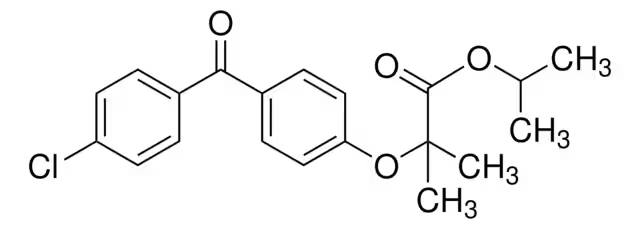
CAS Number49562-28-9
Synonymspropan-2-yl 2-[4-(4-chlorobenzoyl)phenoxy]-2-methylpropanoate; Lipantil; Isopropyl 2-[4-(4-Chlorobenzoyl)phenoxy]-2-methylpropionate; Procetofen; 2-[4-(4-Chlorobenzoyl)phenoxy]-2-methylpropionic Acid Isopropyl Ester; Fenofibrate; Lipidil; Tricor; Isopropyl 2-(4-(4-chlorobenzoyl)phenoxy)-2-methylpropanoate; 2-[4-(4-Chlorobenzoyl)phenoxy]-2-methylpropanoic acid isopropyl ester; Lipanthyl; Supralip; Secalip
Molecular FormulaC20H21ClO4
Molecular Weight360.83
Purity≥99%
Density1.2±0.1 g/cm3
Boiling Point469.8±35.0 °C at 760 mmHg
Melting Point80-81ºC
Appearancepowder
EINECS256-376-3
Symbol
Signal WordWarning
| Chemical & Physical Properties | |
|---|---|
| CAS Number | 49562-28-9 |
| Catalog No. | 2A-9010479 |
| Chinese Name | 非诺贝特 |
| Synonyms | propan-2-yl 2-[4-(4-chlorobenzoyl)phenoxy]-2-methylpropanoate; Lipantil; Isopropyl 2-[4-(4-Chlorobenzoyl)phenoxy]-2-methylpropionate; Procetofen; 2-[4-(4-Chlorobenzoyl)phenoxy]-2-methylpropionic Acid Isopropyl Ester; Fenofibrate; Lipidil; Tricor; Isopropyl 2-(4-(4-chlorobenzoyl)phenoxy)-2-methylpropanoate; 2-[4-(4-Chlorobenzoyl)phenoxy]-2-methylpropanoic acid isopropyl ester; Lipanthyl; Supralip; Secalip |
| Molecular Formula | C20H21ClO4 |
| Molecular Weight | 360.83 |
| Purity | ≥99 |
| Density | 1.2±0.1 g/cm3 |
| Boiling Point | 469.8±35.0 °C at 760 mmHg |
| Melting Point | 80-81ºC |
| Appearance | powder |
| Water Solubility | Practically insoluble in water, very soluble in me |
| Storage Condition | Store at RT |
| Application | Fenofibrate is a PPARα agonist with an EC50 of 30 μM. |
| EINECS | 256-376-3 |
| HTC | 2932999099 |
| PubChem ID | 24278015 |
| MDL Number | MFCD00133314 |
| SMILES | CC(C)OC(=O)C(C)(C)Oc1ccc(cc1)C(=O)c2ccc(Cl)cc2 |
| InChI | 1S/C20H21ClO4/c1-13(2)24-19(23)20(3,4)25-17-11-7-15(8-12-17)18(22)14-5-9-16(21)10-6-14/h5-13H,1-4H3 |
| InChI Key | YMTINGFKWWXKFG-UHFFFAOYSA-N |
| NACRES Code | NA.77 |
| UNSPSC | 12352200 |
| Hazard Symbols | Transport |
| MSDS | msds/10479_1_49562_28_9.pdf |
| Bioactivity | Fenofibrate is a PPARα agonist with an EC50 of 30 μM. Related Catalog Signaling Pathways >> Autophagy >> Autophagy Signaling Pathways >> Metabolic Enzyme/Protease >> Cytochrome P450 Signaling Pathways >> Cell Cycle/DNA Damage >> PPAR Research Areas >> Cardiovascular Disease Target CYP2C19:0.2 μM (IC50) CYP2B6:0.7 μM (IC50) CYP2C9:9.7 μM (IC50) CYP2C8:4.8 μM (IC50) CYP3A4:142.1 μM (IC50) PPARα:30 μM (IC50) In Vitro Fenofibrate is a relatively potent inhibitor of CYP2B6 (IC50=0.7±0.2 μM) and CYP2C19 (IC50=0.2±0.1 μM). Fenofibrate is also a moderate inhibitor of CYP2C8 (IC50=4.8±1.7 μM) and CYP2C9 (IC50=9.7 μM)[1]. Fenofibrate binds to and inhibits cytochrome P450 epoxygenase (CYP)2C with higher affinity than to PPARα. Fenofibrate is a well-known PPARα agonist, but an in vitro assessment of 209 frequently prescribed drugs and related xenobiotics suggests that Fenofibrate is also a potent inhibitor of cytochrome P450 epoxygenase (CYP)2C. The affinity of Fenofibrate to CYP2C is >10 times higher (EC50=2.39±0.4 μM) than to PPARα (EC50=30 μM). Fenofibrate at a low dose inhibits CYP2C8 activity without PPARα activation[2]. In Vivo Daily intake of Fenofibrate at this low dose (10 μg/g/day) inhibits retinal and choroidal neovascularization induced by CYP2C8 overexpression by 29% (P=0.021) and 36% (P=1.2×10⁻⁹) respectively[2]. Kinase Assay The half-maximal inhibitory concentrations (IC50s) of Fenofibrate, statins (atorvastatin, lovastatin, pravastatin, simvastatin and simvastatin acid, the active form of simvastatin) and glipizide for recombinant human CYP1A2, CYP2B6, CYP2C8, CYP2C9, CYP2C19, CYP2D6, and CYP3A4 are determined using fluorometric CYP450 inhibition assays. Briefly, the drugs are dissolved in methanol or acetonitrile. In 96 well assay plates, the drugs are diluted to a series of concentrations in a solution containing cofactors including NADP+ (final concentration 1.3 mM), MgCl2 (final concentration 3.3 m M), glucose-6-phosphate (G6P, final concentration 3.3 mM) and glucose 6-phosphate dehydrogenase (final concentration 0.4 U/mL). The mixture is pre-incubated at 37°C for 10 min. The enzymes and fluorogenic substrates are diluted to desired concentrations in sodium phosphate reaction buffer (pH 7.4, final concentration 200 mM) and mixed. Reactions are initiated with addition of the enzyme and substrate mixture to the cofactor and drug mixture. The final reaction volume of all assays is 200 μL. After incubating at 37°C for a pre-specified period of time (15 to 45 min), the reactions are stopped with addition of 75 μL quenching solution (0.5 M Tris base or 2N NaOH). Fluorescence is determined using a BioTek Synergy 2 fluorescence reader. Each of the drugs is tested at eight concentrations in duplicate. To estimate IC50s, percent of inhibition is calculated using net fluorescence that is corrected for the background. The values of percent of inhibition are then fitted to a three or four parameter log-logistic model[1]. Animal Admin Mice[2] The mouse oxygen-induced retinopathy (OIR) model is used. Briefly to induce retinal neovascularization, mouse pups and their nursing mother are exposed to 75±3% oxygen from P7 to P12. For the higher dose Fenofibrate (F6020) treatment (100 mg/kg/day). Fenofibrate is dissolved in corn oil to make 100mg/mL solution and pure corn oil is used as vehicle control. For the lower dose treatment (10 mg/kg/day), Fenofibrate is dissolved in 10% DMSO, D2650 to make a 10 mg/mL solution and 10% DMSO is used as vehicle control. After return to room air, mice are orally gavaged with Fenofibrate (100 or 10 mg/kg) or vehicle control daily from P12 to P16. At P17, eyes are enucleated immediately after euthanasia and fixed in 4% paraformaldehyde in PBS for 1 h at room temperature. Retinas are then dissected and stained overnight with Alexa Fluor 594 conjugated isolectin GS-IB4 (10 μg/mL) at room temperature. After washing with PBS, retinas are mounted onto microscope slides with photoreceptor side down and embedded in SlowFade antifade mounting medium. Retinal images are taken using a fluorescence microscope with image software. Retinal neovascularization is analyzed. References [1]. Schelleman H, et al. Pharmacoepidemiologic and in vitro evaluation of potential drug-drug interactions of sulfonylureas with fibrates and statins. Br J Clin Pharmacol. 2014 Sep;78(3):639-48. [2]. Gong Y, et al. Fenofibrate Inhibits Cytochrome P450 Epoxygenase 2C Activity to Suppress Pathological Ocular Angiogenesis. EBioMedicine. 2016 Sep 30. pii: S2352-3964(16)30448-0. Chemical & Physical Properties Density 1.2±0.1 g/cm3 Boiling Point 469.8±35.0 °C at 760 mmHg Melting Point 80-81ºC Molecular Formula C20H21ClO4 Molecular Weight 360.831 Flash Point 165.4±24.9 °C Exact Mass 360.112823 PSA 52.60000 LogP 4.80 Vapour Pressure 0.0±1.2 mmHg at 25°C Index of Refraction 1.547 InChIKey YMTINGFKWWXKFG-UHFFFAOYSA-N SMILES CC(C)OC(=O)C(C)(C)Oc1ccc(C(=O)c2ccc(Cl)cc2)cc1 Storage condition Store at RT Water Solubility Practically insoluble in water, very soluble in methylene chloride, slightly soluble in ethanol (96 per cent) |
| Use of | Fenofibrate is a PPARα agonist with an EC50 of 30 μM. Properties Articles129 Name fenofibrate Synonym More Synonyms Fenofibrate Biological Activity Description Fenofibrate is a PPARα agonist with an EC50 of 30 μM. Related Catalog Signaling Pathways >> Autophagy >> Autophagy Signaling Pathways >> Metabolic Enzyme/Protease >> Cytochrome P450 Signaling Pathways >> Cell Cycle/DNA Damage >> PPAR Research Areas >> Cardiovascular Disease CYP2B6:0.7 μM (IC50) CYP3A4:142.1 μM (IC50) PPARα:30 μM (IC50) References [1]. Schelleman H, et al. Pharmacoepidemiologic and in vitro evaluation of potential drug-drug interactions of sulfonylureas with fibrates and statins. Br J Clin Pharmacol. 2014 Sep;78(3):639-48. Chemical & Physical Properties Exact Mass 360.112823 PSA 52.60000 Index of Refraction 1.547 InChIKey YMTINGFKWWXKFG-UHFFFAOYSA-N Storage condition Store at RT Water Solubility Practically insoluble in water, very soluble in methylene chloride, slightly soluble in ethanol (96 per cent) |
| Tax Rebate | 13.0% |
| Supervision | None. MFN tariff: 6.5%. Ordinary tariff: 20.0% |
| Transport Info | Shipping Name: UN |
| MSDS Transport Info | Module 14. Shipping information 14.1 UN dangerous goods number European Land Transport Dangerous Regulations: -International Maritime Dangerous Regulations: -International Air Transport Dangerous Regulations: - 14.2 United Nations shipping name European Land Transport Dangerous Regulations: Non-dangerous goods IMDG Code: Non-dangerous goods International air transport dangerous goods regulations: non-dangerous goods 14.3 Transport hazard categories European Land Transport Dangerous Regulations: -International Maritime Dangerous Regulations: -International Air Transport Dangerous Regulations: - 14.4 Package group European Land Transport Dangerous Regulations: -International Maritime Dangerous Regulations: -International Air Transport Dangerous Regulations: - 14.5 Environmental hazards European Land Transport Danger Regulations: No International Maritime Danger Regulations International Air Transport Danger Regulations: No Marine pollutants (yes/no): No 14.6 Special reminder to users No data available |
| Related Products in Specialty Chemicals | ||
|---|---|---|
| Fenfluthrin | 75867-00-4 | 2A-9010474 |
| Fenitrothion | 122-14-5 | 2A-9010475 |
| Fenobam | 57653-26-6 | 2A-9010476 |
| Fenobit | 25319-90-8 | 2A-9010477 |
| Fenobucarb | 3766-81-2 | 2A-9010478 |
| Fenoprofen | 31879-05-7 | 2A-9010481 |
| Fenoprofen calcium | 34597-40-5 | 2A-9010482 |
| Fenothiocarb | 62850-32-2 | 2A-9010483 |
| Fenoverine | 37561-27-6 | 2A-9010484 |
| Fenoxazoline | 4846-91-7 | 2A-9010486 |
| Browse all Specialty Chemicals products » | ||
Phone:
630-322-8886
630-322-8887
Email:
Office Locations:
Chicago, IL, USA
San Francisco, CA, USA


 EN
EN


 SDS
SDS