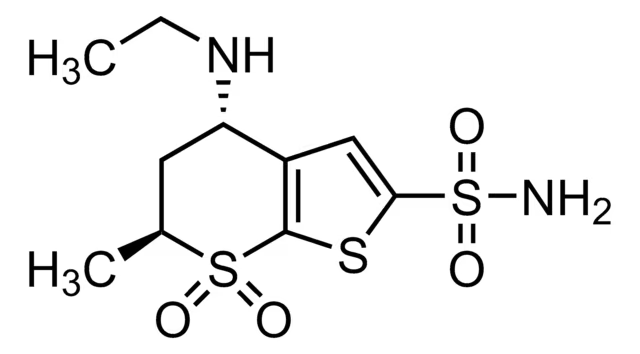
CAS Number120279-96-1
Synonyms(4S,6S)-4-(ethylamino)-6-methyl-7,7-dioxo-5,6-dihydro-4H-thieno[2,3-b]thiopyran-2-sulfonamide; (4S,6S)-4H-Thieno[2,3-b]thiopyran-2-sulfonamide (4-(ethylamino)-5,6-dihydro-6-methyl; Trusopt; MFCD00865636
Molecular FormulaC10H16N2O4S3
Molecular Weight324.44
Purity≥98 (HPLC)%
Density1.53 g/cm3
Boiling Point575.8ºC at 760 mmHg
Appearancepowder
Symbol
Signal WordWarning
| Chemical & Physical Properties | |
|---|---|
| CAS Number | 120279-96-1 |
| Catalog No. | 2A-0200605 |
| Chinese Name | 多佐胺 |
| Synonyms | (4S,6S)-4-(ethylamino)-6-methyl-7,7-dioxo-5,6-dihydro-4H-thieno[2,3-b]thiopyran-2-sulfonamide; (4S,6S)-4H-Thieno[2,3-b]thiopyran-2-sulfonamide (4-(ethylamino)-5,6-dihydro-6-methyl; Trusopt; MFCD00865636 |
| Molecular Formula | C10H16N2O4S3 |
| Molecular Weight | 324.44 |
| Purity | ≥98 (HPLC) |
| Density | 1.53 g/cm3 |
| Boiling Point | 575.8ºC at 760 mmHg |
| Appearance | powder |
| Storage Condition | room temp |
| Application | Dorzolamide (L671152; MK507) is a carbonic anhydrase (CA) inhibitor that can act on glaucoma. |
| PubChem ID | 329824746 |
| MDL Number | MFCD00865636 |
| SMILES | CCN[C@H]1C[C@H](C)S(=O)(=O)c2sc(cc12)S(N)(=O)=O |
| InChI | 1S/C10H16N2O4S3/c1-3-12-8-4-6(2)18(13,14)10-7(8)5-9(17-10)19(11,15)16/h5-6,8,12H,3-4H2,1-2H3,(H2,11,15,16)/t6-,8-/m0/s1 |
| InChI Key | IAVUPMFITXYVAF-XPUUQOCRSA-N |
| NACRES Code | NA.77 |
| UNSPSC | 12352200 |
| Hazard Symbols | Transport |
| MSDS | msds/10235_1_120279_96_1.pdf |
| Bioactivity | Dorzolamide(L671152; MK507) is an anti-glaucoma agent, which is a carbonic anhydrase inhibitor.Target: carbonic anhydrase (CA)Dorzolamide is a carbonic anhydrase inhibitor. It is an anti-glaucoma agent, and acts by decreasing the production of aqueous humour [1]. Glaucoma was induced in the right eye of adult Wistar rats by episcleral venous occlusion. One experimental group was administered dorzolamide 2%-timolol 0.5% combination eye drops, while the other experimental group was administered dorzolamide 2% eye drops. Control groups had surgery without drug administration. Drug application was initiated either 2 weeks before surgery (Group A), from the day of surgery (Group B), 2 weeks after surgery (Group C), or 4 weeks after surgery (Group D). RGCs were labeled by intratectal Fluorogold injections and counted from flat-mount preparations, and IOP was measured using Tonopen. Both dorzolamide-timolol combination and dorzolamide, when applied topically, significantly reduced IOP and improved RGC densities in experimental eyes when compared to control eyes. Earlier initiation, as well as longer duration of drug application, resulted in higher RGC densities [2].Clinical indications: Glaucoma; Ocular hypertensionFDA Approved Date: 1995Toxicity: Dizziness, headache, shortness of breath, slow heartbeat, severe asthma, cardiac arrest Related Catalog Signaling Pathways >> Metabolic Enzyme/Protease >> Carbonic Anhydrase Research Areas >> Others References [1]. Rankin AJ, et al. Effects of ocular administration of ophthalmic 2% dorzolamide hydrochloride solution on aqueous humor flow rate and intraocular pressure in clinically normal cats. Am J Vet Res. 2012 Jul;73(7):1074-8. [2]. Sarup V, et al. Dorzolamide and timolol saves retinal ganglion cells in glaucomatous adult rats. J Ocul Pharmacol Ther. 2005 Dec;21(6):454-62. Chemical & Physical Properties Density 1.53 g/cm3 Boiling Point 575.8ºC at 760 mmHg Molecular Formula C10H16N2O4S3 Molecular Weight 324.44 Flash Point 302ºC PSA 151.33000 LogP 4.66680 Index of Refraction 1.626 InChIKey IAVUPMFITXYVAF-XPUUQOCRSA-N SMILES CCNC1CC(C)S(=O)(=O)c2sc(S(N)(=O)=O)cc21 Storage condition room temp |
| Use of | Dorzolamide(L671152; MK507) is an anti-glaucoma agent, which is a carbonic anhydrase inhibitor.Target: carbonic anhydrase (CA)Dorzolamide is a carbonic anhydrase inhibitor. It is an anti-glaucoma agent, and acts by decreasing the production of aqueous humour [1]. Glaucoma was induced in the right eye of adult Wistar rats by episcleral venous occlusion. One experimental group was administered dorzolamide 2%-timolol 0.5% combination eye drops, while the other experimental group was administered dorzolamide 2% eye drops. Control groups had surgery without drug administration. Drug application was initiated either 2 weeks before surgery (Group A), from the day of surgery (Group B), 2 weeks after surgery (Group C), or 4 weeks after surgery (Group D). RGCs were labeled by intratectal Fluorogold injections and counted from flat-mount preparations, and IOP was measured using Tonopen. Both dorzolamide-timolol combination and dorzolamide, when applied topically, significantly reduced IOP and improved RGC densities in experimental eyes when compared to control eyes. Earlier initiation, as well as longer duration of drug application, resulted in higher RGC densities [2].Clinical indications: Glaucoma; Ocular hypertensionFDA Approved Date: 1995Toxicity: Dizziness, headache, shortness of breath, slow heartbeat, severe asthma, cardiac arrest Properties Name dorzolamide Synonym More Synonyms Dorzolamide Biological Activity Description Dorzolamide(L671152; MK507) is an anti-glaucoma agent, which is a carbonic anhydrase inhibitor.Target: carbonic anhydrase (CA)Dorzolamide is a carbonic anhydrase inhibitor. It is an anti-glaucoma agent, and acts by decreasing the production of aqueous humour [1]. Glaucoma was induced in the right eye of adult Wistar rats by episcleral venous occlusion. One experimental group was administered dorzolamide 2%-timolol 0.5% combination eye drops, while the other experimental group was administered dorzolamide 2% eye drops. Control groups had surgery without drug administration. Drug application was initiated either 2 weeks before surgery (Group A), from the day of surgery (Group B), 2 weeks after surgery (Group C), or 4 weeks after surgery (Group D). RGCs were labeled by intratectal Fluorogold injections and counted from flat-mount preparations, and IOP was measured using Tonopen. Both dorzolamide-timolol combination and dorzolamide, when applied topically, significantly reduced IOP and improved RGC densities in experimental eyes when compared to control eyes. Earlier initiation, as well as longer duration of drug application, resulted in higher RGC densities [2].Clinical indications: Glaucoma; Ocular hypertensionFDA Approved Date: 1995Toxicity: Dizziness, headache, shortness of breath, slow heartbeat, severe asthma, cardiac arrest Related Catalog Signaling Pathways >> Metabolic Enzyme/Protease >> Carbonic Anhydrase Research Areas >> Others References [1]. Rankin AJ, et al. Effects of ocular administration of ophthalmic 2% dorzolamide hydrochloride solution on aqueous humor flow rate and intraocular pressure in clinically normal cats. Am J Vet Res. 2012 Jul;73(7):1074-8. [2]. Sarup V, et al. Dorzolamide and timolol saves retinal ganglion cells in glaucomatous adult rats. J Ocul Pharmacol Ther. 2005 Dec;21(6):454-62. Chemical & Physical Properties Molecular Formula C10H16N2O4S3 PSA 151.33000 LogP 4.66680 Index of Refraction 1.626 InChIKey IAVUPMFITXYVAF-XPUUQOCRSA-N Storage condition room temp |
| Transport Info | Shipping Name: UN |
| MSDS Transport Info | Module 14. Shipping information 14.1 UN dangerous goods number European Land Transport Dangerous Regulations: -International Maritime Dangerous Regulations: -International Air Transport Dangerous Regulations: - 14.2 United Nations shipping name European Land Transport Dangerous Regulations: Non-dangerous goods IMDG Code: Non-dangerous goods International air transport dangerous goods regulations: non-dangerous goods 14.3 Transport hazard categories European Land Transport Dangerous Regulations: -International Maritime Dangerous Regulations: -International Air Transport Dangerous Regulations: - 14.4 Package group European Land Transport Dangerous Regulations: -International Maritime Dangerous Regulations: -International Air Transport Dangerous Regulations: - 14.5 Environmental hazards European Land Transport Danger Regulations: No International Maritime Danger Regulations International Air Transport Danger Regulations: No Marine pollutants (yes/no): No 14.6 Special reminder to users No data available |
| Related Products in Specialty Chemicals | ||
|---|---|---|
| Domazoline | 6043-01-2 | 2A-9010224 |
| Domiphen bromide | 538-71-6 | 2A-9010225 |
| Donaxine;Gramine | 87-52-5 | 2A-9010226 |
| Doramectin | 117704-25-3 | 2A-9010232 |
| Doretinel | 104561-36-6 | 2A-9010233 |
| Dorzolamide HCl | 130693-82-2 | 2A-9010236 |
| Dotarizine | 84625-59-2 | 2A-9010238 |
| Dothiepin hydrochloride | 897-15-4 | 2A-9010239 |
| Doxaminol | 55286-56-1 | 2A-9010240 |
| Doxapram HCl | 7081-53-0 | 2A-9010241 |
| Browse all Specialty Chemicals products » | ||
Phone:
630-322-8886
630-322-8887
Email:
Office Locations:
Chicago, IL, USA
San Francisco, CA, USA


 EN
EN


 SDS
SDS