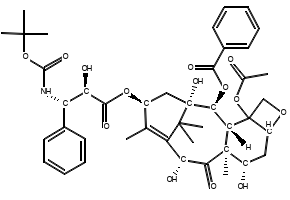
CAS Number114977-28-5
SynonymsD-2-amino-5-phosphonovaleric acid; APV; AP-5; DL-APV; MFCD00800737; DOCETAXEL TRIHYDRATE; Docetaxol; 5-PHOSPHONO-DL-NORVALINE; Taxotere; DL-2-amino-5-phosphonovaleric acid; DOCETAXEL(TAXOTERE); N-Debenzoyl-N-tert-butoxycarbonyl-10-deacetyltaxol; Docetaxel; N-DEBENZOYL-N-TERT-BUTOXYCARBONYL-10-DEACETYL; DOCETAXEL(TAXOTERE) UK 427857; N-debenzoyl-N-Boc-10-deacetyl taxol; TAXOTERE, DOCETAXEL; 2-amino-5-phosphopentanoicacid; N-debenzoyl-N-tert-butoxycarbonyl-10-deacetyl taxol; 2-amino-5-phosphonovaleric acid; 2-amino-5-phosphovaleric acid
Molecular FormulaC43H53NO14
Molecular Weight807.879
Purity99%
Density1.4±0.1 g/cm3
Boiling Point900.5±65.0 °C at 760 mmHg
Melting Point186-192 °C (dec.)
Appearanceoff-white crystal
Symbol
Signal WordWarning
| Chemical & Physical Properties | |
|---|---|
| CAS Number | 114977-28-5 |
| Catalog No. | 2A-9010215 |
| Chinese Name | 多烯紫杉醇;多西他赛 |
| Synonyms | D-2-amino-5-phosphonovaleric acid; APV; AP-5; DL-APV; MFCD00800737; DOCETAXEL TRIHYDRATE; Docetaxol; 5-PHOSPHONO-DL-NORVALINE; Taxotere; DL-2-amino-5-phosphonovaleric acid; DOCETAXEL(TAXOTERE); N-Debenzoyl-N-tert-butoxycarbonyl-10-deacetyltaxol; Docetaxel; N-DEBENZOYL-N-TERT-BUTOXYCARBONYL-10-DEACETYL; DOCETAXEL(TAXOTERE) UK 427857; N-debenzoyl-N-Boc-10-deacetyl taxol; TAXOTERE, DOCETAXEL; 2-amino-5-phosphopentanoicacid; N-debenzoyl-N-tert-butoxycarbonyl-10-deacetyl taxol; 2-amino-5-phosphonovaleric acid; 2-amino-5-phosphovaleric acid |
| Molecular Formula | C43H53NO14 |
| Molecular Weight | 807.879 |
| Purity | 99 |
| Density | 1.4±0.1 g/cm3 |
| Boiling Point | 900.5±65.0 °C at 760 mmHg |
| Melting Point | 186-192 °C (dec.) |
| Appearance | off-white crystal |
| Storage Condition | Sealed and stored in a cool, dry warehouse. |
| Packaging | III |
| Application | Docetaxel is an anti-tumor drug whose main mechanism of action is to inhibit microtubule depolymerization and weaken the expression of Bcl-2 and Bcl-xL genes. |
| HTC | 2932999099 |
| SMILES | CC(=O)OC12COC1CC(O)C1(C)C(=O)C(O)C3=C(C)C(OC(=O)C(O)C(NC(=O)OC(C)(C)C)c4ccccc4)CC(O)(C(OC(=O)c4ccccc4)C21)C3(C)C |
| InChI | InChI=1S/C43H53NO14/c1-22-26(55-37(51)32(48)30(24-15-11-9-12-16-24)44-38(52)58-39(3,4)5)20-43(53)35(56-36(50)25-17-13-10-14-18-25)33-41(8,34(49)31(47)29(22)40(43,6)7)27(46)19-28-42(33,21-54-28)57-23(2)45/h9-18,26-28,30-33,35,46-48,53H,19-21H2,1-8H3,(H,44,52)/t26-,27-,28+,30-,31+,32+,33-,35-,41+,42-,43+/m0/s1 |
| InChI Key | ZDZOTLJHXYCWBA-VCVYQWHSSA-N |
| Hazard Symbols | 6.1(b) |
| MSDS | msds/10215_1_114977_28_5.pdf |
| Bioactivity | Docetaxel is an antineoplastic drug by inhibiting microtubule depolymerization, and attenuating of the effects of bcl-2 and bcl-xL gene expression. Related Catalog Signaling Pathways >> Cell Cycle/DNA Damage >> Microtubule/Tubulin Signaling Pathways >> Cytoskeleton >> Microtubule/Tubulin Research Areas >> Cancer Natural Products >> Terpenoids and Glycosides Target Microtubule[1] In Vitro Docetaxel (DOC) and Glufosfamide (GLU) single and combined treatments affect the cells viability in a dose-dependent manner. The IC50 of GLU are 70±4 µM and 86.8±8 µM in PC-3 and LNCaP cells; respectively. While, the IC50 of Docetaxel alone is found to be 3.08±0.4 nM and 1.46±0.2 nM in PC-3 and LNCaP cells; respectively. The co-treatment of GLU with Docetaxel is found to synergize the cytotoxicity and the IC50 values are decreased to be 2.7±0.1 nM and 0.75±0.3 nM in PC-3 and LNCaP cells; respectively[1]. IC50 of NCI-H460 to Docetaxel at 24 h is 116 nM and at 72 h is 30 nM. According to data reported in DTP Data Search, the mean IC50 of NCI-60 cell panel to Docetaxel is 14-34 nM[2]. In Vivo In female mice, the Docetaxel-induced intestinal apoptosis in the 14-hours after light on (HALO) group is significantly greater than that in the 2-HALO group. Bax expression is significantly elevated by Docetaxel in the 2-HALO group, but not in the 14-HALO group. On the other hand, cleaved Caspase-3 expression is significantly elevated by Docetaxel in the 14-HALO group, but not in the 2-HALO group. The expressions of Wee1 and phosphorylated CKD1 are significantly elevated after dosing of Docetaxel at 14 HALO, but not at 2 HALO. In addition, Docetaxel significantly reduces survivin expression in the 14-HALO group but not in the 2-HALO group. The survivin expression level in the Docetaxel-treated 14-HALO group is significantly smaller than that in the drug-treated 2-HALO group[3]. Piperine (PIP) is administrated via intravenous bolus at 3.5 mg/kg and via oral administration at 35 mg/kg and 3.5 mg/kg, while Docetaxel (DOX) is intravenously administrated at 7 mg/kg to Sprague-Daley rats. The co-administrations of PIP at 35 mg/kg via oral administration and Docetaxel at 7 mg/kg via intravenous bolus administration in Sprague-Dawley rats. The combination use of PIP and Docetaxel results in a synergic increase of both their in vivo exposure[4]. Cell Assay Single-drug concentration-response curves are assessed. Seeding is done at a density of 2,000 cells/well for PC-3 and LNCaP, in 96-well plates. Cells are treated with each single drug and their combination for 72 h at different drug concentrations. Docetaxel is used at concentrations of 0.1-1,000 nM. GLU is used at concentrations of 0.1-300 µm. Cytotoxicity is assessed at the end of drug exposure using SRB assay. Following 72 h exposure the cells are fixed with 10% trichloroacetic acid (150 µL) for 1 h at 4°C. Then, cells are stained for 10 min at room temperature with 0.4% SRB dissolved in 1% acetic acid. The plates are then air dried for 24 h and the dye is made soluble with 150 µL Tris (10 mM, PH 7.4) for 5 min on a shaker at 1,600 rpm. Absorbance is then measured at 545 nM using microplate reader. Results are expressed as the relative percentage of absorbance compared to control[1]. Animal Admin Mice[3] Five-week-old male Balb/c mice are used. Docetaxel (0, 10, 20, 30, 40, 60, and 80 mg/kg per week) is given once a week for 3 weeks for mice. Because more than 30 mg/kg per week of Docetaxel causes body weight loss in mice, 20 mg/kg per week of Docetaxel is judged to be the maximum nontoxic dose. Docetaxel (20 mg/kg per week) is given to mice once a week for 3 weeks at one of the following different points (2, 10, 14, or 22 HALO). Seventy-two hours after the final dosing of the agent, the intestinal mucosa of the small intestine (proximal 8 cm) is removed, fixed in 20 N Mildform solution (containing 8% formaldehyde in a buffered solution), and embedded in paraffin blocks, and sections of 5 μm are put on glass slides. Apoptosis is detected using the terminal deoxynucleotidyl transferase-mediated dUTP nick-end labeling (TUNEL) method, using the Apop Tag Peroxidase In Situ Apoptosis Detection Kit. Rats[4] Male Sprague-Dawley rats with body weight between 230-250 g and age between 6-7 weeks are used. About 25 SD rats are divided into five groups receiving Docetaxel (7 mg/kg, i.v.), PIP (35 mg/kg, p.o.) and their combined administration (DOX+PIP) as well as PIP (3.5 mg/kg, p.o.) and PIP (3.5 mg/kg, i.v.). A day before the drug administrations, the rats are anesthetized with an intramuscular injection of a cocktail containing 60 mg/kg ketamine and 6 mg/kg xylazine (injection volume, 0.2 mL). Right jugular vein is cannulated with a polyethylene tubing (0.5 mm ID, 1 mm) for blood collection. References [1]. Attia RT, et al. The chemomodulatory effects of glufosfamide on docetaxel cytotoxicity in prostate cancer cells. PeerJ. 2016 Jun 29;4:e2168. [2]. Che CL, et al. DNA microarray reveals different pathways responding to paclitaxel and docetaxel in non-small cell lung cancer cell line. Int J Clin Exp Pathol. 2013 Jul 15;6(8):1538-48. [3]. Obi-Ioka Y, et al. Involvement of Wee1 in the circadian rhythm dependent intestinal damage induced by docetaxel. J Pharmacol Exp Ther. 2013 Oct;347(1):242-8. [4]. Li C, et al. Non-linear pharmacokinetics of piperine and its herb-drug interactions with docetaxel in Sprague-Dawley rats. J Pharm Biomed Anal. 2016 Sep 5;128:286-93. Chemical & Physical Properties Density 1.4±0.1 g/cm3 Boiling Point 900.5±65.0 °C at 760 mmHg Melting Point 186-192 °C (dec.) Molecular Formula C43H53NO14 Molecular Weight 807.879 Flash Point 498.4±34.3 °C Exact Mass 807.346619 PSA 224.45000 LogP 6.55 Vapour Pressure 0.0±0.3 mmHg at 25°C Index of Refraction 1.618 InChIKey ZDZOTLJHXYCWBA-VCVYQWHSSA-N SMILES CC(=O)OC12COC1CC(O)C1(C)C(=O)C(O)C3=C(C)C(OC(=O)C(O)C(NC(=O)OC(C)(C)C)c4ccccc4)CC(O)(C(OC(=O)c4ccccc4)C21)C3(C)C Storage condition 2~8°C |
| Use of | Docetaxel is an antineoplastic drug by inhibiting microtubule depolymerization, and attenuating of the effects of bcl-2 and bcl-xL gene expression. Properties Articles224 Name docetaxel anhydrous Synonym More Synonyms Docetaxel Biological Activity Description Docetaxel is an antineoplastic drug by inhibiting microtubule depolymerization, and attenuating of the effects of bcl-2 and bcl-xL gene expression. Related Catalog Signaling Pathways >> Cell Cycle/DNA Damage >> Microtubule/Tubulin Signaling Pathways >> Cytoskeleton >> Microtubule/Tubulin Research Areas >> Cancer Natural Products >> Terpenoids and Glycosides Microtubule[1] References [1]. Attia RT, et al. The chemomodulatory effects of glufosfamide on docetaxel cytotoxicity in prostate cancer cells. PeerJ. 2016 Jun 29;4:e2168. [2]. Che CL, et al. DNA microarray reveals different pathways responding to paclitaxel and docetaxel in non-small cell lung cancer cell line. Int J Clin Exp Pathol. 2013 Jul 15;6(8):1538-48. [3]. Obi-Ioka Y, et al. Involvement of Wee1 in the circadian rhythm dependent intestinal damage induced by docetaxel. J Pharmacol Exp Ther. 2013 Oct;347(1):242-8. [4]. Li C, et al. Non-linear pharmacokinetics of piperine and its herb-drug interactions with docetaxel in Sprague-Dawley rats. J Pharm Biomed Anal. 2016 Sep 5;128:286-93. Chemical & Physical Properties Molecular Formula C43H53NO14 Exact Mass 807.346619 PSA 224.45000 Index of Refraction 1.618 InChIKey ZDZOTLJHXYCWBA-VCVYQWHSSA-N |
| Tax Rebate | 13.0% |
| Supervision | None. MFN tariff: 6.5%. Ordinary tariff: 20.0% |
| Transport Info | Product name: Purity: 99.0% |
| MSDS Transport Info | Module 14. Shipping information United Nations classification: inconsistent with United Nations classification standards UN number: not specified |
| Related Products in API & Advanced Intermediates | ||
|---|---|---|
| Dihydroartemisinin | 81496-81-3 | 2A-9010150 |
| Dihydroartemisinin | 71939-50-9 | 2A-9010151 |
| Dihydromorphine | 509-60-4 | 2A-9010158 |
| Diltiazem hydrochloride | 33286-22-5 | 2A-9010165 |
| Naproxen | 22204-53-1 | 2A-9010213 |
| Donepezil hydrochloride | 120014-06-4 | 2A-9010227 |
| Donepezil Hydrochloride | 120011-70-3 | 2A-9010228 |
| Doripenem | 148016-81-3 | 2A-9010234 |
| Doxycycline hyclate | 24390-14-5 | 2A-9010246 |
| Doxycycline hydrate | 564-25-0 | 2A-9010247 |
| Browse all API & Advanced Intermediates products » | ||
Phone:
630-322-8886
630-322-8887
Email:
Office Locations:
Chicago, IL, USA
San Francisco, CA, USA


 EN
EN


 SDS
SDS