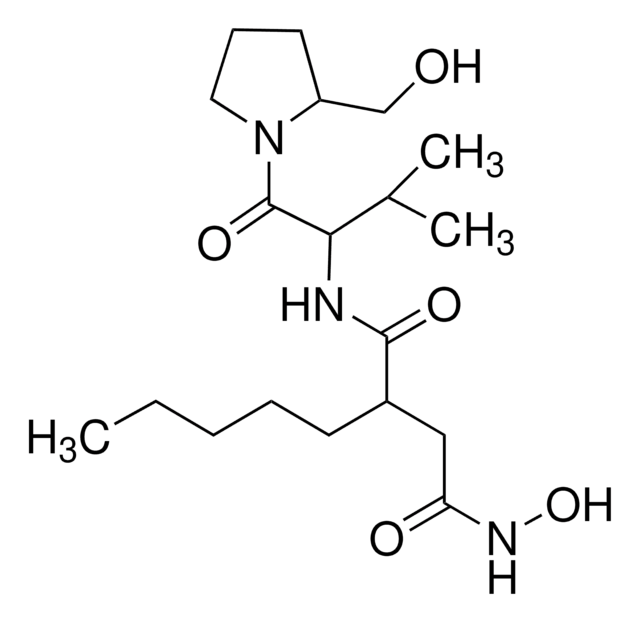
| Chemical & Physical Properties | |
|---|---|
| CAS Number | 13434-13-4 |
| Catalog No. | 2A-0100321 |
| Chinese Name | (R)-N4- 羟基-N1-((S)-1-((S)-2-(羟甲基)吡咯烷-1-基)-3-甲基-1-氧代丁-2-基)-2-戊基琥珀酰胺 |
| Synonyms | Actinonine; MFCD00080257; hylpropyl)carbamoyl) |
| Molecular Formula | C19H35N3O5 |
| Molecular Weight | 385.50 |
| Purity | ≥98 (TLC) |
| Density | 1.1±0.1 g/cm3 |
| Melting Point | 137-139ºC |
| Appearance | powder |
| Storage Condition | Sealed in a cool, dry environment at -20 ºC |
| Application | Actinonin ((-)-Actinonin) is a natural antibacterial agent produced by actinomycetes. Actinonin inhibits aminopeptidase M, aminopeptidase N and leucine aminopeptidase. Actinonin is a potent, reversibl |
| EINECS | 0 |
| HTC | 0 |
| UN(IATA) | 0 |
| PubChem ID | 24278232 |
| MDL Number | MFCD00080257 |
| SMILES | CCCCCC(CC(=O)NO)C(=O)NC(C(C)C)C(=O)N1CCCC1CO |
| InChI | 1S/C19H35N3O5/c1-4-5-6-8-14(11-16(24)21-27)18(25)20-17(13(2)3)19(26)22-10-7-9-15(22)12-23/h13-15,17,23,27H,4-12H2,1-3H3,(H,20,25)(H,21,24) |
| InChI Key | XJLATMLVMSFZBN-UHFFFAOYSA-N |
| Beilstein/REAXYS | 1555250 |
| NACRES Code | NA.77 |
| UNSPSC | 12352200 |
| Hazard Symbols | transportation |
| MSDS | msds/100321_1_13434_13_4.pdf |
| Bioactivity | Actinonin ((-)-Actinonin) is a naturally occurring antibacterial agent produced by Actinomyces. Actinonin inhibits aminopeptidase M, aminopeptidase N and leucine aminopeptidase. Actinonin is a potent reversible peptide deformylase (PDF) inhibitor with a Ki of 0.28 nM. Actinonin also inhibits MMP-1, MMP-3, MMP-8, MMP-9, and hmeprin α with Ki values of 300 nM, 1,700 nM, 190 nM, 330 nM, and 20 nM, respectively. Actinonin is an apoptosis inducer. Actinonin has antiproliferative and antitumor activities[1][2][3][4][5]. Related Catalog Signaling Pathways >> Apoptosis >> Apoptosis Research Areas >> Cancer Research Areas >> Infection Signaling Pathways >> Metabolic Enzyme/Protease >> Aminopeptidase Signaling Pathways >> Metabolic Enzyme/Protease >> MMP Signaling Pathways >> Anti-infection >> Bacterial Target Ki: 0.28 nM (Peptide deformylase (PDF))[2], 300 nM (MMP-1), 1,700 nM (MMP-3), 190 nM (MMP-8), 330 nM (MMP-9)[3], and 20 nM (hmeprin α)[5] Apoptosis[1] Aminopeptidase M, Aminopeptidase N and Leucine aminopeptidase[1] In Vitro Actinonin inhibits cell growth in various human tumor cell lines. The IC50 of 4, 6.9, 12.8, 16.6, 27.4, 15.7 and 49.3 μM for Raji cells, MDA-MB-468 cells,PC3 cells, SK-LC-19 cells, Hela cells, HT-1080 cells and AL67 cells, respectively[1]. HsPDF is a critical target of actinonin and that the inhibition of this protein in the mitochondria leads to cell death in tumor cells. Actinonin treatment of cells led to a tumor-specific mitochondrial membrane depolarization and ATP depletion in a time- and dose-dependent manner[1]. Actinonin is a potent inhibitor of all three forms (Zn-, Ni-, and Fe-) of peptide deformylases from both S. aureus and E. coli bacteria. Under the assay conditions, the IC50 values for Actinonin are 90, 3, 0.8, and 11 nM for Zn-PDF (E. coli), Ni-PDF (E. coli), Fe-PDF (E. coli), and Ni-PDF (S. aureus), respectively[2]. Actinonin is active against Gram-positive bacteria, including S. aureus (MIC value of 8-16 µg/mL), Streptococcus pyogenes (MIC value of 8 µg/mL) and Streptococcus epidermidis (MIC value of 2-4 µg/mL). Actinonin is also active against fastidious Gramne-gative bacteria, such as H. influenzae (MIC value of 1-2 µg/mL), Moraxella catarrhalis (MIC value of 0.5 µg/mL), and Neisseria gonorrheae (MIC value of 1-4 µg/mL). Actinonin is very active against the H. influenzae acr (MIC value of 0.13 µg/mL) and E. coli acr (MIC value of 0.25 µg/mL) efflux pump mutants[2]. In Vivo Actinonin has been safely administered to mice as an antibiotic at doses up to 400 mg/kg. Actinonin does not appear to have significant toxicity to normal tissues, despite its antitumor activity in vitro. Remarkably, Actinonin exhibits significant antitumor activity when given i.p. or orally in a CWR22 human prostate tumor xenograft model in nude mice. During treatment, the animals show no signs of toxicity[1]. References [1]. Lee MD, et al. Human mitochondrial peptide deformylase, a new anticancer target of actinonin-based antibiotics. J Clin Invest. 2004 Oct;114(8):1107-16. [2]. Chen DZ, et al. Actinonin, a naturally occurring antibacterial agent, is a potent deformylase inhibitor. Biochemistry. 2000 Feb 15;39(6):1256-62. [3]. Wahl, R.C., et al. Hydroxamate inhibitors of human gelatinase B (92 kDa). Bioorganic & Medicinal Chemistry Letters 5(4), 349-352 (1995). [4]. Duke SO, et al. Modes of action of microbially-produced phytotoxins. Toxins (Basel). 2011 Aug;3(8):1038-64. [5]. Kruse MN, et al. Human meprin alpha and beta homo-oligomers: cleavage of basement membrane proteins and sensitivity to metalloprotease inhibitors. Biochem J. 2004 Mar 1;378(Pt 2):383-9. Chemical & Physical Properties Density 1.1±0.1 g/cm3 Melting Point 137-139ºC Molecular Formula C19H35N3O5 Molecular Weight 385.498 Exact Mass 385.257660 PSA 118.97000 LogP 0.59 Index of Refraction 1.513 InChIKey XJLATMLVMSFZBN-UHFFFAOYSA-N SMILES CCCCCC(CC(=O)NO)C(=O)NC(C(=O)N1CCCC1CO)C(C)C Storage condition −20°C |
| Use of | Actinonin ((-)-Actinonin) is a naturally occurring antibacterial agent produced by Actinomyces. Actinonin inhibits aminopeptidase M, aminopeptidase N and leucine aminopeptidase. Actinonin is a potent reversible peptide deformylase (PDF) inhibitor with a Ki of 0.28 nM. Actinonin also inhibits MMP-1, MMP-3, MMP-8, MMP-9, and hmeprin α with Ki values of 300 nM, 1,700 nM, 190 nM, 330 nM, and 20 nM, respectively. Actinonin is an apoptosis inducer. Actinonin has antiproliferative and antitumor activities[1][2][3][4][5]. Properties Articles30 Name actinonin Synonym More Synonyms ACTINONIN Biological Activity Description Actinonin ((-)-Actinonin) is a naturally occurring antibacterial agent produced by Actinomyces. Actinonin inhibits aminopeptidase M, aminopeptidase N and leucine aminopeptidase. Actinonin is a potent reversible peptide deformylase (PDF) inhibitor with a Ki of 0.28 nM. Actinonin also inhibits MMP-1, MMP-3, MMP-8, MMP-9, and hmeprin α with Ki values of 300 nM, 1,700 nM, 190 nM, 330 nM, and 20 nM, respectively. Actinonin is an apoptosis inducer. Actinonin has antiproliferative and antitumor activities[1][2][3][4][5]. Related Catalog Signaling Pathways >> Apoptosis >> Apoptosis Research Areas >> Cancer Research Areas >> Infection Signaling Pathways >> Metabolic Enzyme/Protease >> Aminopeptidase Signaling Pathways >> Metabolic Enzyme/Protease >> MMP Signaling Pathways >> Anti-infection >> Bacterial Ki: 0.28 nM (Peptide deformylase (PDF))[2], 300 nM (MMP-1), 1,700 nM (MMP-3), 190 nM (MMP-8), 330 nM (MMP-9)[3], and 20 nM (hmeprin α)[5] Apoptosis[1] Aminopeptidase M, Aminopeptidase N and Leucine aminopeptidase[1] References [1]. Lee MD, et al. Human mitochondrial peptide deformylase, a new anticancer target of actinonin-based antibiotics. J Clin Invest. 2004 Oct;114(8):1107-16. [2]. Chen DZ, et al. Actinonin, a naturally occurring antibacterial agent, is a potent deformylase inhibitor. Biochemistry. 2000 Feb 15;39(6):1256-62. [3]. Wahl, R.C., et al. Hydroxamate inhibitors of human gelatinase B (92 kDa). Bioorganic & Medicinal Chemistry Letters 5(4), 349-352 (1995). [4]. Duke SO, et al. Modes of action of microbially-produced phytotoxins. Toxins (Basel). 2011 Aug;3(8):1038-64. [5]. Kruse MN, et al. Human meprin alpha and beta homo-oligomers: cleavage of basement membrane proteins and sensitivity to metalloprotease inhibitors. Biochem J. 2004 Mar 1;378(Pt 2):383-9. Chemical & Physical Properties Molecular Formula C19H35N3O5 Exact Mass 385.257660 PSA 118.97000 Index of Refraction 1.513 InChIKey XJLATMLVMSFZBN-UHFFFAOYSA-N |
| Transport Info | Product name: Purity: 98.0% |
| MSDS Transport Info | Module 14. Shipping information 14.1 UN number European Land Transport Dangerous Regulations: -International Maritime Dangerous Regulations: -International Air Transport Dangerous Regulations: - 14.2 Names specified by the United Nations (UN) European Land Transport Dangerous Regulations: No dangerous goods IMDG Code: No dangerous goods International Air Transport Dangerous Regulations: No dangerous goods 14.3 Transport hazard categories European Land Transport Dangerous Regulations: -International Maritime Dangerous Regulations: -International Air Transport Dangerous Regulations: - 14.4 Package group European Land Transport Dangerous Regulations: -International Maritime Dangerous Regulations: -International Air Transport Dangerous Regulations: - 14.5 Environmental hazards European Land Transport Dangerous Regulations: No International Maritime Transport Dangerous Regulations Maritime Pollutants: No International Air Transport Risk Regulations: No 14.6 Special reminder to users No data available |
| Related Products in Pharmaceutical Intermediates | ||
|---|---|---|
| (R)-N-METHYL-1,2,3,4-TETRAHYDRONAPHTHALEN-1-AMINE | 114419-88-4 | 2A-1100313 |
| (R)-N-METHYL-1,2,3,4-TETRAHYDROQUINOLIN-3-AMINE | 166742-75-2 | 2A-0100314 |
| (R)-N-METHYL-1-PHENYL-2-(PYRROLIDIN-1-YL)ETHANAMINE | 136329-39-0 | 2A-0100315 |
| (R)-N-METHYL-2-PYRROLIDIN-1-YLMETHYL-PYRROLIDINE | 76411-80-8 | 2A-0100316 |
| (R)-N-METHYL-N-(PROP-2-YN-1-YL)-2,3-DIHYDRO-1H-INDEN-1-AMINE | 124192-87-6 | 2A-0100319 |
| (R)-N6-PROPYL-4,5,6,7-TETRAHYDROBENZO[D]THIAZOLE-2,6-DIAMINE | 104632-28-2 | 2A-0100322 |
| (R)-O-((2,2-DIMETHYL-1,3-DIOXOLAN-4-YL)METHYL)HYDROXYLAMINE HYDROCHLORIDE | 114778-50-6 | 2A-0100323 |
| (R)-OCTAN-2-YL 4-((4-(HEXYLOXY)BENZOYL)OXY)BENZOATE | 133676-09-2 | 2A-0100325 |
| (R)-PIPERAZIN-2-YLMETHANOL DIHYDROCHLORIDE | 1217482-26-2 | 2A-0100329 |
| (R)-PIPERIDIN-2-YLMETHANOL | 3197-44-2 | 2A-0100331 |
| Browse all Pharmaceutical Intermediates products » | ||
Phone:
630-322-8886
630-322-8887
Email:
Office Locations:
Chicago, IL, USA
San Francisco, CA, USA


 EN
EN


 SDS
SDS