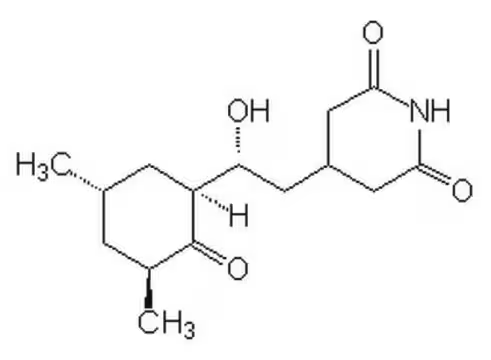
CAS Number66-81-9
Synonyms4-[2-(3,5-dimethyl-2-oxocyclohexyl)-2-hydroxyethyl]glutarimide; 4-{(2R)-2-[(1S,3S,5S)-3,5-dimethyl-2-oxocyclohexyl]-2-hydroxyethyl}piperidine-2,6-dione; Acti-Aid; Actidion; ACTIDIONE; NARAMYCIN A; Actidone; cyclohexamide; MFCD06202064; Hizarocin; cycloheximide; Kaken; 4-[(2R)-2-[(1S,3S,5S)-3,5-dimethyl-2-oxocyclohexyl]-2-hydroxyethyl]-2,6-piperidinedione; EINECS 200-636-0; Cicloheximide; 4-[(2R)-2-[(1S,3S,5S)-3,5-dimethyl-2-oxocyclohexyl]-2-hydroxyethyl]piperidine-2,6-dione
Molecular FormulaC15H23NO4
Molecular Weight281.35
Purity≥90 (by assay)%
Density1.1±0.1 g/cm3
Boiling Point491.8±10.0 °C at 760 mmHg
Melting Point111-116 °C
Appearancepowder
Symbol
Signal WordWarning


Please Login or Create an Account to: See VlP prices and availability
US Stock: ship in 0-1 business day
Global Stock: ship in 5-7 days
| Chemical & Physical Properties | |
|---|---|
| CAS Number | 66-81-9 |
| Catalog No. | 2A-9009946 |
| Chinese Name | 放线菌酮 |
| Synonyms | 4-[2-(3,5-dimethyl-2-oxocyclohexyl)-2-hydroxyethyl]glutarimide; 4-{(2R)-2-[(1S,3S,5S)-3,5-dimethyl-2-oxocyclohexyl]-2-hydroxyethyl}piperidine-2,6-dione; Acti-Aid; Actidion; ACTIDIONE; NARAMYCIN A; Actidone; cyclohexamide; MFCD06202064; Hizarocin; cycloheximide; Kaken; 4-[(2R)-2-[(1S,3S,5S)-3,5-dimethyl-2-oxocyclohexyl]-2-hydroxyethyl]-2,6-piperidinedione; EINECS 200-636-0; Cicloheximide; 4-[(2R)-2-[(1S,3S,5S)-3,5-dimethyl-2-oxocyclohexyl]-2-hydroxyethyl]piperidine-2,6-dione |
| Molecular Formula | C15H23NO4 |
| Molecular Weight | 281.35 |
| Purity | ≥90 (by assay) |
| Density | 1.1±0.1 g/cm3 |
| Boiling Point | 491.8±10.0 °C at 760 mmHg |
| Melting Point | 111-116 °C |
| Appearance | powder |
| Water Solubility | 2.1 g/100 mL (2 ºC) |
| Storage Condition | Store sealed and dry at 0-4ºC. |
| Packaging | II |
| Application | Cycloheximide (Naramycin A) is an inhibitor of eukaryotic protein synthesis. The IC50 values for inhibiting protein synthesis and RNA synthesis in vivo are 532.5 nM and 2880 nM respectively. |
| HTC | 29419000 |
| MDL Number | MFCD00082346 |
| SMILES | N1C(=O)CC(CC1=O)C[C@@H](O)[C@@H]2C[C@H](C[C@@H](C2=O)C)C |
| InChI | 1S/C15H23NO4/c1-8-3-9(2)15(20)11(4-8)12(17)5-10-6-13(18)16-14(19)7-10/h8-12,17H,3-7H2,1-2H3,(H,16,18,19)/t8-,9-,11-,12+/m0/s1 |
| InChI Key | YPHMISFOHDHNIV-FSZOTQKASA-N |
| NACRES Code | NA.77 |
| UNSPSC | 12352111 |
| Hazard Symbols | 6.1(a) |
| MSDS | msds/9946_1_66_81_9.pdf |
| Bioactivity | Cycloheximide (Naramycin A) is an eukaryote protein synthesis inhibitor, with IC50s of 532.5 nM and 2880 nM for protein synthesis and RNA synthesis in vivo, respectively. Related Catalog Signaling Pathways >> Autophagy >> Autophagy Signaling Pathways >> Cell Cycle/DNA Damage >> DNA/RNA Synthesis Signaling Pathways >> Anti-infection >> Fungal Research Areas >> Infection Natural Products >> Others Target IC50: 532.5 nM (protein synthesis), 2.88 μM (RNA synthesis)[1] In Vitro Cycloheximide (CHX) is the most common laboratory reagent used to inhibit protein synthesis. Cycloheximide has been shown to block the elongation phase of eukaryotic translation. Cycloheximide binds the ribosome and inhibits eEF2-mediated translocation. Surprisingly, Cycloheximide allows one complete translocation cycle to proceed before halting any further elongation. Cycloheximide has been speculated that Cycloheximide requires an E-site bound deacylated tRNA for activity[1]. In Vivo The mice receive Cycloheximide injections at 30, 60, or 120 mg/kg prior to training with a 200 µA shock. There is a significant effect of Cycloheximide on latencies on the memory test trials (P<0.001). In saline controls, this shock level results in latencies on the test trial that are significantly higher than those at training. Injections of the lowest dose of Cycloheximide tested, 30 mg/kg, results in latencies on the test trial that are significantly higher than those seen in the saline control group. Mice receiving either of the two higher doses of Cycloheximide has latencies on the test trial that are comparable to those of the saline group, i.e., the higher doses neither enhanced nor impaired memory under these conditions, resulting in an inverted-U dose-response curve for Cycloheximide enhancement of memory[2]. Infarct volume, as measured by morphometric analysis of infarct areas with triphenyl tetrazolium chloride (TTC), is significantly reduced by 92% and 61% when Cycloheximide is given 0 or 6 hr after HI respectively, but shows an insignificant trend in infarct reduction if Cycloheximide is administered 12 hr after hypoxia-ischemia (HI) compared to the HI control group, and no protective effect is observed when administration is delayed until 24 hr after HI[3]. Cell Assay To test cell proliferation, 3000-5000 cells (HeLa, HTB1 and HEK 293T cells; Jurkat, BT 474, HCC 1395, HCC 1937, HCC 2218 and MDA MB231 cells; MCF 10A) per well are plated in a 96-well plate and allowed to adhere overnight. Cycloheximide dissolved in DMSO at the indicated concentrations (0.1 nM-1000μM) are then added and cells are incubated for a further 24 h. [3H]-thymidine is added at 1 μCi per well and incubation is continued for an additional 7 h. Cells are washed twice with PBS and then trypsinized before they are collected with a Tomtec harvester and bound to GF/C filter mats. Thymidine uptake is then measured by scintillation counting[1]. Animal Admin Mice[2] Male ICR mice (approximately 2 months old) are used in this experiment. Cycloheximide is administered IP at concentrations of 0 (saline controls), 30, 60, or 120 mg/kg. Cycloheximide injections are administered 30 min prior to training. The 120 mg/kg dose is commonly used to study amnesia in mice. Note that amnestic Cycloheximide doses are much lower in rats (1-3 mg/kg) than in mice, consistent with a similar difference in LD50s for rats and mice. Cycloheximide doses of 120-150 mg/kg result in approximately 95% inhibition of brain protein synthesis as measured 30-60 min after injection; the dose of 30 mg/kg produces approximately 80% inhibition of brain protein synthesis. Rats[3] Unilateral carotid artery ligation is performed in 7-day old Sprague Dawley rat pups under methoxyflurane anesthesia. The neck is incised in the midline, and the right common carotid artery is permanently ligated with 4-0 silk. Total time of surgery in each animal never exceeded 5 min. Following surgery, rats are returned to their mother for recovery and feeding for 2 hr. The pups are then exposed to a 100 min-period of hypoxia (8% O2, 92% N2) by placing them in an airtight chamber partially submerged in a temperature controlled water bath to maintain the ambient temperature inside the chamber at a constant 36°C. In the HI with Cycloheximide treatment group, the rat pups receive an intraperitoneal injection of Cycloheximide at a dose of 0.6 mg/kg at 0, 6, 12 or 24 hr of recovery, and an equal volume of normal saline is given to a HI control group. Then, the rat pups are returned to their dam until sacrifice; the whole brain tissue is obtained under deep pentobarbital anesthesia (60 mg/kg, intraperitoneal) for flow cytometry and triphenyl tetrazolium chloride (TTC) at 48 and 72 hr after HI, respectively. References [1]. Schneider-Poetsch T, et al. Inhibition of eukaryotic translation elongation by cycloheximide and lactimidomycin. Nat Chem Biol. 2010 Mar;6(3):209-217. [2]. Gold PE, et al. Cycloheximide impairs and enhances memory depending on dose and footshock intensity. Behav Brain Res. 2012 Aug 1;233(2):293-7. [3]. Park W S, et al. Therapeutic window for cycloheximide treatment after hypoxic-ischemic brain injury in neonatal rats. J Korean Med Sci. 2006 Jun;21(3):490-4. Chemical & Physical Properties Density 1.1±0.1 g/cm3 Boiling Point 491.8±10.0 °C at 760 mmHg Melting Point 111-116 °C Molecular Formula C15H23NO4 Molecular Weight 281.347 Flash Point 251.2±19.0 °C Exact Mass 281.162720 PSA 83.47000 LogP 0.56 Vapour Pressure 0.0±2.8 mmHg at 25°C Index of Refraction 1.499 InChIKey YPHMISFOHDHNIV-FSZOTQKASA-N SMILES CC1CC(C)C(=O)C(C(O)CC2CC(=O)NC(=O)C2)C1 Water Solubility 2.1 g/100 mL (2 ºC) |
| Use of | Cycloheximide (Naramycin A) is an eukaryote protein synthesis inhibitor, with IC50s of 532.5 nM and 2880 nM for protein synthesis and RNA synthesis in vivo, respectively. Properties Articles881 Name cicloheximide Synonym More Synonyms Cycloheximide Biological Activity Description Cycloheximide (Naramycin A) is an eukaryote protein synthesis inhibitor, with IC50s of 532.5 nM and 2880 nM for protein synthesis and RNA synthesis in vivo, respectively. Related Catalog Signaling Pathways >> Autophagy >> Autophagy Signaling Pathways >> Cell Cycle/DNA Damage >> DNA/RNA Synthesis Signaling Pathways >> Anti-infection >> Fungal Research Areas >> Infection Natural Products >> Others IC50: 532.5 nM (protein synthesis), 2.88 μM (RNA synthesis)[1] In Vitro Cycloheximide (CHX) is the most common laboratory reagent used to inhibit protein synthesis. Cycloheximide has been shown to block the elongation phase of eukaryotic translation. Cycloheximide binds the ribosome and inhibits eEF2-mediated translocation. Surprisingly, Cycloheximide allows one complete translocation cycle to proceed before halting any further elongation. Cycloheximide has been speculated that Cycloheximide requires an E-site bound deacylated tRNA for activity[1]. References [1]. Schneider-Poetsch T, et al. Inhibition of eukaryotic translation elongation by cycloheximide and lactimidomycin. Nat Chem Biol. 2010 Mar;6(3):209-217. [2]. Gold PE, et al. Cycloheximide impairs and enhances memory depending on dose and footshock intensity. Behav Brain Res. 2012 Aug 1;233(2):293-7. [3]. Park W S, et al. Therapeutic window for cycloheximide treatment after hypoxic-ischemic brain injury in neonatal rats. J Korean Med Sci. 2006 Jun;21(3):490-4. Chemical & Physical Properties Molecular Formula C15H23NO4 Exact Mass 281.162720 PSA 83.47000 Index of Refraction 1.499 InChIKey YPHMISFOHDHNIV-FSZOTQKASA-N |
| Transport Info | Shipping Name: UN |
| MSDS Transport Info | Module 14. Shipping information 14.1 UN dangerous goods number European Dangerous Regulations for land transport: 2811 International Dangerous Regulations for sea transport: 2811 International Dangerous Regulations for air transport: 2811 14.2 United Nations shipping name European Land Transport Hazardous Regulations: TOXIC SOLID, ORGANIC, N.O.S. (Cycloheximide) IMDG: TOXIC SOLID, ORGANIC, N.O.S. (Cycloheximide) International air transport hazard regulations: Toxic solid, organic, n.o.s. (Cycloheximide) 14.3 Transport hazard categories European Land Transport Danger Regulations: 6.1 International Maritime Transport Danger Regulations: 6.1 International Air Transport Danger Regulations: 6.1 14.4 Package group European Dangerous Regulations for land transport: I International Dangerous Regulations for sea transport: I International Dangerous Regulations for air transport: I 14.5 Environmental hazards European Land Transport Danger Regulations: No International Maritime Danger Regulations International Air Transport Danger Regulations: No Marine pollutants (yes/no): No 14.6 Special reminder to users No data available |
| Related Products in Specialty Chemicals | ||
|---|---|---|
| Cyanophos | 2636-26-2 | 2A-9009939 |
| Cycloate | 1134-23-2 | 2A-9009940 |
| Cyclobenzaprine | 303-53-7 | 2A-9009941 |
| Cyclobenzaprine hydrochloride | 6202-23-9 | 2A-9009942 |
| Cyclofenil | 2624-43-3 | 2A-9009945 |
| Cyclomenol | 5591-47-9 | 2A-9009947 |
| Cyclopamine | 4449-51-8 | 2A-9009948 |
| Cyclopentadiene hexachkoride; Hexachlorocyclopentadiene | 77-47-4 | 2A-9009949 |
| Cyclopentamine | 102-45-4 | 2A-9009950 |
| Cyclopentolate | 512-15-2 | 2A-9009951 |
| Browse all Specialty Chemicals products » | ||
Phone:
630-322-8886
630-322-8887
Email:
Office Locations:
Chicago, IL, USA
San Francisco, CA, USA


 EN
EN

 SDS
SDS