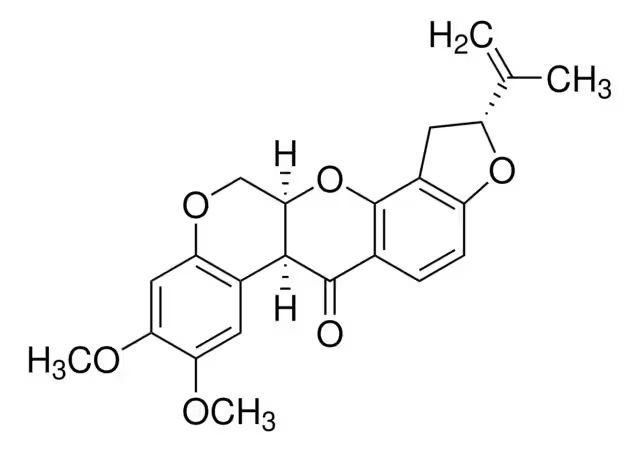
CAS Number83-79-4
Synonyms(-)-rotenone; derris; protax; Derris root; Rotacide E.C.; MFCD09025614; 5'-b-Rotenone; TUBATOXIN; Foliafume E.C.; paraderil; Dermostatin A; (-)-cis-rotenone; Noxfire; EINECS 201-501-9; Tubotoxine; Canex
Molecular FormulaC23H22O6
Molecular Weight394.42
Purity≥95%
Density1.3±0.1 g/cm3
Boiling Point210-220 °C/0.5 mmHg (lit.)
Melting Point159-164 °C (lit.)
AppearanceColorless rhombic flake crystals.
EINECS201-501-9
Symbol
Signal WordWarning
| Chemical & Physical Properties | |
|---|---|
| CAS Number | 83-79-4 |
| Catalog No. | 2A-0202274 |
| Chinese Name | 鱼藤酮 |
| Synonyms | (-)-rotenone; derris; protax; Derris root; Rotacide E.C.; MFCD09025614; 5'-b-Rotenone; TUBATOXIN; Foliafume E.C.; paraderil; Dermostatin A; (-)-cis-rotenone; Noxfire; EINECS 201-501-9; Tubotoxine; Canex |
| Molecular Formula | C23H22O6 |
| Molecular Weight | 394.42 |
| Purity | ≥95 |
| Density | 1.3±0.1 g/cm3 |
| Boiling Point | 210-220 °C/0.5 mmHg (lit.) |
| Melting Point | 159-164 °C (lit.) |
| Appearance | Colorless rhombic flake crystals. |
| Storage Condition | Sealed packaging in plastic bags. Store in a cool, |
| Packaging | III |
| Application | Rotenone is a mitochondrial electron transport chain complex I inhibitor. |
| EINECS | 201-501-9 |
| PubChem ID | 24278683 |
| MDL Number | MFCD09025614 |
| SMILES | COc1cc2OCC3Oc4c5C[C@@H](Oc5ccc4C(=O)C3c2cc1OC)C(C)=C |
| InChI | 1S/C23H22O6/c1-11(2)16-8-14-15(28-16)6-5-12-22(24)21-13-7-18(25-3)19(26-4)9-17(13)27-10-20(21)29-23(12)14/h5-7,9,16,20-21H,1,8,10H2,2-4H3/t16-,20-,21+/m1/s1 |
| InChI Key | JUVIOZPCNVVQFO-HBGVWJBISA-N |
| Beilstein/REAXYS | 6773081 |
| NACRES Code | NA.77 |
| UNSPSC | 12352202 |
| Hazard Symbols | 6.1(b) |
| MSDS | msds/9935_1_83_79_4.pdf |
| Bioactivity | Rotenone is an mitochondrial electron transport chain complex I inhibitor. Related Catalog Signaling Pathways >> Metabolic Enzyme/Protease >> Mitochondrial Metabolism Research Areas >> Neurological Disease In Vitro Mitogen Activated Protein Kinase (MAPK), Toll-like receptor, Wnt, and Ras signaling pathways are intensively involved in the effect of rotenone on the ENS[2]. Rotenone-induced cell death is reduced by treatment as measured by decline in the levels of pro-apoptotic proteins. Moreover, treatment significantly augments the levels of anti-apoptotic Bcl2 and blocks the release of cytochrome c, thereby alleviating the rotenone-induced dopaminergic neuronal loss, as evidenced by tyrosine hydroxylase (TH) immunostaining in the striatum[3]. In Vivo Rotenone causes a significant increase in the excitatory amino acid neurotransmitters; glutamate and aspartate together with a significant decrease in the inhibitory amino acids, GABA, glycine and taurine are observed in the cerebellum of rat model of PD[1]. Rotenone (1.5, 2, or 2.5 mg/kg) causes a dose-dependent increase in α-synuclein in the substantia nigra. Furthermore, at 2 and 2.5 mg/kg, rotenone causes a significant decrease in the number of tyrosine hydroxylase-immunoreactive neurons in the substantia nigra, and dopamine in the striatum in rats[4]. References [1]. Khadrawy YA, et al. Cerebellar neurochemical and histopathological changes in rat model of Parkinson's disease induced by intrastriatal injection of rotenone. Gen Physiol Biophys. 2016 Nov 30 [2]. Guan Q, et al. RNA-Seq Expression Analysis of Enteric Neuron Cells with Rotenone Treatment and Prediction of Regulated Pathways. Neurochem Res. 2016 Nov 30 [3]. Kishore Kumar SN, et al. Morinda citrifolia mitigates rotenone-induced striatal neuronal loss in male Sprague-Dawley rats by preventing mitochondrial pathway of intrinsic apoptosis. Redox Rep. 2016 Nov 24:1-12 [4]. Zhang ZN, et al. Subcutaneous rotenone rat model of Parkinson's disease: dose exploration study. Brain Res. 2016 Nov 19. pii: S0006-8993(16)30776-4 Chemical & Physical Properties Density 1.3±0.1 g/cm3 Boiling Point 559.8±50.0 °C at 760 mmHg Melting Point 159-164 °C(lit.) Molecular Formula C23H22O6 Molecular Weight 394.417 Flash Point 244.6±30.2 °C Exact Mass 394.141632 PSA 63.22000 LogP 4.65 Vapour Pressure 0.0±1.5 mmHg at 25°C Index of Refraction 1.591 InChIKey JUVIOZPCNVVQFO-HBGVWJBISA-N SMILES C=C(C)C1Cc2c(ccc3c2OC2COc4cc(OC)c(OC)cc4C2C3=O)O1 Stability Stable, but light and air sensitive. Combustible. Incompatible with oxidizing agents, especially in the presence of alkalies. |
| Use of | Rotenone is an mitochondrial electron transport chain complex I inhibitor. Properties Articles312 Name rotenone Synonym More Synonyms Rotenone Biological Activity Description Rotenone is an mitochondrial electron transport chain complex I inhibitor. Related Catalog Signaling Pathways >> Metabolic Enzyme/Protease >> Mitochondrial Metabolism Research Areas >> Neurological Disease In Vitro Mitogen Activated Protein Kinase (MAPK), Toll-like receptor, Wnt, and Ras signaling pathways are intensively involved in the effect of rotenone on the ENS[2]. Rotenone-induced cell death is reduced by treatment as measured by decline in the levels of pro-apoptotic proteins. Moreover, treatment significantly augments the levels of anti-apoptotic Bcl2 and blocks the release of cytochrome c, thereby alleviating the rotenone-induced dopaminergic neuronal loss, as evidenced by tyrosine hydroxylase (TH) immunostaining in the striatum[3]. References [1]. Khadrawy YA, et al. Cerebellar neurochemical and histopathological changes in rat model of Parkinson's disease induced by intrastriatal injection of rotenone. Gen Physiol Biophys. 2016 Nov 30 [2]. Guan Q, et al. RNA-Seq Expression Analysis of Enteric Neuron Cells with Rotenone Treatment and Prediction of Regulated Pathways. Neurochem Res. 2016 Nov 30 [3]. Kishore Kumar SN, et al. Morinda citrifolia mitigates rotenone-induced striatal neuronal loss in male Sprague-Dawley rats by preventing mitochondrial pathway of intrinsic apoptosis. Redox Rep. 2016 Nov 24:1-12 [4]. Zhang ZN, et al. Subcutaneous rotenone rat model of Parkinson's disease: dose exploration study. Brain Res. 2016 Nov 19. pii: S0006-8993(16)30776-4 Chemical & Physical Properties Molecular Formula C23H22O6 Exact Mass 394.141632 PSA 63.22000 Index of Refraction 1.591 InChIKey JUVIOZPCNVVQFO-HBGVWJBISA-N Stability Stable, but light and air sensitive. Combustible. Incompatible with oxidizing agents, especially in the presence of alkalies. |
| Transport Info | Shipping Name: UN |
| MSDS Transport Info | Module 14. Shipping information 14.1 UN dangerous goods number European Dangerous Regulations for land transport: 2811 International Dangerous Regulations for sea transport: 2811 International Dangerous Regulations for air transport: 2811 14.2 United Nations shipping name European Land Transport Dangerous Regulations: TOXIC SOLID, ORGANIC, N.O.S. (Rotenone) IMDG: TOXIC SOLID, ORGANIC, N.O.S. (Rotenone) International air transport hazard regulations: Toxic solid, organic, n.o.s. (Rotenone) 14.3 Transport hazard categories European Land Transport Danger Regulations: 6.1 International Maritime Transport Danger Regulations: 6.1 International Air Transport Danger Regulations: 6.1 14.4 Package group European Land Transport Danger Regulations: III International Maritime Transport Danger Regulations: III International Air Transport Danger Regulations: III 14.5 Environmental hazards European Land Transport Danger Regulations: No International Maritime Danger Regulations International Air Transport Danger Regulations: No Marine Pollutants (Yes/No): Yes 14.6 Special reminder to users No data available |
| Related Products in Specialty Chemicals | ||
|---|---|---|
| Crotamiton | 483-63-6 | 2A-9009929 |
| Croton oil | 8001-28-3 | 2A-9009930 |
| Crotonoyl chloride | 10487-71-5 | 2A-9009931 |
| Crotoxyphos | 7700-17-6 | 2A-9009932 |
| Cubebin | 18423-69-3 | 2A-9009934 |
| Curcumenol | 19431-84-6 | 2A-9009936 |
| CV-6209 | 117064-08-1 | 2A-9009937 |
| Cyanophos | 2636-26-2 | 2A-9009939 |
| Cycloate | 1134-23-2 | 2A-9009940 |
| Cyclobenzaprine | 303-53-7 | 2A-9009941 |
| Browse all Specialty Chemicals products » | ||
Phone:
630-322-8886
630-322-8887
Email:
Office Locations:
Chicago, IL, USA
San Francisco, CA, USA


 EN
EN


 SDS
SDS