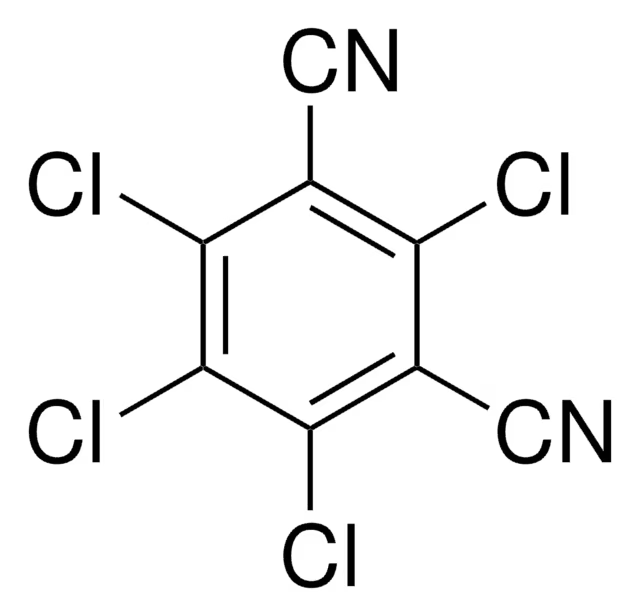
CAS Number1897-45-6
Synonymsmeta-TCPN; 2,4,5,6-Tetrachloroisophthalonitrile; Chloroalonil; MFCD00045594; 2,4-Dicyanotetrachlorobenzene; 1,3-dicyano-2,4,5,6-tetrachlorobenzene; 2,4,5,6-tetrachlorobenzene-1,3-dicarbonitrile; 2,4,5,6-tetrachloro-1,3-benzenedicarbonitrile; m-Tcpn; 2,4,5,6-tetrachloro-1,3-dicyanobenzene; Nopcocide; TPN; Perchloroisophthalonitrile; 2,4,5,6-tetrachloroisophthalodinitrile; Chlorothalonil; EINECS 217-588-1; tetrachloroisophthalonitrile; Bravo; Daconil; Tetrachloroisophthalodinitrile; 1,3-dicyanotetrachlorobenzene
Molecular FormulaC8Cl4N2
Molecular Weight265.91
Purity98%
Density1.7±0.1 g/cm3
Boiling Point350.5±37.0 °C at 760 mmHg
Melting Point250-251ºC
AppearanceWhite crystalline powder
EINECS217-588-1
Symbol
Signal WordWarning
| Chemical & Physical Properties | |
|---|---|
| CAS Number | 1897-45-6 |
| Catalog No. | 2A-9009750 |
| Chinese Name | 百菌清 |
| Synonyms | meta-TCPN; 2,4,5,6-Tetrachloroisophthalonitrile; Chloroalonil; MFCD00045594; 2,4-Dicyanotetrachlorobenzene; 1,3-dicyano-2,4,5,6-tetrachlorobenzene; 2,4,5,6-tetrachlorobenzene-1,3-dicarbonitrile; 2,4,5,6-tetrachloro-1,3-benzenedicarbonitrile; m-Tcpn; 2,4,5,6-tetrachloro-1,3-dicyanobenzene; Nopcocide; TPN; Perchloroisophthalonitrile; 2,4,5,6-tetrachloroisophthalodinitrile; Chlorothalonil; EINECS 217-588-1; tetrachloroisophthalonitrile; Bravo; Daconil; Tetrachloroisophthalodinitrile; 1,3-dicyanotetrachlorobenzene |
| Molecular Formula | C8Cl4N2 |
| Molecular Weight | 265.91 |
| Purity | 98 |
| Density | 1.7±0.1 g/cm3 |
| Boiling Point | 350.5±37.0 °C at 760 mmHg |
| Melting Point | 250-251ºC |
| Appearance | White crystalline powder |
| Water Solubility | Water solubility: insoluble; water solubility: 0.6 |
| Storage Condition | The product is flammable and toxic and is packaged |
| Packaging | I |
| Application | Chlorothalonil is a broad-spectrum fungicide that effectively protects plants against Phytophthora and tomato blight. Chlorothalonil is used to control fungal foliar diseases of vegetables and crops. |
| EINECS | 217-588-1 |
| HTC | 2926909090 |
| PubChem ID | 329755511 |
| MDL Number | MFCD00045594 |
| SMILES | Clc1c(Cl)c(C#N)c(Cl)c(C#N)c1Cl |
| InChI | 1S/C8Cl4N2/c9-5-3(1-13)6(10)8(12)7(11)4(5)2-14 |
| InChI Key | CRQQGFGUEAVUIL-UHFFFAOYSA-N |
| Beilstein/REAXYS | 1978326 |
| NACRES Code | NA.24 |
| UNSPSC | 41116107 |
| Hazard Symbols | 6.1(a) |
| MSDS | msds/9750_1_1897_45_6.pdf |
| Bioactivity | Chlorothalonil is a broad spectrum fungicide and is effective in protecting plants against fungal diseases caused mainly by Phytophthora infestans and Alternaria solani. Chlorothalonil is used for controlling of fungal foliar diseases of vegetables and crops[1][2]. Related Catalog Research Areas >> Infection Signaling Pathways >> Anti-infection >> Fungal References [1]. Pengfei Zhang, et al. Low Dose Chlorothalonil Impairs Mouse Spermatogenesis Through the Intertwining of Estrogen Receptor Pathways With Histone and DNA Methylation.Chemosphere. 2019 Sep;230:384-395. [2]. Małgorzata Baćmaga, et al. The Influence of Chlorothalonil on the Activity of Soil Microorganisms and Enzymes. Ecotoxicology. 2018 Nov;27(9):1188-1202. Chemical & Physical Properties Density 1.7±0.1 g/cm3 Boiling Point 350.5±37.0 °C at 760 mmHg Melting Point 250-251ºC Molecular Formula C8Cl4N2 Molecular Weight 265.911 Flash Point 153.8±20.7 °C Exact Mass 263.881561 PSA 47.58000 LogP 2.88 Vapour Pressure 0.0±0.8 mmHg at 25°C Index of Refraction 1.633 InChIKey CRQQGFGUEAVUIL-UHFFFAOYSA-N SMILES N#Cc1c(Cl)c(Cl)c(Cl)c(C#N)c1Cl |
| Use of | Chlorothalonil is a broad spectrum fungicide and is effective in protecting plants against fungal diseases caused mainly by Phytophthora infestans and Alternaria solani. Chlorothalonil is used for controlling of fungal foliar diseases of vegetables and crops[1][2]. Properties Articles38 Name chlorothalonil Synonym More Synonyms Chlorothalonil Biological Activity Description Chlorothalonil is a broad spectrum fungicide and is effective in protecting plants against fungal diseases caused mainly by Phytophthora infestans and Alternaria solani. Chlorothalonil is used for controlling of fungal foliar diseases of vegetables and crops[1][2]. Related Catalog Research Areas >> Infection Signaling Pathways >> Anti-infection >> Fungal References [1]. Pengfei Zhang, et al. Low Dose Chlorothalonil Impairs Mouse Spermatogenesis Through the Intertwining of Estrogen Receptor Pathways With Histone and DNA Methylation.Chemosphere. 2019 Sep;230:384-395. [2]. Małgorzata Baćmaga, et al. The Influence of Chlorothalonil on the Activity of Soil Microorganisms and Enzymes. Ecotoxicology. 2018 Nov;27(9):1188-1202. Chemical & Physical Properties Exact Mass 263.881561 PSA 47.58000 Index of Refraction 1.633 InChIKey CRQQGFGUEAVUIL-UHFFFAOYSA-N |
| Tax Rebate | 9.0% |
| Supervision | S. Import and export pesticide registration certificate |
| Transport Info | Product name: Chemical name |
| Related Products in Agrochemical Intermediates | ||
|---|---|---|
| Butafenacil | 134605-64-4 | 2A-9009497 |
| Captan | 133-06-2 | 2A-0201631 |
| Chlorfenapyr | 122453-73-0 | 2A-9009728 |
| Chlormequat chloride | 999-81-5 | 2A-9009739 |
| Chlorophacinone | 3691-35-8 | 2A-9009745 |
| Chlorpyrifos | 2921-88-2 | 2A-9009757 |
| Chlorpyrifos-methyl | 5598-13-0 | 2A-9009758 |
| Chlorsulfuron | 64902-72-3 | 2A-9009760 |
| Clofentezine | 74115-24-5 | 2A-9009857 |
| Clothianidin | 210880-92-5 | 2A-9009880 |
| Browse all Agrochemical Intermediates products » | ||
Phone:
630-322-8886
630-322-8887
Email:
Office Locations:
Chicago, IL, USA
San Francisco, CA, USA


 EN
EN


 SDS
SDS