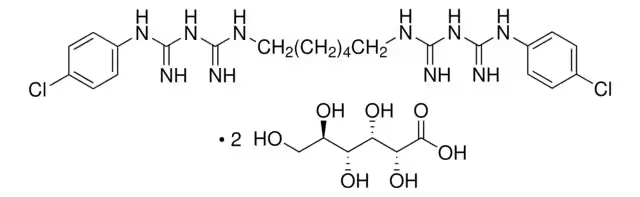
CAS Number18472-51-0
SynonymsMaskin; Unisept; Chlorhexamed; 1,6-Bis(N5-[p-chlorophenyl]-N1-biguanido)hexane; Septeal; Betasept; N,N''''-1,6-Hexanediylbis[N'-(4-chlorophenyl)(imidodicarbonimidic diamide)] - D-gluconic acid (1:2); N,N''-Bis(4-chlorophenyl)-3,12-diimino-2,4,11,13-tetraazatetradecanediimidamide di-D-gluconate; Peridex; Rotersept; hibitane; Manusan; chlorohexidine digluconate; Chlorhexidin Bigluconate; MFCD00083599; Chlorhexidine gluconate; disteryl; chlorhexidine gigluconate; Hibident; Plurexid; Hibidil; N,N''''-Hexane-1,6-diylbis[N'-(4-chlorophenyl)(imidodicarbonimidic diamide)] - D-gluconic acid (1:2); 1,1'-Hexamethylenebis(5-[p-chlorophenyl]biguanide); chlorhexidine bigluconate; EINECS 242-354-0; STERILON; 4-CHLORHEXIDINE DIGLUCONATE; Corsodyl; chlorhexidine D-digluconate; chlorhexidine di-D-gluconate
Molecular FormulaC34H54Cl2N10O14
Molecular Weight897.757
Purity20%
Density1.06 g/mL at 25 °C(lit.)
Boiling Point699.3ºC at 760 mmHg
Melting Point134ºC
Appearanceliquid
| Chemical & Physical Properties | |
|---|---|
| CAS Number | 18472-51-0 |
| Catalog No. | 2A-9009733 |
| Chinese Name | 葡萄糖酸氯己定 |
| Synonyms | Maskin; Unisept; Chlorhexamed; 1,6-Bis(N5-[p-chlorophenyl]-N1-biguanido)hexane; Septeal; Betasept; N,N''''-1,6-Hexanediylbis[N'-(4-chlorophenyl)(imidodicarbonimidic diamide)] - D-gluconic acid (1:2); N,N''-Bis(4-chlorophenyl)-3,12-diimino-2,4,11,13-tetraazatetradecanediimidamide di-D-gluconate; Peridex; Rotersept; hibitane; Manusan; chlorohexidine digluconate; Chlorhexidin Bigluconate; MFCD00083599; Chlorhexidine gluconate; disteryl; chlorhexidine gigluconate; Hibident; Plurexid; Hibidil; N,N''''-Hexane-1,6-diylbis[N'-(4-chlorophenyl)(imidodicarbonimidic diamide)] - D-gluconic acid (1:2); 1,1'-Hexamethylenebis(5-[p-chlorophenyl]biguanide); chlorhexidine bigluconate; EINECS 242-354-0; STERILON; 4-CHLORHEXIDINE DIGLUCONATE; Corsodyl; chlorhexidine D-digluconate; chlorhexidine di-D-gluconate |
| Molecular Formula | C34H54Cl2N10O14 |
| Molecular Weight | 897.757 |
| Purity | 20 |
| Density | 1.06 g/mL at 25 °C(lit.) |
| Boiling Point | 699.3ºC at 760 mmHg |
| Melting Point | 134ºC |
| Appearance | liquid |
| Storage Condition | Closed at room temperature, protected from light, |
| Application | Chlorhexidine digluconate is an antimicrobial agent effective against both Gram-negative and Gram-positive bacteria. |
| HTC | 3004909090 |
| PubChem ID | 329775206 |
| MDL Number | MFCD00083599 |
| SMILES | OC[C@@H](O)[C@@H](O)[C@H](O)[C@@H](O)C(O)=O.OC[C@@H](O)[C@@H](O)[C@H](O)[C@@H](O)C(O)=O.Clc1ccc(NC(=N)NC(=N)NCCCCCCNC(=N)NC(=N)Nc2ccc(Cl)cc2)cc1 |
| InChI | 1S/C22H30Cl2N10.2C6H12O7/c23-15-5-9-17(10-6-15)31-21(27)33-19(25)29-13-3-1-2-4-14-30-20(26)34-22(28)32-18-11-7-16(24)8-12-18;2*7-1-2(8)3(9)4(10)5(11)6(12)13/h5-12H,1-4,13-14H2,(H5,25,27,29,31,33)(H5,26,28,30,32,34);2*2-5,7-11H,1H2,(H,12,13)/t;2*2-,3-,4+,5-/m.11/s1 |
| InChI Key | YZIYKJHYYHPJIB-UUPCJSQJSA-N |
| NACRES Code | NA.85 |
| UNSPSC | 51102829 |
| MSDS | msds/9733_1_18472_51_0.pdf |
| Bioactivity | Chlorhexidine is an antiseptic effective against a wide variety of gram-negative and gram-positive organisms.Target: AntibacterialChlorhexidine is a chemical antiseptic.It is effective on both Gram-positive and Gram-negative bacteria, although it is less effective with some Gram-negative bacteria.It has both bactericidal and bacteriostatic mechanisms of action, the mechanism of action being membrane disruption, not ATPase inactivation as previously thought.It is also useful against fungi and enveloped viruses, though this has not been extensively investigated. Chlorhexidine is harmful in high concentrations, but is used safely in low concentrations in many products, such as mouthwash and contact lens solutions [1, 2]. Related Catalog Signaling Pathways >> Anti-infection >> Bacterial Research Areas >> Infection References [1]. Jenkins, S., M. Addy, and W. Wade, The mechanism of action of chlorhexidine. A study of plaque growth on enamel inserts in vivo. J Clin Periodontol, 1988. 15(7): p. 415-24. [2]. Maki, D.G., M. Ringer, and C.J. Alvarado, Prospective randomised trial of povidone-iodine, alcohol, and chlorhexidine for prevention of infection associated with central venous and arterial catheters. Lancet, 1991. 338(8763): p. 339-43. Chemical & Physical Properties Density 1.06 g/mL at 25 °C(lit.) Boiling Point 699.3ºC at 760 mmHg Melting Point 134ºC Molecular Formula C34H54Cl2N10O14 Molecular Weight 897.757 Flash Point 376.7ºC Exact Mass 896.319824 PSA 444.48000 Vapour Pressure 0mmHg at 25°C InChIKey YZIYKJHYYHPJIB-UUPCJSQJSA-N SMILES NC(=NCCCCCCN=C(N)N=C(N)Nc1ccc(Cl)cc1)N=C(N)Nc1ccc(Cl)cc1.O=C(O)C(O)C(O)C(O)C(O)CO.O=C(O)C(O)C(O)C(O)C(O)CO |
| Use of | Chlorhexidine is an antiseptic effective against a wide variety of gram-negative and gram-positive organisms.Target: AntibacterialChlorhexidine is a chemical antiseptic.It is effective on both Gram-positive and Gram-negative bacteria, although it is less effective with some Gram-negative bacteria.It has both bactericidal and bacteriostatic mechanisms of action, the mechanism of action being membrane disruption, not ATPase inactivation as previously thought.It is also useful against fungi and enveloped viruses, though this has not been extensively investigated. Chlorhexidine is harmful in high concentrations, but is used safely in low concentrations in many products, such as mouthwash and contact lens solutions [1, 2]. Properties Articles23 Name chlorhexidine gluconate Synonym More Synonyms Chlorhexidine digluconate Biological Activity Description Chlorhexidine is an antiseptic effective against a wide variety of gram-negative and gram-positive organisms.Target: AntibacterialChlorhexidine is a chemical antiseptic.It is effective on both Gram-positive and Gram-negative bacteria, although it is less effective with some Gram-negative bacteria.It has both bactericidal and bacteriostatic mechanisms of action, the mechanism of action being membrane disruption, not ATPase inactivation as previously thought.It is also useful against fungi and enveloped viruses, though this has not been extensively investigated. Chlorhexidine is harmful in high concentrations, but is used safely in low concentrations in many products, such as mouthwash and contact lens solutions [1, 2]. Related Catalog Signaling Pathways >> Anti-infection >> Bacterial Research Areas >> Infection References [1]. Jenkins, S., M. Addy, and W. Wade, The mechanism of action of chlorhexidine. A study of plaque growth on enamel inserts in vivo. J Clin Periodontol, 1988. 15(7): p. 415-24. [2]. Maki, D.G., M. Ringer, and C.J. Alvarado, Prospective randomised trial of povidone-iodine, alcohol, and chlorhexidine for prevention of infection associated with central venous and arterial catheters. Lancet, 1991. 338(8763): p. 339-43. Chemical & Physical Properties Exact Mass 896.319824 PSA 444.48000 InChIKey YZIYKJHYYHPJIB-UUPCJSQJSA-N |
| Transport Info | Product Name: Chlorhexidine Gluconate |
| Related Products in Specialty Chemicals | ||
|---|---|---|
| Chlordene | 3734-48-3 | 2A-9009726 |
| Chlordiazepoxide hydrochloride | 438-41-5 | 2A-9009727 |
| Chlorhexidine | 55-56-1 | 2A-9009730 |
| Chlorhexidine acetate | 56-95-1 | 2A-9009731 |
| Chlorhexidine dihydrochloride | 3697-42-5 | 2A-9009732 |
| Chlorimuron | 99283-00-8 | 2A-9009735 |
| Chlorimuron-Ethyl | 90982-32-4 | 2A-9009736 |
| Chlorisondamine diiodide | 69-27-2 | 2A-9009737 |
| Chlormadinon | 1961-77-9 | 2A-9009738 |
| Chlornitrofen | 1836-77-7 | 2A-9009740 |
| Browse all Specialty Chemicals products » | ||
Phone:
630-322-8886
630-322-8887
Email:
Office Locations:
Chicago, IL, USA
San Francisco, CA, USA


 EN
EN


 SDS
SDS