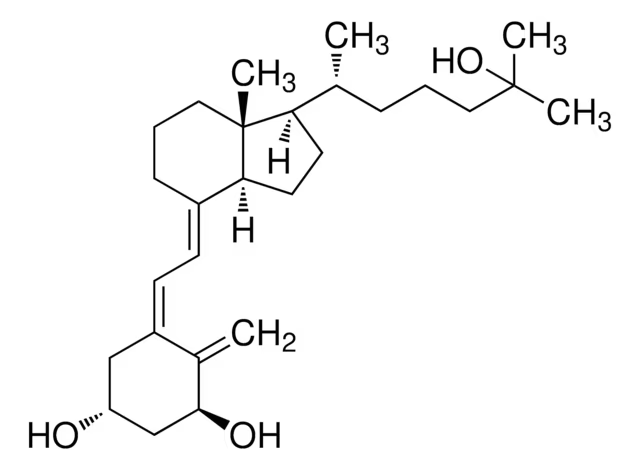
CAS Number32222-06-3
SynonymsMFCD00867079; (1S,3R)-9,10-Secocholesta-5,7,10-triene-1,3,25-triol; 1α,25-Dihydroxyvitamin D3; EINECS 250-963-8
Molecular FormulaC27H44O3
Molecular Weight416.64
Purity≥99 (HPLC)%
Density1.1±0.1 g/cm3
Boiling Point565.0±50.0 °C at 760 mmHg
Melting Point119-1210C
Appearancesolid
EINECS250-963-8
Symbol
Signal WordWarning
| Chemical & Physical Properties | |
|---|---|
| CAS Number | 32222-06-3 |
| Catalog No. | 2A-9009540 |
| Chinese Name | 骨化三醇 |
| Synonyms | MFCD00867079; (1S,3R)-9,10-Secocholesta-5,7,10-triene-1,3,25-triol; 1α,25-Dihydroxyvitamin D3; EINECS 250-963-8 |
| Molecular Formula | C27H44O3 |
| Molecular Weight | 416.64 |
| Purity | ≥99 (HPLC) |
| Density | 1.1±0.1 g/cm3 |
| Boiling Point | 565.0±50.0 °C at 760 mmHg |
| Melting Point | 119-1210C |
| Appearance | solid |
| Storage Condition | Sealed, stored at 2ºC -8ºC |
| Packaging | I |
| Application | Calcitriol is the most active vitamin D metabolite and an agonist of the vitamin D receptor (VDR). |
| EINECS | 250-963-8 |
| HTC | 2942000000 |
| PubChem ID | 24893473 |
| MDL Number | MFCD00867079 |
| SMILES | [H][C@@]1(CC[C@@]2([H])C(\CCC[C@]12C)=C\C=C3\C[C@@H](O)C[C@H](O)C3=C)[C@H](C)CCCC(C)(C)O |
| InChI | 1S/C27H44O3/c1-18(8-6-14-26(3,4)30)23-12-13-24-20(9-7-15-27(23,24)5)10-11-21-16-22(28)17-25(29)19(21)2/h10-11,18,22-25,28-30H,2,6-9,12-17H2,1,3-5H3/b20-10+,21-11-/t18-,22-,23-,24+,25+,27-/m1/s1 |
| InChI Key | GMRQFYUYWCNGIN-NKMMMXOESA-N |
| Beilstein/REAXYS | 7559394 |
| NACRES Code | NA.79 |
| eCl@ss | 34058003 |
| UNSPSC | 12352205 |
| Hazard Symbols | 6.1(a) |
| MSDS | msds/9540_1_32222_06_3.pdf |
| Bioactivity | Calcitriol is the most active metabolite of vitamin D and also a vitamin D receptor (VDR) agonist. Related Catalog Signaling Pathways >> Vitamin D Related >> VD/VDR Research Areas >> Cancer Natural Products >> Others Target Human Endogenous Metabolite In Vitro Calcitriol exerts antiproliferative effects on cervical cancer cells in vitro. Cells decrease by 12.8% when treated with 100 nM Calcitriol for 6 days, compare with control. Inhibition of cell proliferation becomes more pronounced with the increase in Calcitriol concentration. The decrease is 26.1% and 31.6% for 200 and 500 nM Calcitriol, respectively. Treatment with Calcitriol for 72 h induces an evident accumulation of cells in the G1 phase, with approximately 66.18% in 200 nM and 78.10% in 500 nM, compare with the control (24.36%). Calcitriol treatment significantly decreases HCCR-1 protein expression compare with the control in a time- and dose-dependent manner[1]. Calcitriol significantly increases ERα mRNA in a dose dependent manner with an EC50 of 9.8×10⁻⁹ M[2]. In Vivo Chronic treatment with Calcitriol (150 ng/kg per day for 4.5 months) improves the relaxations (pD2: 6.30±0.09, Emax: 68.6±3.9% in Calcitriol-treated OVX, n=8). Renal blood flow in OVX rats is reduced in both kidneys, and the flow is restored by Calcitriol treatment. The increased expression of COX-2 and Thromboxane-prostanoid (TP) receptor in OVX rat renal arteries is reduced by chronic calcitriol administration[3]. High- and low-dose Calcitriol treatment significantly decreases the systolic blood pressure (SBP) in the fructose-fed rats by 14±4 and 9±4 mmHg, respectively, at Day 56. High-dose Calcitriol treatment (20 ng/kg per day) significantly increases serum ionized calcium level (1.44±0.05 mmol/L) compare with the other groups[4]. Cell Assay HeLa S3 cells are plated at a density of 1,000 cells/well in 96-well plates of Dulbecco's modified Eagle's medium (DMEM) with 10% fetal bovine serum (FBS), treated with 1% ethanol (control) or various concentrations of Calcitriol (100, 200, and 500 nM) for 72 h. A Cell Counting Kit8 (CCK-8) is used to determine cell proliferation. At 24, 48, 72, 96, 120, and 144 h after culturing with 200 nM Calcitriol, cells are harvested for analysis. Three independent experiments are performed in quadruplicate[1]. Animal Admin Adult female Sprague-Dawley rats weighing 200 to 220g are used in this study. Rats are housed in a temperature-controlled room (~23°C) with a 12-h light/dark cycle. The animals have free access to a standard diet and water. Ovariectomy (OVX) is performed on rats. At 6 months after the surgical procedure, the OVX rats are randomly assigned to either treatment with vehicle dimethyl sulfoxide (OVX+vehicle) or Calcitriol (150 ng/kg daily, OVX+calcitriol). Calcitriol treatment is given by oral gavage and lasted or 4.5 months. Blood pressure and serum Calcitriol level are measured[3]. References [1]. Wang G, et al. Calcitriol Inhibits Cervical Cancer Cell Proliferation Through Downregulation of HCCR1 Expression. Oncol Res. 2014;22(5-6):301-9. [2]. Santos-Martínez N, et al. Calcitriol restores antiestrogen responsiveness in estrogen receptor negative breast cancer cells: a potential new therapeutic approach. BMC Cancer. 2014 Mar 29;14:230. [3]. Dong J, et al. Calcitriol restores renovascular function in estrogen-deficient rats through downregulation of cyclooxygenase-2 and the thromboxane-prostanoid receptor. Kidney Int. 2013 Jul;84(1):54-63. [4]. Chou CL, et al. Beneficial effects of calcitriol on hypertension, glucose intolerance, impairment of endothelium-dependent vascular relaxation, and visceral adiposity in fructose-fed hypertensive rats. PLoS One. 2015 Mar 16;10(3):e0119843. Chemical & Physical Properties Density 1.1±0.1 g/cm3 Boiling Point 565.0±50.0 °C at 760 mmHg Melting Point 119-1210C Molecular Formula C27H44O3 Molecular Weight 416.637 Flash Point 238.4±24.7 °C Exact Mass 416.329041 PSA 60.69000 LogP 6.12 Vapour Pressure 0.0±3.5 mmHg at 25°C Index of Refraction 1.547 InChIKey GMRQFYUYWCNGIN-ZVUFCXRFSA-N SMILES C=C1C(=CC=C2CCCC3(C)C2CCC3C(C)CCCC(C)(C)O)CC(O)CC1O Stability Air and Light Sensitive |
| Use of | Calcitriol is the most active metabolite of vitamin D and also a vitamin D receptor (VDR) agonist. Properties Articles235 Name calcitriol Synonym More Synonyms Calcitriol Biological Activity Description Calcitriol is the most active metabolite of vitamin D and also a vitamin D receptor (VDR) agonist. Related Catalog Signaling Pathways >> Vitamin D Related >> VD/VDR Research Areas >> Cancer Natural Products >> Others Human Endogenous Metabolite In Vitro Calcitriol exerts antiproliferative effects on cervical cancer cells in vitro. Cells decrease by 12.8% when treated with 100 nM Calcitriol for 6 days, compare with control. Inhibition of cell proliferation becomes more pronounced with the increase in Calcitriol concentration. The decrease is 26.1% and 31.6% for 200 and 500 nM Calcitriol, respectively. Treatment with Calcitriol for 72 h induces an evident accumulation of cells in the G1 phase, with approximately 66.18% in 200 nM and 78.10% in 500 nM, compare with the control (24.36%). Calcitriol treatment significantly decreases HCCR-1 protein expression compare with the control in a time- and dose-dependent manner[1]. Calcitriol significantly increases ERα mRNA in a dose dependent manner with an EC50 of 9.8×10⁻⁹ M[2]. References [1]. Wang G, et al. Calcitriol Inhibits Cervical Cancer Cell Proliferation Through Downregulation of HCCR1 Expression. Oncol Res. 2014;22(5-6):301-9. [2]. Santos-Martínez N, et al. Calcitriol restores antiestrogen responsiveness in estrogen receptor negative breast cancer cells: a potential new therapeutic approach. BMC Cancer. 2014 Mar 29;14:230. [3]. Dong J, et al. Calcitriol restores renovascular function in estrogen-deficient rats through downregulation of cyclooxygenase-2 and the thromboxane-prostanoid receptor. Kidney Int. 2013 Jul;84(1):54-63. [4]. Chou CL, et al. Beneficial effects of calcitriol on hypertension, glucose intolerance, impairment of endothelium-dependent vascular relaxation, and visceral adiposity in fructose-fed hypertensive rats. PLoS One. 2015 Mar 16;10(3):e0119843. Chemical & Physical Properties Molecular Formula C27H44O3 Exact Mass 416.329041 PSA 60.69000 Index of Refraction 1.547 InChIKey GMRQFYUYWCNGIN-ZVUFCXRFSA-N Stability Air and Light Sensitive |
| Transport Info | Product name: Purity: 98.0% |
| MSDS Transport Info | Module 14. Shipping information 14.1 UN dangerous goods number European Dangerous Regulations for land transport: 2811 International Dangerous Regulations for sea transport: 2811 International Dangerous Regulations for air transport: 2811 14.2 Names specified by the United Nations (UN) European Land Transport Dangerous Regulations: TOXIC SOLID, ORGANIC, N.O.S. (Calcitriol) IMDG Code: TOXIC SOLID, ORGANIC, N.O.S. (Calcitriol) International air transport hazard regulations: Toxic solid, organic, n.o.s. (Calcitriol) 14.3 Transport hazard categories European Land Transport Danger Regulations: 6.1 International Maritime Transport Danger Regulations: 6.1 International Air Transport Danger Regulations: 6.1 14.4 Package group European Dangerous Regulations for land transport: I International Dangerous Regulations for sea transport: I International Dangerous Regulations for air transport: I 14.5 Environmental hazards European Land Transport Dangerous Regulations: No International Maritime Transport Dangerous Regulations Maritime Pollutants: No International Air Transport Risk Regulations: No 14.6 Special reminder to users No data available |
| Related Products in Specialty Chemicals | ||
|---|---|---|
| Cafestol | 469-83-0 | 2A-9009531 |
| Cafestol acetate | 81760-48-7 | 2A-9009532 |
| Cafestol eicosanate | 2A-300616 | 2A-9009533 |
| Calanolide A | 142632-32-4 | 2A-9009536 |
| Calcipotriol | 112828-00-9 | 2A-9009538 |
| Calcium ascorbate | 5743-27-1 | 2A-9009541 |
| Calcium clofibrate | 39087-48-4 | 2A-9009542 |
| Calcium dobesilate monohydrate | 20123-80-2 | 2A-9009543 |
| Calcium folinate | 1492-18-8 | 2A-9009544 |
| Calcium glubionate | 12569-38-9 | 2A-9009545 |
| Browse all Specialty Chemicals products » | ||
Phone:
630-322-8886
630-322-8887
Email:
Office Locations:
Chicago, IL, USA
San Francisco, CA, USA


 EN
EN


 SDS
SDS