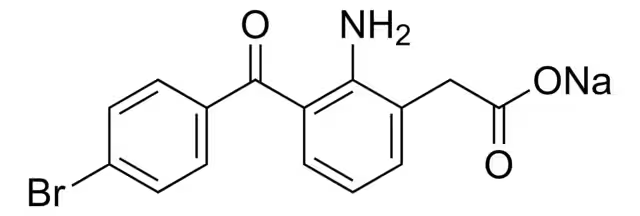
CAS Number91714-94-2
SynonymsBromfenacum [Latin]; Bromfenac [INN]; bromfenacum [INN_la]; 2-[2-amino-3-(4-bromobenzoyl)phenyl]acetic acid; bromfenac; [2-Amino-3-(4-bromobenzoyl)phenyl]acetic acid; Bromfenacum; Bromfenaco [Spanish]; Duract; Xibrom; Bromfenaco
Molecular FormulaC15H12BrNO3
Molecular Weight356.15
Purity≥98 (HPLC)%
Density1.6±0.1 g/cm3
Boiling Point562.2±50.0 °C at 760 mmHg
Melting Point-129ºC
Appearancepowder
| Chemical & Physical Properties | |
|---|---|
| CAS Number | 91714-94-2 |
| Catalog No. | 2A-9009449 |
| Chinese Name | 2-(2-氨基-3-(4-溴苯甲酰基)苯)乙酸 |
| Synonyms | Bromfenacum [Latin]; Bromfenac [INN]; bromfenacum [INN_la]; 2-[2-amino-3-(4-bromobenzoyl)phenyl]acetic acid; bromfenac; [2-Amino-3-(4-bromobenzoyl)phenyl]acetic acid; Bromfenacum; Bromfenaco [Spanish]; Duract; Xibrom; Bromfenaco |
| Molecular Formula | C15H12BrNO3 |
| Molecular Weight | 356.15 |
| Purity | ≥98 (HPLC) |
| Density | 1.6±0.1 g/cm3 |
| Boiling Point | 562.2±50.0 °C at 760 mmHg |
| Melting Point | -129ºC |
| Appearance | powder |
| Storage Condition | 2-8°C |
| Application | Bromfenac is a potent orally active COX inhibitor with IC50s of 5.56 and 7.45 nM for COX-1 and COX-2, respectively. Bromfenac can be used to study ocular inflammation [1]. |
| HTC | 2922509090 |
| PubChem ID | 329825297 |
| MDL Number | MFCD03701673 |
| SMILES | [Na+].Nc1c(CC([O-])=O)cccc1C(=O)c2ccc(Br)cc2 |
| InChI | 1S/C15H12BrNO3.Na/c16-11-6-4-9(5-7-11)15(20)12-3-1-2-10(14(12)17)8-13(18)19;/h1-7H,8,17H2,(H,18,19);/q;+1/p-1 |
| InChI Key | HZFGMQJYAFHESD-UHFFFAOYSA-M |
| NACRES Code | NA.77 |
| UNSPSC | 12352200 |
| MSDS | msds/9449_1_91714_94_2.pdf |
| Bioactivity | Bromfenac is a potent and orally active inhibitor of COX, with IC50s of 5.56 and 7.45 nM for COX-1 and COX-2, respectively. Bromfenac can be used in ocular inflammation research[1]. Related Catalog Research Areas >> Infection Research Areas >> Inflammation/Immunology Signaling Pathways >> Immunology/Inflammation >> COX Target Human COX-1:5.56 nM (IC50) Human COX-2:7.45 nM (IC50) In Vitro Bromfenac (0-80 μg/mL; 24 h) can inhibit transforming growth factor-β2-induced epithelial-mesenchymal transition in HLEC-B3 in a concentration-dependent manner[2]. Bromfenac (80 μg/Ml; 48 h) inhibits transforming growth factor-β2-induced epithelial-mesenchymal transition in human anterior capsules[2]. Cell Viability Assay[2] Cell Line: Transforming growth factor-β2-treated human anterior capsules Concentration: 80 μg/mL Incubation Time: 48 hours Result: Suppressed transforming growth factor-β2-induced epithelial-mesenchymal transition in primary LECs. Cell Migration Assay [2] Cell Line: HLEC-B3 cells Concentration: 0, 20, 40, 60, and 80 μg/mL Incubation Time: 24 hours Result: Suppressed transforming growth factor-β2-induced cell migration in HLEC-B3 cells, and exhibited inhibition of the over-expression of epithelial-mesenchymal transition markers. In Vivo Bromfenac (0.0032-3.16%; 100 or 200 μL; rubbed onto the backs) produces significant anti-inflammatory activity at concentrations as low as 0.1% (4 h pretreatment time) or 0.32% (18h pretreatment time) in rats[3]. Bromfenac (0.032-3.16%; 100 μL; rubbed onto the paws) produces dose-related anti-inflammatory activity in rats[3]. Bromfenac (0.032-1.0%; 50 μL) is 26 times more potent than indomethacin in blocking the erythema when applied directly onto the skin area exposed to UV light in guinea pigs[3]. Bromfenac (0.0032-0.1%; 50μL; rubbed onto the uninjected paw for 4 h per day and 5 days per week) produces a dose and time dependent reduction in the paw volume of both hind limbs in rats[3]. Bromfenac (0.32%; 50μL; rubbed onto the abdomen) produces significant blockade of abdominal constriction to ACh challenge in mice[3]. Bromfenac (eyedrop instillation; 1 μL (0.09%) per eye; twice-daily; 4 w) partially reduces corneal staining, and becomes so more slowly by the 4-week time point[4]. Animal Model: Male Sprague-Dawley rats (150-250 g) are injected carrageenan[3] Dosage: 0.0032, 0.01, 0.032, 0.1, 0.32, 1.0, 3.16% (100 or 200 μL) Administration: Rubbed onto the backs before 1-72 h of injected carrageenan Result: Produced significant anti-inflammatory activity when applied 1, 2, and 4 h prior to carrageenan challenge at 0.32%. Applied 1 or 4 h prior to carrageenan challenge was active, but not when applied 24 h (or longer) prior to challenge at 0.2%. Animal Model: Male injected with Salin or BTX-B[4] Dosage: 1 μL (0.09%) per eye Administration: Eyedrop instillation; 1 μL (0.09%) per eye; twice-daily; 4 weeks Result: Improved the corneal fluorescein staining score later at 4 weeks after treatment. References [1]. Tetsuo Kida, et al. Pharmacokinetics and efficacy of topically applied nonsteroidal anti-inflammatory drugs in retinochoroidal tissues in rabbits. PLoS One. 2014 May 5;9(5):e96481. [2]. Xiaobo Zhang, et al. Drug-eluting intraocular lens with sustained bromfenac release for conquering posterior capsular opacification. Bioact Mater. 2021 Jul 23;9:343-357. [3]. Nolan JC, et, al. The topical anti-inflammatory and analgesic properties of bromfenac in rodents. Agents Actions. 1988 Aug; 25(1-2): 77-85. [4]. Kaevalin Lekhanont, et al. Effects of topical anti-inflammatory agents in a botulinum toxin B-induced mouse model of keratoconjunctivitis sicca. J Ocul Pharmacol Ther. 2007 Feb;23(1):27-34. Chemical & Physical Properties Density 1.6±0.1 g/cm3 Boiling Point 562.2±50.0 °C at 760 mmHg Melting Point -129ºC Molecular Formula C15H12BrNO3 Molecular Weight 334.165 Flash Point 293.8±30.1 °C Exact Mass 333.000061 PSA 80.39000 LogP 2.72 Vapour Pressure 0.0±1.6 mmHg at 25°C Index of Refraction 1.663 InChIKey ZBPLOVFIXSTCRZ-UHFFFAOYSA-N SMILES Nc1c(CC(=O)O)cccc1C(=O)c1ccc(Br)cc1 Storage condition 2-8°C |
| Use of | Bromfenac is a potent and orally active inhibitor of COX, with IC50s of 5.56 and 7.45 nM for COX-1 and COX-2, respectively. Bromfenac can be used in ocular inflammation research[1]. Properties Name bromfenac Synonym More Synonyms Bromfenac Biological Activity Description Bromfenac is a potent and orally active inhibitor of COX, with IC50s of 5.56 and 7.45 nM for COX-1 and COX-2, respectively. Bromfenac can be used in ocular inflammation research[1]. Related Catalog Research Areas >> Infection Research Areas >> Inflammation/Immunology Signaling Pathways >> Immunology/Inflammation >> COX Human COX-1:5.56 nM (IC50) Human COX-2:7.45 nM (IC50) References [1]. Tetsuo Kida, et al. Pharmacokinetics and efficacy of topically applied nonsteroidal anti-inflammatory drugs in retinochoroidal tissues in rabbits. PLoS One. 2014 May 5;9(5):e96481. [2]. Xiaobo Zhang, et al. Drug-eluting intraocular lens with sustained bromfenac release for conquering posterior capsular opacification. Bioact Mater. 2021 Jul 23;9:343-357. [3]. Nolan JC, et, al. The topical anti-inflammatory and analgesic properties of bromfenac in rodents. Agents Actions. 1988 Aug; 25(1-2): 77-85. [4]. Kaevalin Lekhanont, et al. Effects of topical anti-inflammatory agents in a botulinum toxin B-induced mouse model of keratoconjunctivitis sicca. J Ocul Pharmacol Ther. 2007 Feb;23(1):27-34. Chemical & Physical Properties Molecular Formula C15H12BrNO3 Exact Mass 333.000061 PSA 80.39000 Index of Refraction 1.663 InChIKey ZBPLOVFIXSTCRZ-UHFFFAOYSA-N |
| Tax Rebate | 13.0% |
| Supervision | A. Customs clearance form for inbound goods B. Customs clearance form for outbound goods |
| Inspection | R. Hygiene supervision and inspection of imported food S. Hygiene supervision and inspection of exported food |
| Transport Info | Product name: Supervision conditions A. Customs clearance form for inbound goods B. Customs clearance form for outbound goods |
| Related Products in Specialty Chemicals | ||
|---|---|---|
| Broadleaf Liriope Root | 2A-300525 | 2A-9009442 |
| Brocrinat | 72481-99-3 | 2A-9009443 |
| Bromacil | 314-40-9 | 2A-9009445 |
| Bromchlorenone | 5579-85-1 | 2A-9009447 |
| Bromerguride | 83455-48-5 | 2A-9009448 |
| Bromobutide | 74712-19-9 | 2A-9009450 |
| Bromocyclen | 1715-40-8 | 2A-9009451 |
| Bromohexine hydrochloride | 611-75-6 | 2A-9009452 |
| Bromophos-methyl | 2104-96-3 | 2A-9009453 |
| Bromopropylate | 18181-80-1 | 2A-9009454 |
| Browse all Specialty Chemicals products » | ||
Phone:
630-322-8886
630-322-8887
Email:
Office Locations:
Chicago, IL, USA
San Francisco, CA, USA


 EN
EN


 SDS
SDS