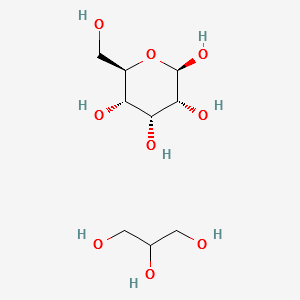
CAS Number9041-35-4
Synonyms(2R,3R,4R,5S,6R)-6-(hydroxymethyl)oxane-2,3,4,5-tetrol; 1,2,3-Propanetriol - β-D-allopyranose (1:1); Sephadex G 25; MFCD00132770
Molecular FormulaC9H20O9
Molecular Weight272.250
Purity98.00%
Boiling Point410.8ºC at 760mmHg
AppearanceWhite sphere, porous
Symbol
Signal WordWarning
| Chemical & Physical Properties | |
|---|---|
| CAS Number | 9041-35-4 |
| Catalog No. | 2A-9094044 |
| Chinese Name | 葡聚糖凝胶G25 |
| Synonyms | (2R,3R,4R,5S,6R)-6-(hydroxymethyl)oxane-2,3,4,5-tetrol; 1,2,3-Propanetriol - β-D-allopyranose (1:1); Sephadex G 25; MFCD00132770 |
| Molecular Formula | C9H20O9 |
| Molecular Weight | 272.250 |
| Purity | 98.00 |
| Boiling Point | 410.8ºC at 760mmHg |
| Appearance | White sphere, porous |
| Storage Condition | room temp |
| Application | Sephadex G 25 is a dextran chromatography medium. Sephadex G-25 separates 1-5kD (globular proteins) and can be used for the separation of peptides as well as desalting and buffer replacement of macrom |
| HTC | 39139000 |
| PubChem ID | 9471612 |
| SMILES | OCC(O)CO.OCC1OC(O)C(O)C(O)C1O |
| InChI | InChI=1S/C6H12O6.C3H8O3/c7-1-2-3(8)4(9)5(10)6(11)12-2;4-1-3(6)2-5/h2-11H,1H2;3-6H,1-2H2/t2-,3-,4-,5-,6-;/m1./s1 |
| InChI Key | BCPVZFFJGCURNR-OCOFDJSDSA-N |
| Hazard Symbols | transportation |
| Bioactivity | Sephadex G 25 is a dextran chromatography medium. Sephadex G-25 separates from 1 to 5 kD (spherical proteins) and can be used for the separation of peptides as well as for the desalting and buffer replacement of large molecule proteins[1]. Related Catalog Research Areas >> Others Signaling Pathways >> Others >> Others In Vitro Guidelines (Following is our recommended protocol. This protocol only provides a guideline, and should be modified according to your specific needs). 1. Swelling: The dry rubber particles need to be swelled for the first time. Place in excess deionized water and swell at room temperature for 3 h, or in a 90°C water bath for 1 h. (forbid to use magnetic stirring during the swelling process to avoid breaking the microspheres) 2. Column packing: (1) Prepare initial buffer (equilibrium solution) and elution buffer according to the properties of the samples to be separated. In the case of desalting proteins such as proteins, it is generally recommended to use only one buffer with a low salt concentration for sample loading, equilibration and elution in gel chromatography. For example, 50 mM Tris-hydrochloric acid or PBS buffer near neutral; if it is the separation of peptides, 0.15 M NaCl can be appropriately added to shield the interaction between the target and the gel; if it is buffer exchange, select the target buffer as needed. (2) Drain the gel, prepare a homogenate with initial buffer (at the ratio of gel:buffer = 3:1) and degas. (3) Fix the column vertically, wet the bottom end with water or buffer and keep the liquid level for a period. (4) Guide the homogenate with a glass rod and pour it into the column at one time along the inner wall of the column to allow the gel to settle freely in the column, seal the column with water, and settle overnight. (5) Connect the movable column head at the top of the column, turn on the peristaltic pump, use the operating flow rate to let the buffer flow through 5 times the column volume, and then use 1.5 times the operating flow rate to flow through 5 times the column volume, and adjust the adapter head to make it as close as possible. Finally, equilibrate the column with 2-3 column volumes of buffer. Note: Air bubbles cannot be introduced during all operations to ensure the uniformity of the gel. 3. Equilibration: Equilibrate the column with the equilibration buffer at the operating flow rate, and observe the change of the detector until the parameters such as conductivity and pH remain unchanged. 4. Loading: switch the switching valve to load the sample, and the sample load is selected according to the nature of the sample and the amount of the chromatography medium. Generally speaking, the sample load does not exceed 25% of the column bed volume. The samples were prepared with equilibration solution and pretreated by filtration with 0.45 μm microporous membrane. 5. Elution: Switch to elution buffer for constant elution, after peaking, to baseline equilibrium. 6. Regeneration: wash with 0.2 mol/L NaOH or non-ionic detergent for 2 times the column volume; then rinse with deionized water for 3-5 times the column volume. 7. Storage: After use, replace the mobile phase with 20% ethanol and store in a refrigerator at 4°C. 8. In order to obtain a better desalination effect, it is recommended to keep the column heights of different particle sizes at: 30 cm and above for coarse particles, 20 cm and above for medium particles, 10 cm and above for fine particles, 5 cm and above for ultra-fine particles, and The smaller the particle size, the higher the resolution and the slower the flow rate. 9. The amount of sample added should be determined according to the experiment. Generally, the maximum sample load does not exceed 30% of the column bed volume, and 10-20% is the best sample load. Chemical & Physical Properties Boiling Point 410.8ºC at 760mmHg Molecular Formula C9H20O9 Molecular Weight 272.250 Exact Mass 272.110718 PSA 171.07000 InChIKey BCPVZFFJGCURNR-OCOFDJSDSA-N SMILES OCC(O)CO.OCC1OC(O)C(O)C(O)C1O Storage condition room temp |
| Use of | Sephadex G 25 is a dextran chromatography medium. Sephadex G-25 separates from 1 to 5 kD (spherical proteins) and can be used for the separation of peptides as well as for the desalting and buffer replacement of large molecule proteins[1]. Properties Articles47 Name (2R,3R,4R,5S,6R)-6-(hydroxymethyl)oxane-2,3,4,5-tetrol,propane-1,2,3-triol Synonym More Synonyms Biological Activity Description Sephadex G 25 is a dextran chromatography medium. Sephadex G-25 separates from 1 to 5 kD (spherical proteins) and can be used for the separation of peptides as well as for the desalting and buffer replacement of large molecule proteins[1]. Related Catalog Research Areas >> Others Signaling Pathways >> Others >> Others Chemical & Physical Properties Molecular Formula C9H20O9 Exact Mass 272.110718 PSA 171.07000 InChIKey BCPVZFFJGCURNR-OCOFDJSDSA-N SMILES OCC(O)CO.OCC1OC(O)C(O)C(O)C1O Storage condition room temp |
| Transport Info | Product name: Purity: 98.0% |
| MSDS Transport Info | Module 14. Shipping information 14.1 UN dangerous goods number European Land Transport Dangerous Regulations: -International Maritime Dangerous Regulations: -International Air Transport Dangerous Regulations: - 14.2 Names specified by the United Nations (UN) European Land Transport Dangerous Regulations: Non-dangerous goods IMDG Code: Non-dangerous goods International air transport dangerous goods regulations: non-dangerous goods 14.3 Transport hazard categories European Land Transport Dangerous Regulations: -International Maritime Dangerous Regulations: -International Air Transport Dangerous Regulations: - 14.4 Package group European Land Transport Dangerous Regulations: -International Maritime Dangerous Regulations: -International Air Transport Dangerous Regulations: - 14.5 Environmental hazards European Land Transport Dangerous Regulations: No International Maritime Transport Dangerous Regulations Maritime Pollutants: No International Air Transport Risk Regulations: No 14.6 Special reminder to users No data available |
| Related Products in Specialty Chemicals | ||
|---|---|---|
| Water | 7732-18-5 | 2A-9094038 |
| ACRYLAMIDO BUFFER | 46348-76-9 | 2A-9094039 |
| L -PHENYLEPHRINE | 614-03-9 | 2A-9094040 |
| OXALYL BROMIDE | 15219-34-8 | 2A-9094042 |
| LIPOPHILIC SEPHADEX | 9041-37-6 | 2A-9094043 |
| PHENYLTRIMETHYLAMMONIUM HYDROXIDE | 1899-02-1 | 2A-9094045 |
| HYDROXYPROPYL CHITOSAN | 84069-44-3 | 2A-9094047 |
| 2-Hexyl-2-(hydroxymethyl)propane-1,3-diol | 4780-31-8 | 2A-9094048 |
| S-(2-AMINOETHYL)-L-CYSTEINE HYDROCHLORIDE | 4099-35-8 | 2A-9094049 |
| dl-3-hydroxynorvaline | 2280-42-4 | 2A-9094050 |
| Browse all Specialty Chemicals products » | ||
Phone:
630-322-8886
630-322-8887
Email:
Office Locations:
Chicago, IL, USA
San Francisco, CA, USA


 EN
EN


 SDS
SDS