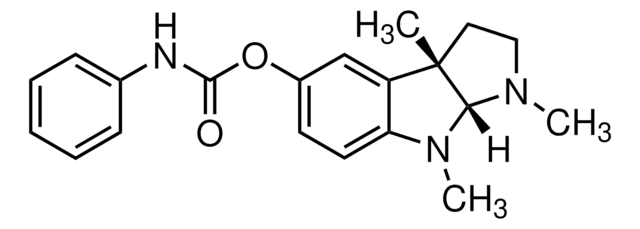
CAS Number101246-66-6
Synonyms[(3aR,8bS)-3,4,8b-trimethyl-2,3a-dihydro-1H-pyrrolo[2,3-b]indol-7-yl] N-phenylcarbamate; N-phenylcarbamic acid [(3aR,8bS)-3,4,8b-trimethyl-2,3a-dihydro-1H-pyrrolo[2,3-b]indol-7-yl] ester; NCGC00163250-01; (-)-Eseroline phenylcarbamate; (-)-Phenserine
Molecular FormulaC20H23N3O2
Molecular Weight337.42
Purity≥98 (HPLC)%
Density1.228g/cm3
Boiling Point468.7ºC at 760mmHg
Appearancesolid
Symbol
Signal WordWarning
| Chemical & Physical Properties | |
|---|---|
| CAS Number | 101246-66-6 |
| Catalog No. | 2A-9093521 |
| Chinese Name | (-)-Eseroline phenylcarbamate |
| Synonyms | [(3aR,8bS)-3,4,8b-trimethyl-2,3a-dihydro-1H-pyrrolo[2,3-b]indol-7-yl] N-phenylcarbamate; N-phenylcarbamic acid [(3aR,8bS)-3,4,8b-trimethyl-2,3a-dihydro-1H-pyrrolo[2,3-b]indol-7-yl] ester; NCGC00163250-01; (-)-Eseroline phenylcarbamate; (-)-Phenserine |
| Molecular Formula | C20H23N3O2 |
| Molecular Weight | 337.42 |
| Purity | ≥98 (HPLC) |
| Density | 1.228g/cm3 |
| Boiling Point | 468.7ºC at 760mmHg |
| Appearance | solid |
| Storage Condition | 2-8°C, sealed, dry |
| Application | Phenserine ((-)-Eseroline phenylcarbamate) is a derivative of Physostigmine and is a potent, non-competitive, long-acting and selective inhibitor of AChE. Phenserine reduces the formation of beta-amyl |
| PubChem ID | 329820018 |
| MDL Number | MFCD00672748 |
| SMILES | [H][C@]12N(C)CC[C@@]1(C)c3cc(OC(=O)Nc4ccccc4)ccc3N2C |
| InChI | 1S/C20H23N3O2/c1-20-11-12-22(2)18(20)23(3)17-10-9-15(13-16(17)20)25-19(24)21-14-7-5-4-6-8-14/h4-10,13,18H,11-12H2,1-3H3,(H,21,24)/t18-,20+/m1/s1 |
| InChI Key | PBHFNBQPZCRWQP-QUCCMNQESA-N |
| NACRES Code | NA.77 |
| UNSPSC | 12352200 |
| Hazard Symbols | transportation |
| MSDS | msds/93521_1_101246_66_6.pdf |
| Bioactivity | Phenserine ((-)-Eseroline phenylcarbamate) is a derivative of Physostigmine and is a potent, noncompetitive, long-acting and selective AChE inhibitor. Phenserine reduces β-amyloid precursor protein (APP) and β-amyloid peptide (Aβ) formation. Phenserine improves cognitive performance and attenuates the progression of Alzheimer's disease[1][2][3]. Related Catalog Research Areas >> Neurological Disease Signaling Pathways >> Neuronal Signaling >> AChE Target AChE; β-amyloid precursor protein; β-amyloid peptide[1] In Vitro Phenserine (1-25 μM; 48 hours; CHO APP751SW cells) treatment CHO APP751SW cell shows 18.6% reduction in cells treated with 10 μM of Phenserine, while 25 μM concentration of Phenserine reduces APP level by 51.4%[2]. Western Blot Analysis[2] Cell Line: CHO APP751SW cells Concentration: 1 μM, 2.5 μM, 5 μM, 10 μM, 25 μM Incubation Time: 48 hours Result: 8.6% reduction in cells treated with 10 μM, while 25 μM concentration reduces APP level by 51.4%. In Vivo Phenserine (1-4 mg/kg; intraperitoneal injection; for 4 days; male Fischer-344 rats) treatment improves learning when cholinergic function has been impaired in a spatial memory task[3]. Animal Model: Male Fischer-344 rats (5 months old) induced by scopolamine[3] Dosage: 1 mg/kg, 2 mg/kg, 4 mg/kg Administration: Intraperitoneal injection; for 4 days Result: Improved morris water maze performance of scopolamine-treated rats.. References [1]. Klein J. Phenserine. Expert Opin Investig Drugs. 2007 Jul;16(7):1087-97. [2]. Asuni AA, et al. Modulation of amyloid precursor protein expression reduces β-amyloid deposition in a mouse model. Ann Neurol. 2014 May;75(5):684-99. [3]. Janas AM, et al. The cholinesterase inhibitor, phenserine, improves Morris water maze performance of scopolamine-treated rats. Life Sci. 2005 Jan 21;76(10):1073-81. Chemical & Physical Properties Density 1.228g/cm3 Boiling Point 468.7ºC at 760mmHg Molecular Formula C20H23N3O2 Molecular Weight 337.41600 Flash Point 237.3ºC Exact Mass 337.17900 PSA 44.81000 LogP 3.74250 Vapour Pressure 5.85E-09mmHg at 25°C Index of Refraction 1.633 InChIKey PBHFNBQPZCRWQP-QUCCMNQESA-N SMILES CN1CCC2(C)c3cc(OC(=O)Nc4ccccc4)ccc3N(C)C12 |
| Use of | Phenserine ((-)-Eseroline phenylcarbamate) is a derivative of Physostigmine and is a potent, noncompetitive, long-acting and selective AChE inhibitor. Phenserine reduces β-amyloid precursor protein (APP) and β-amyloid peptide (Aβ) formation. Phenserine improves cognitive performance and attenuates the progression of Alzheimer's disease[1][2][3]. Properties Name Phenserine,(3aS,8aR)-1,2,3,3a,8,8a-Hexahydro-1,3a,8-trimethylpyrrolo[2,3-b]indol-5-ol5-(N-phenylcarbamate) Phenserine Biological Activity Description Phenserine ((-)-Eseroline phenylcarbamate) is a derivative of Physostigmine and is a potent, noncompetitive, long-acting and selective AChE inhibitor. Phenserine reduces β-amyloid precursor protein (APP) and β-amyloid peptide (Aβ) formation. Phenserine improves cognitive performance and attenuates the progression of Alzheimer's disease[1][2][3]. Related Catalog Research Areas >> Neurological Disease Signaling Pathways >> Neuronal Signaling >> AChE AChE; β-amyloid precursor protein; β-amyloid peptide[1] In Vitro Phenserine (1-25 μM; 48 hours; CHO APP751SW cells) treatment CHO APP751SW cell shows 18.6% reduction in cells treated with 10 μM of Phenserine, while 25 μM concentration of Phenserine reduces APP level by 51.4%[2]. Western Blot Analysis[2] Cell Line: CHO APP751SW cells Concentration: 1 μM, 2.5 μM, 5 μM, 10 μM, 25 μM Incubation Time: 48 hours Result: 8.6% reduction in cells treated with 10 μM, while 25 μM concentration reduces APP level by 51.4%. References [1]. Klein J. Phenserine. Expert Opin Investig Drugs. 2007 Jul;16(7):1087-97. [2]. Asuni AA, et al. Modulation of amyloid precursor protein expression reduces β-amyloid deposition in a mouse model. Ann Neurol. 2014 May;75(5):684-99. [3]. Janas AM, et al. The cholinesterase inhibitor, phenserine, improves Morris water maze performance of scopolamine-treated rats. Life Sci. 2005 Jan 21;76(10):1073-81. Chemical & Physical Properties Molecular Formula C20H23N3O2 Exact Mass 337.17900 PSA 44.81000 LogP 3.74250 Index of Refraction 1.633 InChIKey PBHFNBQPZCRWQP-QUCCMNQESA-N |
| Transport Info | Product name: Purity: 98.0% |
| MSDS Transport Info | Module 14. Shipping information 14.1 UN dangerous goods number European Land Transport Dangerous Regulations: -International Maritime Dangerous Regulations: -International Air Transport Dangerous Regulations: - 14.2 Names specified by the United Nations (UN) European Land Transport Dangerous Regulations: Non-dangerous goods IMDG Code: Non-dangerous goods International air transport dangerous goods regulations: non-dangerous goods 14.3 Transport hazard categories European Land Transport Dangerous Regulations: -International Maritime Dangerous Regulations: -International Air Transport Dangerous Regulations: - 14.4 Package group European Land Transport Dangerous Regulations: -International Maritime Dangerous Regulations: -International Air Transport Dangerous Regulations: - 14.5 Environmental hazards European Land Transport Dangerous Regulations: No International Maritime Transport Dangerous Regulations Maritime Pollutants: No International Air Transport Risk Regulations: No 14.6 Special reminder to users No data available |
| Related Products in Specialty Chemicals | ||
|---|---|---|
| COLISTIMETHATE SODIUM | 8068-37-9 | 2A-9093513 |
| LYS-LYS-LYS | 13184-14-0 | 2A-9093514 |
| HEXAETHOXYETHANE | 65789-73-3 | 2A-9093515 |
| N-(2-HYDROXYBENZOYL)-L-ASPARTIC ACID | 56145-94-9 | 2A-9093519 |
| FUMIGATIN | 484-89-9 | 2A-9093520 |
| 3,6-dihydro-2H-pyran | 3174-74-1 | 2A-9093523 |
| TRIDECANOIC ACID | 638-53-9 | 2A-9093524 |
| PENTADECANOIC ACID | 1002-84-2 | 2A-9093525 |
| phytoestrol | 78515-75-0 | 2A-9093526 |
| Methyl arachidate | 1120-28-1 | 2A-9093528 |
| Browse all Specialty Chemicals products » | ||
Phone:
630-322-8886
630-322-8887
Email:
Office Locations:
Chicago, IL, USA
San Francisco, CA, USA


 EN
EN


 SDS
SDS