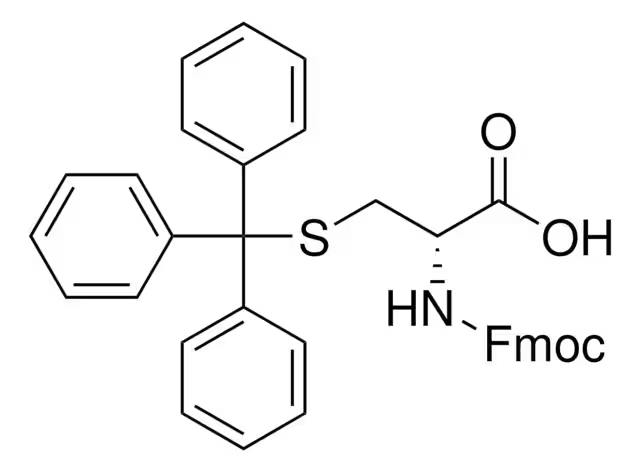
CAS Number167015-11-4
Synonyms(2R)-2-(9H-fluoren-9-ylmethoxycarbonylamino)-3-tritylsulfanylpropanoic acid; AmbotzFAA1035; Fmoc-S-trityl-D-cysteine; MFCD00151922; N-(9-Fluorenyl methoxy carbonyl)-S-trityl-L-cysteine; N-Fmoc-S-trityl-D-cysteine; Na-Fmoc-Ng-trityl-L-glutamine; N-[(9H-Fluoren-9-ylMethoxy)carbonyl]-S-(triphenylMethyl)-L-cysteine; Fmoc-Cys(Trt)-OH; Fmoc-D-Cys(Trt)-OH; Fmoc-S-Trityl-L-Cysteine; N-Fmoc-S-trityl-L-cysteine; (2R)-2-{[(9H-Fluoren-9-ylmethoxy)carbonyl]amino}-3-(tritylsulfanyl)propanoic acid; N-[(9H-Fluoren-9-ylmethoxy)carbonyl]-S-tritylcysteine; N-[(9H-Fluoren-9-ylmethoxy)carbonyl]-S-(triphenylmethyl)-D-cysteine; 2-((((9H-Fluoren-9-yl)methoxy)carbonyl)amino)-3-(tritylthio)propanoic acid
Molecular FormulaC37H31NO4S
Molecular Weight585.71
Purity96%%
Density1.3±0.1 g/cm3
Boiling Point763.4±60.0 °C at 760 mmHg
Melting Point174 °C
AppearanceSolid;White to Almost white powder to crystal
Symbol
Signal WordWarning
| Chemical & Physical Properties | |
|---|---|
| CAS Number | 167015-11-4 |
| Catalog No. | 2A-9093169 |
| Chinese Name | N-Fmoc-S-三苯甲基-D-半胱氨酸 |
| Synonyms | (2R)-2-(9H-fluoren-9-ylmethoxycarbonylamino)-3-tritylsulfanylpropanoic acid; AmbotzFAA1035; Fmoc-S-trityl-D-cysteine; MFCD00151922; N-(9-Fluorenyl methoxy carbonyl)-S-trityl-L-cysteine; N-Fmoc-S-trityl-D-cysteine; Na-Fmoc-Ng-trityl-L-glutamine; N-[(9H-Fluoren-9-ylMethoxy)carbonyl]-S-(triphenylMethyl)-L-cysteine; Fmoc-Cys(Trt)-OH; Fmoc-D-Cys(Trt)-OH; Fmoc-S-Trityl-L-Cysteine; N-Fmoc-S-trityl-L-cysteine; (2R)-2-{[(9H-Fluoren-9-ylmethoxy)carbonyl]amino}-3-(tritylsulfanyl)propanoic acid; N-[(9H-Fluoren-9-ylmethoxy)carbonyl]-S-tritylcysteine; N-[(9H-Fluoren-9-ylmethoxy)carbonyl]-S-(triphenylmethyl)-D-cysteine; 2-((((9H-Fluoren-9-yl)methoxy)carbonyl)amino)-3-(tritylthio)propanoic acid |
| Molecular Formula | C37H31NO4S |
| Molecular Weight | 585.71 |
| Purity | 96% |
| Density | 1.3±0.1 g/cm3 |
| Boiling Point | 763.4±60.0 °C at 760 mmHg |
| Melting Point | 174 °C |
| Appearance | Solid;White to Almost white powder to crystal |
| Water Solubility | Soluble in: Tetrahydrofuran |
| Storage Condition | Sealed in a cool, dry environment at -15 ºC |
| Application | Fmoc-D-Cys(Trt)-OH is a cysteine derivative [1]. |
| PubChem ID | 16469988 |
| SMILES | O=C(NC(CSC(c1ccccc1)(c1ccccc1)c1ccccc1)C(=O)O)OCC1c2ccccc2-c2ccccc21 |
| InChI | InChI=1S/C37H31NO4S/c39-35(40)34(38-36(41)42-24-33-31-22-12-10-20-29(31)30-21-11-13-23-32(30)33)25-43-37(26-14-4-1-5-15-26,27-16-6-2-7-17-27)28-18-8-3-9-19-28/h1-23,33-34H,24-25H2,(H,38,41)(H,39,40)/t34-/m1/s1 |
| InChI Key | KLBPUVPNPAJWHZ-UUWRZZSWSA-N |
| Hazard Symbols | transportation |
| Bioactivity | Fmoc-D-Cys(Trt)-OH is a cysteine derivative[1]. Related Catalog Research Areas >> Others Signaling Pathways >> Others >> Others In Vitro Amino acids and amino acid derivatives have been commercially used as ergogenic supplements. They influence the secretion of anabolic hormones, supply of fuel during exercise, mental performance during stress related tasks and prevent exercise induced muscle damage. They are recognized to be beneficial as ergogenic dietary substances[1]. References [1]. Luckose F, et al. Effects of amino acid derivatives on physical, mental, and physiological activities. Crit Rev Food Sci Nutr. 2015;55(13):1793-807. Chemical & Physical Properties Density 1.3±0.1 g/cm3 Boiling Point 763.4±60.0 °C at 760 mmHg Melting Point 174 °C Molecular Formula C37H31NO4S Molecular Weight 585.711 Flash Point 415.5±32.9 °C Exact Mass 585.197388 PSA 100.93000 LogP 9.96 Vapour Pressure 0.0±2.7 mmHg at 25°C Index of Refraction 1.656 InChIKey KLBPUVPNPAJWHZ-UUWRZZSWSA-N SMILES O=C(NC(CSC(c1ccccc1)(c1ccccc1)c1ccccc1)C(=O)O)OCC1c2ccccc2-c2ccccc21 Storage condition -15°C |
| Use of | Fmoc-D-Cys(Trt)-OH is a cysteine derivative[1]. Properties Name (2S)-2-(9H-fluoren-9-ylmethoxycarbonylamino)-3-tritylsulfanylpropanoic acid Synonym More Synonyms Fmoc-D-Cys(Trt)-OH Biological Activity Description Fmoc-D-Cys(Trt)-OH is a cysteine derivative[1]. Related Catalog Research Areas >> Others Signaling Pathways >> Others >> Others In Vitro Amino acids and amino acid derivatives have been commercially used as ergogenic supplements. They influence the secretion of anabolic hormones, supply of fuel during exercise, mental performance during stress related tasks and prevent exercise induced muscle damage. They are recognized to be beneficial as ergogenic dietary substances[1]. References [1]. Luckose F, et al. Effects of amino acid derivatives on physical, mental, and physiological activities. Crit Rev Food Sci Nutr. 2015;55(13):1793-807. Chemical & Physical Properties Molecular Formula C37H31NO4S Exact Mass 585.197388 PSA 100.93000 Index of Refraction 1.656 InChIKey KLBPUVPNPAJWHZ-UUWRZZSWSA-N |
| Transport Info | Product name: Purity: 98.0% |
| MSDS Transport Info | Module 14. Shipping information 14.1 UN dangerous goods number European Land Transport Dangerous Regulations: -International Maritime Dangerous Regulations: -International Air Transport Dangerous Regulations: - 14.2 Names specified by the United Nations (UN) European Land Transport Dangerous Regulations: Non-dangerous goods IMDG Code: Non-dangerous goods International air transport dangerous goods regulations: non-dangerous goods 14.3 Transport hazard categories European Land Transport Dangerous Regulations: -International Maritime Dangerous Regulations: -International Air Transport Dangerous Regulations: - 14.4 Package group European Land Transport Dangerous Regulations: -International Maritime Dangerous Regulations: -International Air Transport Dangerous Regulations: - 14.5 Environmental hazards European Land Transport Dangerous Regulations: No International Maritime Transport Dangerous Regulations Maritime Pollutants: No International Air Transport Risk Regulations: No 14.6 Special reminder to users No data available |
Phone:
630-322-8886
630-322-8887
Email:
Office Locations:
Chicago, IL, USA
San Francisco, CA, USA


 EN
EN


 SDS
SDS