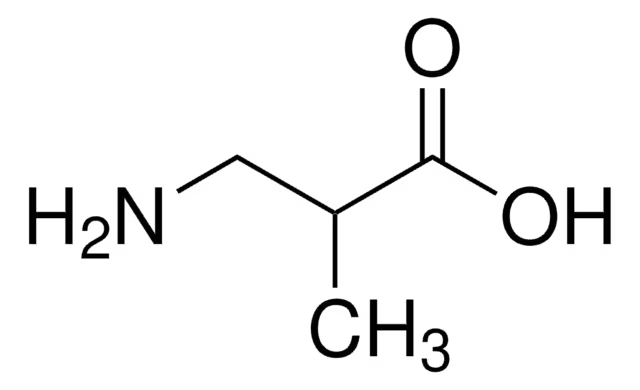
CAS Number144-90-1
SynonymsL-3-amino-isobutyric acid; D-3-Amino-2-methylpropanoic acid; EINECS 205-644-8; D-3-Amino-2-methylpropionic acid; (-)-β-Aminoisobutyric acid; D-2-methyl-b-Alanine; b-Aminoisobutyric acid; (±)-b-Aminoisobutyric acid; 2-Methyl-b-alanine; 3-Amino-2-methylpropanoic acid; 3-Aminoisobutyric Acid; D-b-Aminoisobutyric acid; DL-3-Aminoisobutyric Acid; DL-2-Methyl-b-alanine; L-3-amino-isobutanoic acid; UNII:T68ALE2O9F; L-3-aminoisobutyric acid; 3-amino-2-methyl-propioinic acid; (-)-b-Aminoisobutyric acid; MFCD00008145
Molecular FormulaNH2CH2CH(CH3)COOH
Molecular Weight103.12
Purity98%
Density1.1±0.1 g/cm3
Boiling Point223.6±23.0 °C at 760 mmHg
Melting Point179-182 °C (lit.)
Appearancepowder
EINECS205-644-8
Symbol
Signal WordWarning
| Chemical & Physical Properties | |
|---|---|
| CAS Number | 144-90-1 |
| Catalog No. | 2A-9091707 |
| Chinese Name | DL-3-氨基异丁酸 |
| Synonyms | L-3-amino-isobutyric acid; D-3-Amino-2-methylpropanoic acid; EINECS 205-644-8; D-3-Amino-2-methylpropionic acid; (-)-β-Aminoisobutyric acid; D-2-methyl-b-Alanine; b-Aminoisobutyric acid; (±)-b-Aminoisobutyric acid; 2-Methyl-b-alanine; 3-Amino-2-methylpropanoic acid; 3-Aminoisobutyric Acid; D-b-Aminoisobutyric acid; DL-3-Aminoisobutyric Acid; DL-2-Methyl-b-alanine; L-3-amino-isobutanoic acid; UNII:T68ALE2O9F; L-3-aminoisobutyric acid; 3-amino-2-methyl-propioinic acid; (-)-b-Aminoisobutyric acid; MFCD00008145 |
| Molecular Formula | NH2CH2CH(CH3)COOH |
| Molecular Weight | 103.12 |
| Purity | 98 |
| Density | 1.1±0.1 g/cm3 |
| Boiling Point | 223.6±23.0 °C at 760 mmHg |
| Melting Point | 179-182 °C (lit.) |
| Appearance | powder |
| Storage Condition | room temperature, inert gas |
| Application | 3-Amino-2-methylpropanoic acid induces browning of white fat and is inversely related to cardiometabolic risk factors. |
| EINECS | 205-644-8 |
| PubChem ID | 24853033 |
| MDL Number | MFCD00008145 |
| SMILES | CC(CN)C(O)=O |
| InChI | 1S/C4H9NO2/c1-3(2-5)4(6)7/h3H,2,5H2,1H3,(H,6,7) |
| InChI Key | QCHPKSFMDHPSNR-UHFFFAOYSA-N |
| Beilstein/REAXYS | 1720958 |
| NACRES Code | NA.22 |
| UNSPSC | 12352106 |
| Hazard Symbols | transportation |
| MSDS | msds/91707_1_144_90_1.pdf |
| Bioactivity | 3-Amino-2-methylpropanoic acid could induce browning of white fat and hepatic β-oxidation and is inversely correlated with cardiometabolic risk factors. Related Catalog Natural Products >> Acids and Aldehydes Research Areas >> Cardiovascular Disease Research Areas >> Metabolic Disease Target Human Endogenous Metabolite In Vivo Weight is slightly decreased in the mice by the end of 3-Amino-2-methylpropanoic acid (BAIBA) treatment. Analysis of body composition using MRI demonstrates BAIBA treatment significantly decreases body fat in the mice. Consistent with the effects on thermogenic and β-oxidation gene expression and body weights, analysis with metabolic cages indicates that oxygen consumption (VO2) and whole body energy expenditure are increased in the BAIBA treated mice without any significant difference in activity or food intake. The mice are also challenged with an intraperitoneal glucose tolerance test (IPGTT). BAIBA is found to significantly improve the glucose tolerance in the mice as determined by the area under the curve of the IPGTT[1]. Animal Admin Mice[1]Six week old mice are either treated with 3-Amino-2-methylpropanoic acid (BAIBA:100 mg/kg/day) or remains untreated (control mice). Their weights are monitored weekly[1]. References [1]. Roberts LD, et al. β-Aminoisobutyric acid induces browning of white fat and hepatic β-oxidation and is inversely correlated with cardiometabolic risk factors. Cell Metab. 2014 Jan 7;19(1):96-108. Chemical & Physical Properties Density 1.1±0.1 g/cm3 Boiling Point 223.6±23.0 °C at 760 mmHg Melting Point 246.72°C (estimate) Molecular Formula C4H9NO2 Molecular Weight 103.120 Flash Point 89.0±22.6 °C Exact Mass 103.063332 PSA 63.32000 LogP -0.51 Vapour Pressure 0.0±0.9 mmHg at 25°C Index of Refraction 1.462 |
| Use of | 3-Amino-2-methylpropanoic acid could induce browning of white fat and hepatic β-oxidation and is inversely correlated with cardiometabolic risk factors. Properties Articles56 Name DL-3-Aminoisobutyric acid DL-3-Aminoisobutyric acid Synonym More Synonyms 3-Aminoisobutanoic acid Biological Activity Description 3-Amino-2-methylpropanoic acid could induce browning of white fat and hepatic β-oxidation and is inversely correlated with cardiometabolic risk factors. Related Catalog Natural Products >> Acids and Aldehydes Research Areas >> Cardiovascular Disease Research Areas >> Metabolic Disease Human Endogenous Metabolite In Vivo Weight is slightly decreased in the mice by the end of 3-Amino-2-methylpropanoic acid (BAIBA) treatment. Analysis of body composition using MRI demonstrates BAIBA treatment significantly decreases body fat in the mice. Consistent with the effects on thermogenic and β-oxidation gene expression and body weights, analysis with metabolic cages indicates that oxygen consumption (VO2) and whole body energy expenditure are increased in the BAIBA treated mice without any significant difference in activity or food intake. The mice are also challenged with an intraperitoneal glucose tolerance test (IPGTT). BAIBA is found to significantly improve the glucose tolerance in the mice as determined by the area under the curve of the IPGTT[1]. References [1]. Roberts LD, et al. β-Aminoisobutyric acid induces browning of white fat and hepatic β-oxidation and is inversely correlated with cardiometabolic risk factors. Cell Metab. 2014 Jan 7;19(1):96-108. Chemical & Physical Properties Molecular Formula C4H9NO2 Exact Mass 103.063332 PSA 63.32000 LogP -0.51 Index of Refraction 1.462 |
| Transport Info | Product name: Purity: 98.0% |
| MSDS Transport Info | Module 14. Shipping information 14.1 UN dangerous goods number European Land Transport Dangerous Regulations: -International Maritime Dangerous Regulations: -International Air Transport Dangerous Regulations: - 14.2 Names specified by the United Nations (UN) European Land Transport Dangerous Regulations: Non-dangerous goods IMDG Code: Non-dangerous goods International air transport dangerous goods regulations: non-dangerous goods 14.3 Transport hazard categories European Land Transport Dangerous Regulations: -International Maritime Dangerous Regulations: -International Air Transport Dangerous Regulations: - 14.4 Package group European Land Transport Dangerous Regulations: -International Maritime Dangerous Regulations: -International Air Transport Dangerous Regulations: - 14.5 Environmental hazards European Land Transport Dangerous Regulations: No International Maritime Transport Dangerous Regulations Maritime Pollutants: No International Air Transport Risk Regulations: No 14.6 Special reminder to users No data available |
| Related Products in Functional Building Blocks | ||
|---|---|---|
| Cyclohexanecarboxylic acid, 4-(1-methylethoxy)-, ethyl ester, trans- | 1227187-59-8 | 2A-9091553 |
| 1,2,3-Propanetricarboxylic acid, 2-hydroxy-, zinc salt (1:1) | 56265-02-2 | 2A-9091561 |
| 4-DIAZODIPHENYLAMINE/FORMALDEHYDE CONDENSATE HYDROGEN SULFATE | 41432-19-3 | 2A-9091587 |
| Cyclohexanecarboxylic acid, 4-(1-methoxy-1-methylethyl) | 95233-33-3 | 2A-9091641 |
| 1,7-DIOXASPIRO[5.5]UNDECANE | 180-84-7 | 2A-9091687 |
| 5-(TRIFLUOROMETHYL)PYRIDIN-3-OL | 186593-14-6 | 2A-9091752 |
| 2-Oxa-6-azaspiro[3.5]nonane | 1046153-20-1 | 2A-9091757 |
| DIETHYL (CHLOROMETHYL)PHOSPHONATE | 3167-63-3 | 2A-9091787 |
| isonicotinaldehyde thiosemicarbazone | 1200-00-6 | 2A-9091950 |
| (Trifluoromethylthio) silver(I) | 811-68-7 | 2A-9091979 |
| Browse all Functional Building Blocks products » | ||
Phone:
630-322-8886
630-322-8887
Email:
Office Locations:
Chicago, IL, USA
San Francisco, CA, USA


 EN
EN


 SDS
SDS