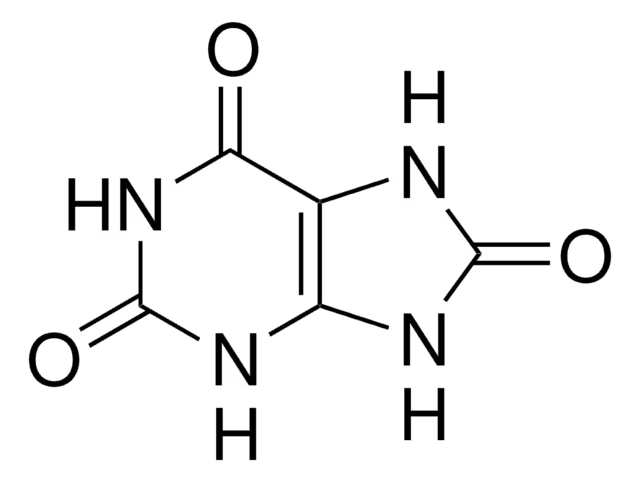
CAS Number69-93-2
Synonyms2,6,8-trioxypurine; 2,6,8-trioxopurine; EINECS 200-720-7; 7,9-Dihydro-1H-purine-2,6,8(3H)-trione; 1H-Purine-2,6,8-triol; urate; [3H]-Uric acid; 2,6,8-trihydroxypurine; Uric Acid; MFCD00005712; 1H-Purine-2,6,8(3H)-trione,7,9-dihydro; Lithic acid; 7,9-dihydro-3H-purine-2,6,8-trione
Molecular FormulaC5H4N4O3
Molecular Weight168.11
Density1.9±0.1 g/cm3
Boiling Point863ºC at 760 mmHg
Melting Point>300 °C(lit.)
AppearanceWhite or off-white powder or crystal
Symbol
Signal WordWarning
| Chemical & Physical Properties | |
|---|---|
| CAS Number | 69-93-2 |
| Catalog No. | 2A-9090355 |
| Chinese Name | 尿酸 |
| Synonyms | 2,6,8-trioxypurine; 2,6,8-trioxopurine; EINECS 200-720-7; 7,9-Dihydro-1H-purine-2,6,8(3H)-trione; 1H-Purine-2,6,8-triol; urate; [3H]-Uric acid; 2,6,8-trihydroxypurine; Uric Acid; MFCD00005712; 1H-Purine-2,6,8(3H)-trione,7,9-dihydro; Lithic acid; 7,9-dihydro-3H-purine-2,6,8-trione |
| Molecular Formula | C5H4N4O3 |
| Molecular Weight | 168.11 |
| Density | 1.9±0.1 g/cm3 |
| Boiling Point | 863ºC at 760 mmHg |
| Melting Point | >300 °C(lit.) |
| Appearance | White or off-white powder or crystal |
| Water Solubility | Water solubility: virtually insoluble; insoluble: |
| Storage Condition | Sealed packaging in brown wide-mouth glass bottles |
| Application | Uric acid is an endogenous antioxidant that scavenges reactive oxygen species (ROS), including singlet oxygen, oxygen free radicals and peroxynitrite. |
| HTC | 2933990090 |
| PubChem ID | 3273 |
| SMILES | O=c1[nH]c(=O)c2[nH]c(=O)[nH]c2[nH]1 |
| InChI | InChI=1S/C5H4N4O3/c10-3-1-2(7-4(11)6-1)8-5(12)9-3/h(H4,6,7,8,9,10,11,12) |
| InChI Key | LEHOTFFKMJEONL-UHFFFAOYSA-N |
| Hazard Symbols | transportation |
| Bioactivity | Uric acid is an endogenous antioxidant that scavenges reactive oxygen species (ROS) including singlet oxygen, oxygen radicals, and peroxynitrite. Related Catalog Research Areas >> Inflammation/Immunology Natural Products >> Others Target Human Endogenous Metabolite In Vitro Uric acid is an endogenous antioxidant that scavenges reactive oxygen species (ROS) including singlet oxygen, oxygen radicals, and peroxynitrite. Incubation with indomethacin significantly increases malondialdehyde (MDA) levels in Caco-2 cells compare to those not treated indomethacin. Incubation with both indomethacin and Uric acid significantly decreases MDA levels compare to those grown in the presence of indomethacin alone. Co-treatment of cells with indomethacin and Uric acid significantly decreases ROS levels compare to those in cells incubated with indomethacin alone. Cell viability in Caco-2 cells treated with both indomethacin and Uric acid is higher than that in cells treated with indomethacin alone. Uric acid has a protective effect on indomethacin-induced intestinal cell changes through its antioxidant activity[1]. In Vivo When mice treated with indomethacin are concurrently administered Uric acid orally, ulcer areas are significantly reduced, in a Uric acid dose-dependent manner. Indomethacin increases the ratio of crypt depth to villous height in the ileum, while the ratio is significantly lower when mice are concurrently administered Uric acid orally. Administration of indomethacin also increases the histopathological score of tissue damage in the small intestine, while mice concurrently administered Uric acid orally has a significantly lower histopathological score. The ileal levels of malondialdehyde (MDA) in indomethacin-induced enteropathy model mice orally administered Uric acid are also significantly lower than the levels in mice administered indomethacin alone[1]. Cell Assay Human colon carcinoma cells (Caco-2) are used and grown in Eagle's minimum essential medium supplemented with 10% FBS, 1% non-essential amino acid mixture, and 1% Pen-Strep at 37°C in a humidified atmosphere with 5% CO2. Caco-2 cells are incubated with indomethacin in the presence or absence of Uric acid for 24 or 48 hours[1]. Animal Admin To evaluate the effect of oral administration of Uric acid on NSAID-induced enteropathy, mice are given Uric acid (2.5, 10, 25, 100, or 250 mg/kg body weight) suspended in 0.5% carboxymethyl cellulose orally at 30 minutes before, and 12 hours after indomethacin or vehicle treatment. To evaluate the effect of intraperitoneal administration of inosinic acid plus potassium oxonate on NSAID-induced enteropathy, mice are given inosinic acid (500 mg/kg body weight) plus potassium oxonate (250 mg/kg body weight) 24 intraperitoneally at 30 minutes before, and 12 hours after indomethacin or vehicle treatment[1]. References [1]. Yasutake Y, et al. Uric acid ameliorates indomethacin-induced enteropathy in mice through its antioxidant activity. J Gastroenterol Hepatol. 2017 Nov;32(11):1839-1845. Chemical & Physical Properties Density 1.9±0.1 g/cm3 Boiling Point 863ºC at 760 mmHg Melting Point >300 °C(lit.) Molecular Formula C5H4N4O3 Molecular Weight 168.110 Flash Point 475.7ºC Exact Mass 168.028336 PSA 114.37000 LogP -1.08 Index of Refraction 1.721 InChIKey LEHOTFFKMJEONL-UHFFFAOYSA-N SMILES O=c1[nH]c(=O)c2[nH]c(=O)[nH]c2[nH]1 Storage condition Store at RT. Stability Stable. Incompatible with acids, bases, oxidising agents. |
| Use of | Uric acid is an endogenous antioxidant that scavenges reactive oxygen species (ROS) including singlet oxygen, oxygen radicals, and peroxynitrite. Properties Articles401 Name 7,9-dihydro-1H-purine-2,6,8(3H)-trione Synonym More Synonyms Uric Acid Biological Activity Description Uric acid is an endogenous antioxidant that scavenges reactive oxygen species (ROS) including singlet oxygen, oxygen radicals, and peroxynitrite. Related Catalog Research Areas >> Inflammation/Immunology Natural Products >> Others Human Endogenous Metabolite In Vivo When mice treated with indomethacin are concurrently administered Uric acid orally, ulcer areas are significantly reduced, in a Uric acid dose-dependent manner. Indomethacin increases the ratio of crypt depth to villous height in the ileum, while the ratio is significantly lower when mice are concurrently administered Uric acid orally. Administration of indomethacin also increases the histopathological score of tissue damage in the small intestine, while mice concurrently administered Uric acid orally has a significantly lower histopathological score. The ileal levels of malondialdehyde (MDA) in indomethacin-induced enteropathy model mice orally administered Uric acid are also significantly lower than the levels in mice administered indomethacin alone[1]. References [1]. Yasutake Y, et al. Uric acid ameliorates indomethacin-induced enteropathy in mice through its antioxidant activity. J Gastroenterol Hepatol. 2017 Nov;32(11):1839-1845. Chemical & Physical Properties Molecular Formula C5H4N4O3 Exact Mass 168.028336 PSA 114.37000 LogP -1.08 Index of Refraction 1.721 InChIKey LEHOTFFKMJEONL-UHFFFAOYSA-N SMILES O=c1[nH]c(=O)c2[nH]c(=O)[nH]c2[nH]1 Storage condition Store at RT. Stability Stable. Incompatible with acids, bases, oxidising agents. |
| Tax Rebate | 13.0% |
| Supervision | None. MFN tariff: 6.5%. Ordinary tariff: 20.0% |
| Transport Info | Product name: Purity: 99.0% |
| MSDS Transport Info | Module 14. Shipping information 14.1 UN dangerous goods number European Land Transport Dangerous Regulations: -International Maritime Dangerous Regulations: -International Air Transport Dangerous Regulations: - 14.2 Names specified by the United Nations (UN) European Land Transport Dangerous Regulations: Non-dangerous goods IMDG Code: Non-dangerous goods International air transport dangerous goods regulations: non-dangerous goods 14.3 Transport hazard categories European Land Transport Dangerous Regulations: -International Maritime Dangerous Regulations: -International Air Transport Dangerous Regulations: - 14.4 Package group European Land Transport Dangerous Regulations: -International Maritime Dangerous Regulations: -International Air Transport Dangerous Regulations: - 14.5 Environmental hazards European Land Transport Dangerous Regulations: No International Maritime Transport Dangerous Regulations Maritime Pollutants: No International Air Transport Risk Regulations: No 14.6 Special reminder to users No data available |
| Related Products in Specialty Chemicals | ||
|---|---|---|
| 6,8-Dichlorochromone | 57645-97-3 | 2A-9090342 |
| 2-(2,7-Dimethyl-1H-indol-3-yl)ethylamine | 17725-95-0 | 2A-9090344 |
| 2,6-Dimethyl-3-(methylsulfonyl)aniline | 10311-40-7 | 2A-9090348 |
| 4-(2,5-Dimethylphenyl)-5-methylthiazol-2-ylamine | 438220-19-0 | 2A-9090351 |
| 4-(3,4-Dimethylphenyl)-5-methylthiazol-2-ylamine | 438215-91-9 | 2A-9090354 |
| N-(cyclohexylmethyl)cyclopropanamine | 7615-85-2 | 2A-9090358 |
| N-(3-methylbutan-2-yl)cyclopropanamine | 92604-43-5 | 2A-9090362 |
| 4-(2,5-Dimethylphenyl)thiazol-2-ylamine | 101967-39-9 | 2A-9090363 |
| 4-(3,4-Dimethylphenyl)thiazol-2-ylamine | 104296-00-6 | 2A-9090366 |
| 2,3-dimethylbutan-2-amine | 4358-75-2 | 2A-9090367 |
| Browse all Specialty Chemicals products » | ||
Phone:
630-322-8886
630-322-8887
Email:
Office Locations:
Chicago, IL, USA
San Francisco, CA, USA


 EN
EN


 SDS
SDS