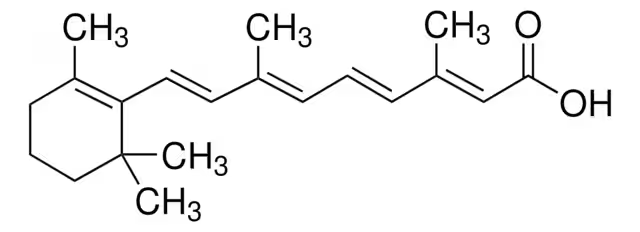
CAS Number302-79-4
Synonyms(2E,4E,6E,8E)-3,7-Dimethyl-9-(2,6,6-trimethylcyclohex-1-en-1-yl)nona-2,4,6,8-tetraenoic acid; eudyna; effederm; all-trans-β-Retinoic acid; aknoten; β-Retinoic acid; MFCD00079542; all trans-Retinoic acid; Atragen; all-trans tretinoin; 15-Apo-b-caroten-15-oic acid; (all-e); trans-Retinoic acid; Tretinoin; all-trans retinoic acid; trans-Vitamin a acid; EINECS 206-129-0; all-trans-Tretinoin; 13-cis-retinoic acid; all-trans-vitamin A acid; retin-a; ALL-TRANS-RETINOIC ACID; aberel; all-trans-3,7-Dimethyl-9-(2,6,6-trimethyl-1-cyclohexen-1-yl)-2,4,6,8-nonatetraenoic Acid; β-all-trans-Retinoic acid; Vitamin A Acid; Acid A Vit; [3H]-Retinoic Acid; ATRA; Retinoic acid
Molecular FormulaC20H28O2
Molecular Weight300.44
Purity≥98 (HPLC)%
Density1.0±0.1 g/cm3
Boiling Point462.8±14.0 °C at 760 mmHg
Melting Point180-181 °C (lit.)
Appearancepowder
EINECS206-129-0
Symbol
Signal WordWarning
| Chemical & Physical Properties | |
|---|---|
| CAS Number | 302-79-4 |
| Catalog No. | 2A-9008863 |
| Chinese Name | 维生素A酸; 视黄酸 |
| Synonyms | (2E,4E,6E,8E)-3,7-Dimethyl-9-(2,6,6-trimethylcyclohex-1-en-1-yl)nona-2,4,6,8-tetraenoic acid; eudyna; effederm; all-trans-β-Retinoic acid; aknoten; β-Retinoic acid; MFCD00079542; all trans-Retinoic acid; Atragen; all-trans tretinoin; 15-Apo-b-caroten-15-oic acid; (all-e); trans-Retinoic acid; Tretinoin; all-trans retinoic acid; trans-Vitamin a acid; EINECS 206-129-0; all-trans-Tretinoin; 13-cis-retinoic acid; all-trans-vitamin A acid; retin-a; ALL-TRANS-RETINOIC ACID; aberel; all-trans-3,7-Dimethyl-9-(2,6,6-trimethyl-1-cyclohexen-1-yl)-2,4,6,8-nonatetraenoic Acid; β-all-trans-Retinoic acid; Vitamin A Acid; Acid A Vit; [3H]-Retinoic Acid; ATRA; Retinoic acid |
| Molecular Formula | C20H28O2 |
| Molecular Weight | 300.44 |
| Purity | ≥98 (HPLC) |
| Density | 1.0±0.1 g/cm3 |
| Boiling Point | 462.8±14.0 °C at 760 mmHg |
| Melting Point | 180-181 °C (lit.) |
| Appearance | powder |
| Water Solubility | insoluble |
| Storage Condition | 2-8°C |
| Packaging | III |
| Application | Retinoic acid is a metabolite of vitamin A and plays an important role in cell growth, differentiation and organogenesis. Retinoic acid is a natural agonist of RAR nuclear receptors, with an IC50 of 1 |
| EINECS | 206-129-0 |
| HTC | 2916209090 |
| PubChem ID | 24278674 |
| MDL Number | MFCD00001551 |
| SMILES | CC1=C(\C=C\C(C)=C\C=C\C(C)=C\C(O)=O)C(C)(C)CCC1 |
| InChI | 1S/C20H28O2/c1-15(8-6-9-16(2)14-19(21)22)11-12-18-17(3)10-7-13-20(18,4)5/h6,8-9,11-12,14H,7,10,13H2,1-5H3,(H,21,22)/b9-6+,12-11+,15-8+,16-14+ |
| InChI Key | SHGAZHPCJJPHSC-YCNIQYBTSA-N |
| Beilstein/REAXYS | 2057223 |
| NACRES Code | NA.77 |
| UNSPSC | 12352106 |
| Hazard Symbols | Transport |
| Risk Codes | R22;R38;R63 |
| Safety Description | S36/37;S45 |
| MSDS | msds/8863_1_302_79_4.pdf |
| Bioactivity | Retinoic acid is a metabolite of vitamin A that plays important roles in cell growth, differentiation, and organogenesis. Retinoic acid is a natural agonist of RAR nuclear receptors, with IC50s of 14 nM for RARα/β/γ. Retinoic acid bind to PPARβ/δ with Kd of 17 nM. Related Catalog Signaling Pathways >> Cell Cycle/DNA Damage >> PPAR Signaling Pathways >> Metabolic Enzyme/Protease >> RAR/RXR Research Areas >> Cancer Natural Products >> Others Target PPARβ/δ:17 nM (Kd) PPARα:103 nM (Kd) PPARγ:178 nM (Kd) RARα:14 nM (IC50) RARβ:14 nM (IC50) RARγ:14 nM (IC50) Human Endogenous Metabolite In Vitro Retinoic acid (All-trans-retinoic acid, ATRA) is a highly potent derivative of vitamin A that is required for virtually all essential physiological processes and functions because of its involvement in transcriptional regulation of over 530 different genes. Retinoic acid exerts its actions by serving as an activating ligand of nuclear retinoic acid receptors (RARα-γ), which form heterodimers with retinoid X receptors (RXRα-γ)[1]. Retinoic acid (RA) bound to PPARα and PPARγ with a low affinity demonstrated by Kd values of 100-200 nM. In contrast, Retinoic acid associates with PPARβ/δ with a Kd of 17 nM, revealing both high affinity and isotype selectivity[2]. Undifferentiated P19 cells express the Retinoic acid (RA) receptors RARα, RARβ, RARγ, and PPARβ/δ, as well as the Retinoic acid -binding proteins CRABP-II and FABP5. Induction of differentiation by treatment of cells with Retinoic acid results in transient up-regulation of CRABP-II and down-regulation of FABP5 that are observed at the level of both the respective proteins and mRNAs. Following the initial decrease, the level of both FABP5 protein and mRNA increases to attain a 2-2.5-fold higher level in mature neurons as compared with undifferentiated P19 cells. Induction of differentiation does not markedly affect the levels of either RARα or PPARβ/δ. The level of RARγ mRNA decreases by about 5-fold by day 4 and remained low in mature neurons[3]. Retinoic acid (RA) is a morphogen derived from retinol (vitamin A) that plays important roles in cell growth, differentiation, and organogenesis. The Retinoic acid interacts with retinoic acid receptor (RAR) and retinoic acid X receptor (RXR) which then regulate the target gene expression[4]. Cell Assay P19 cell are induced to undergo neuronal differentiation according to established procedures. Briefly, cells are cultured on 1% agarose-coated 10 cm dishes at 3×10 5 cells/mL in α-minimal essential medium supplemented with 10% FBS. Differentiation is induced by addition of Retinoic acid (1 μM) and medium containing Retinoic acid replaced 2 days later. On day 4, cell aggregates are collected by centrifugation, separated to single cells by trypsin/EDTA treatment, replated onto poly-L-lysine-coated plates, and cultured in α-minimal essential medium supplemented with 10% FBS. On day 6, medium is replaced with neurobasal medium containing B27 supplement and 2 mM GlutaMAX. Medium is replaced every 2 days for an additional week[3]. References [1]. Wu L, et al. Retinoid X Receptor Agonists Upregulate Genes Responsible for the Biosynthesis of All-Trans-Retinoic Acid in Human Epidermis. PLoS One. 2016 Apr 14;11(4):e0153556. [2]. Shaw N, et al. Retinoic acid is a high affinity selective ligand for the peroxisome proliferator-activated receptor beta/delta. J Biol Chem. 2003 Oct 24;278(43):41589-92. [3]. Yu S, et al. Retinoic acid induces neurogenesis by activating both retinoic acid receptors (RARs) and peroxisomeproliferator-activated receptor β/δ (PPARβ/δ). J Biol Chem. 2012 Dec 7;287(50):42195-205. [4]. Kam RK, et al. Retinoic acid synthesis and functions in early embryonic development. Cell Biosci. 2012 Mar 22;2(1):11. [5]. Apfel C, et al. A retinoic acid receptor alpha antagonist selectively counteracts retinoic acid effects. Proc Natl Acad Sci U S A. 1992 Aug 1;89(15):7129-33. Chemical & Physical Properties Density 1.0±0.1 g/cm3 Boiling Point 462.8±14.0 °C at 760 mmHg Melting Point 179-184ºC Molecular Formula C20H28O2 Molecular Weight 300.435 Flash Point 350.6±11.0 °C Exact Mass 300.208923 PSA 37.30000 LogP 6.83 Vapour Pressure 0.0±2.5 mmHg at 25°C Index of Refraction 1.556 InChIKey SHGAZHPCJJPHSC-YCNIQYBTSA-N SMILES CC(C=CC1=C(C)CCCC1(C)C)=CC=CC(C)=CC(=O)O Storage condition 2-8°C Stability Store Dry in Freezer at -20°C for up to 1 year; in Solution at -20°C for up to 3 Months. Water Solubility insoluble |
| Use of | Retinoic acid is a metabolite of vitamin A that plays important roles in cell growth, differentiation, and organogenesis. Retinoic acid is a natural agonist of RAR nuclear receptors, with IC50s of 14 nM for RARα/β/γ. Retinoic acid bind to PPARβ/δ with Kd of 17 nM. Properties Articles676 Name all-trans-retinoic acid Synonym More Synonyms Retinoic acid Biological Activity Description Retinoic acid is a metabolite of vitamin A that plays important roles in cell growth, differentiation, and organogenesis. Retinoic acid is a natural agonist of RAR nuclear receptors, with IC50s of 14 nM for RARα/β/γ. Retinoic acid bind to PPARβ/δ with Kd of 17 nM. Related Catalog Signaling Pathways >> Cell Cycle/DNA Damage >> PPAR Signaling Pathways >> Metabolic Enzyme/Protease >> RAR/RXR Research Areas >> Cancer Natural Products >> Others PPARβ/δ:17 nM (Kd) PPARα:103 nM (Kd) PPARγ:178 nM (Kd) RARα:14 nM (IC50) RARβ:14 nM (IC50) RARγ:14 nM (IC50) Human Endogenous Metabolite References [1]. Wu L, et al. Retinoid X Receptor Agonists Upregulate Genes Responsible for the Biosynthesis of All-Trans-Retinoic Acid in Human Epidermis. PLoS One. 2016 Apr 14;11(4):e0153556. [2]. Shaw N, et al. Retinoic acid is a high affinity selective ligand for the peroxisome proliferator-activated receptor beta/delta. J Biol Chem. 2003 Oct 24;278(43):41589-92. [3]. Yu S, et al. Retinoic acid induces neurogenesis by activating both retinoic acid receptors (RARs) and peroxisomeproliferator-activated receptor β/δ (PPARβ/δ). J Biol Chem. 2012 Dec 7;287(50):42195-205. [4]. Kam RK, et al. Retinoic acid synthesis and functions in early embryonic development. Cell Biosci. 2012 Mar 22;2(1):11. [5]. Apfel C, et al. A retinoic acid receptor alpha antagonist selectively counteracts retinoic acid effects. Proc Natl Acad Sci U S A. 1992 Aug 1;89(15):7129-33. Chemical & Physical Properties Molecular Formula C20H28O2 Exact Mass 300.208923 PSA 37.30000 Index of Refraction 1.556 InChIKey SHGAZHPCJJPHSC-YCNIQYBTSA-N SMILES CC(C=CC1=C(C)CCCC1(C)C)=CC=CC(C)=CC(=O)O Water Solubility insoluble |
| Tax Rebate | 9.0% |
| Supervision | A. Customs clearance form for inbound goods B. Customs clearance form for outbound goods |
| Inspection | R. Imported food hygiene supervision and inspection S. Export food hygiene supervision and inspection M. Imported commodity inspection N. Exported commodity inspection |
| Transport Info | Shipping Name: UN |
| MSDS Transport Info | Module 14. Shipping information 14.1 UN dangerous goods number European Land Transport Danger Regulations: 3077 International Maritime Transport Danger Regulations: 3077 International Air Transport Danger Regulations: 3077 14.2 United Nations shipping name European land transport hazard regulations: ENVIRONMENTALLY HAZARDOUS SUBSTANCE, SOLID, N.O.S. (Tretinoin) IMDG: ENVIRONMENTALLY HAZARDOUS SUBSTANCE, SOLID, N.O.S. (Tretinoin) International air transport hazard regulations: Environmentally hazardous substance, solid, n.o.s. (Tretinoin) 14.3 Transport hazard categories European land transport Dangerous Regulations: 9 International sea transport Dangerous Regulations: 9 International air transport Dangerous Regulations: 9 14.4 Package group European Land Transport Danger Regulations: III International Maritime Transport Danger Regulations: III International Air Transport Danger Regulations: III 14.5 Environmental hazards European Land Transport Dangerous Regulations: Yes International Maritime Transport Dangerous Regulations International Air Transport Dangerous Regulations: Yes Marine Pollutants (Yes/No): Yes 14.6 Special reminder to users further information Dangerous goods are individually packaged, with liquids exceeding 5 liters or solids exceeding 5 kilograms. The outer packaging of each independent package and the combined independent inner package must have EHS on it. Identification (according to European ADR Regulation 2.2.9.1.10, IMDG Regulation 2.10.3), |
| Related Products in Specialty Chemicals | ||
|---|---|---|
| trans-4-Hydroxy-D-proline | 3398-22-9 | 2A-9008856 |
| trans-4-Methylcyclohexylamine | 2523-55-9 | 2A-9008858 |
| trans-4-Methylcyclohexylamine hydrochloride | 33483-65-7 | 2A-9008859 |
| trans-4-Phenyl-3-buten-2-one | 1896-62-4 | 2A-9008860 |
| trans-4-Phenyl-L-proline hydrochloride | 90657-53-7 | 2A-9008862 |
| Tremuloidin | 529-66-8 | 2A-9008864 |
| Trenbolone 17-acetate | 10161-34-9 | 2A-9008865 |
| Trenbolone enanthate | 2A-108866 | 2A-9008866 |
| Tribromoacetic acid | 75-96-7 | 2A-9008868 |
| Tricosan | 638-67-5 | 2A-9008869 |
| Browse all Specialty Chemicals products » | ||
Phone:
630-322-8886
630-322-8887
Email:
Office Locations:
Chicago, IL, USA
San Francisco, CA, USA


 EN
EN


 SDS
SDS