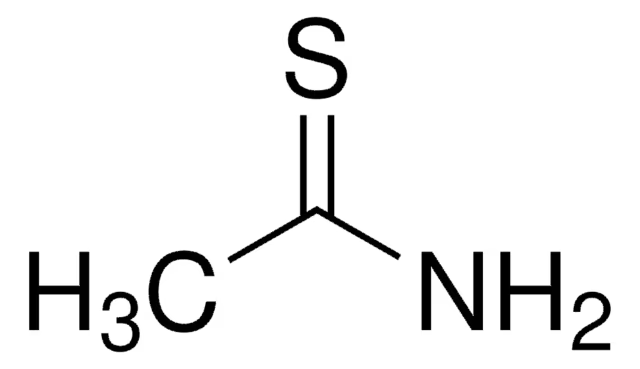
CAS Number62-55-5
Synonymsthio-acetamid; Thioacetamide; Thioactamide; MFCD00008070; usafek-1719; hioacetamide; USAF cb-21; Thiacetamide; EINECS 200-541-4; Ethanethioamide; ethanimidothioic acid
Molecular FormulaCH3CSNH2
Molecular Weight75.13
Purity≥99.0%
Density1.1±0.1 g/cm3
Boiling Point45.3±23.0 °C at 760 mmHg
Melting Point108-112 °C (lit.)
Appearancesolid
EINECS200-541-4
Symbol
Signal WordWarning
| Chemical & Physical Properties | |
|---|---|
| CAS Number | 62-55-5 |
| Catalog No. | 2A-9008829 |
| Chinese Name | 硫代乙酰胺 |
| Synonyms | thio-acetamid; Thioacetamide; Thioactamide; MFCD00008070; usafek-1719; hioacetamide; USAF cb-21; Thiacetamide; EINECS 200-541-4; Ethanethioamide; ethanimidothioic acid |
| Molecular Formula | CH3CSNH2 |
| Molecular Weight | 75.13 |
| Purity | ≥99.0 |
| Density | 1.1±0.1 g/cm3 |
| Boiling Point | 45.3±23.0 °C at 760 mmHg |
| Melting Point | 108-112 °C (lit.) |
| Appearance | solid |
| Water Solubility | 16.3 g/100 mL (25 ºC) |
| Storage Condition | This product should be sealed and stored in a cool |
| Application | Thioacetamide (TAA) is an indirect hepatotoxin that can cause parenchymal cell necrosis. Thioacetamide requires microsomal CYP2E1 for first metabolic activation to thioacetamide-S-oxide and then conve |
| EINECS | 200-541-4 |
| HTC | 2942000000 |
| UN(IATA) | UN 3077 |
| PubChem ID | 24849761 |
| MDL Number | MFCD00008070 |
| SMILES | CC(N)=S |
| InChI | 1S/C2H5NS/c1-2(3)4/h1H3,(H2,3,4) |
| InChI Key | YUKQRDCYNOVPGJ-UHFFFAOYSA-N |
| Beilstein/REAXYS | 506006 |
| NACRES Code | NA.21 |
| UNSPSC | 12352100 |
| Hazard Symbols | Transport |
| Risk Codes | R22;R36/38;R45;R52/53 |
| Safety Description | S45;S53;S61 |
| MSDS | msds/8829_1_62_55_5.pdf |
| Bioactivity | Thioacetamide (TAA) is an indirect hepatotoxin and causes parenchymal cell necrosis. Thioacetamide requires metabolic activation by microsomal CYP2E1 to thioacetamide-S-oxide initially and then to thioacetamide-S-dioxide, which is a highly reactive metabolite, and its reactive metabolites covalently bind to proteins and lipids thereby causing oxidative stress and centrilobular necrosis. Thioacetamide can induce chronic liver fibrosis, encephalopathy and other events model[1][2][3][4]. Related Catalog Signaling Pathways >> Others >> Others Research Areas >> Inflammation/Immunology In Vitro Thioacetamide (TAA; 0-10000 μM; 24 h; WB-F344 cells) has cytotoxicity in a concentration-dependent manner[4]. Thioacetamide (TAA; 1000 and 10000 μM; 0-24 h; WB-F344 cells) has differentially-expressed genes in the early phases at low (1000 μM) and high (10000 μM) concentrations[4]. Cell Viability Assay[4] Cell Line: WB-F344 cells Concentration: 0-10000 μM Incubation Time: 24 hours Result: Had 20% and 50% cell death at the 1000 and 10000 μM concentrations, respectively. In Vivo Thioacetamide (TAA; 100 mg/kg; i.p.; three times weekly) can induce chronic liver fibrosis in male ICR mice[2]. Thioacetamide (200-1200 mg/kg; i.p.; once) induces hepatic encephalopathy model in C57BL/6 mice[3]. Animal Model: Male ICR mice[2] Dosage: 100 mg/kg Administration: Intraperitoneal injection; three times weekly for eight weeks Result: Induced chronic liver fibrosis in male ICR mice and resulted in lower body weight, serum cholesterol and triglycerides as well as increased liver size, ALT, AST and LDH values. Animal Model: Male C57BL/6 mice (20-25g, aged 8-12 weeks)[3] Dosage: 200, 600, and 1,200 mg/kg Administration: Intraperitoneal injection; once Result: Altered the neuropsychiatric state, motor behavior and reflex and sensory functions. Increased in the glutamate release in the cerebral cortex of Hepatic encephalopathy (HE) mice. Chemical & Physical Properties Density 1.1±0.1 g/cm3 Boiling Point 45.3±23.0 °C at 760 mmHg Melting Point 108-112 °C(lit.) Molecular Formula C2H5NS Molecular Weight 75.133 Flash Point -18.8±22.6 °C Exact Mass 75.014267 PSA 58.11000 LogP 0.12 Vapour Pressure 363.9±0.1 mmHg at 25°C Index of Refraction 1.522 InChIKey YUKQRDCYNOVPGJ-UHFFFAOYSA-N SMILES CC(N)=S Storage condition Store at RT. Stability Stability Incompatible with water, mineral acids. Water Solubility 16.3 g/100 mL (25 ºC) |
| Use of | Thioacetamide (TAA) is an indirect hepatotoxin and causes parenchymal cell necrosis. Thioacetamide requires metabolic activation by microsomal CYP2E1 to thioacetamide-S-oxide initially and then to thioacetamide-S-dioxide, which is a highly reactive metabolite, and its reactive metabolites covalently bind to proteins and lipids thereby causing oxidative stress and centrilobular necrosis. Thioacetamide can induce chronic liver fibrosis, encephalopathy and other events model[1][2][3][4]. Properties Articles83 Name thioacetamide Synonym More Synonyms Thioacetamide Biological Activity Description Thioacetamide (TAA) is an indirect hepatotoxin and causes parenchymal cell necrosis. Thioacetamide requires metabolic activation by microsomal CYP2E1 to thioacetamide-S-oxide initially and then to thioacetamide-S-dioxide, which is a highly reactive metabolite, and its reactive metabolites covalently bind to proteins and lipids thereby causing oxidative stress and centrilobular necrosis. Thioacetamide can induce chronic liver fibrosis, encephalopathy and other events model[1][2][3][4]. Related Catalog Signaling Pathways >> Others >> Others Research Areas >> Inflammation/Immunology Chemical & Physical Properties Molecular Formula C2H5NS Exact Mass 75.014267 PSA 58.11000 Index of Refraction 1.522 InChIKey YUKQRDCYNOVPGJ-UHFFFAOYSA-N SMILES CC(N)=S Storage condition Store at RT. Stability Stability Incompatible with water, mineral acids. |
| Transport Info | Product name: Purity: 0.0% |
| MSDS Transport Info | Module 14. Shipping information 14.1 UN dangerous goods number European Land Transport Dangerous Regulations: -International Maritime Dangerous Regulations: -International Air Transport Dangerous Regulations: - 14.2 Names specified by the United Nations (UN) European Land Transport Dangerous Regulations: Non-dangerous goods IMDG Code: Non-dangerous goods International air transport dangerous goods regulations: non-dangerous goods 14.3 Transport hazard categories European Land Transport Dangerous Regulations: -International Maritime Dangerous Regulations: -International Air Transport Dangerous Regulations: - 14.4 Package group European Land Transport Dangerous Regulations: -International Maritime Dangerous Regulations: -International Air Transport Dangerous Regulations: - 14.5 Environmental hazards European Land Transport Dangerous Regulations: No International Maritime Transport Dangerous Regulations Maritime Pollutants: No International Air Transport Risk Regulations: No 14.6 Special reminder to users No data available |
| Related Products in Specialty Chemicals | ||
|---|---|---|
| Tetrahydrothiophen-3-one | 1003-04-9 | 2A-9008819 |
| Tetramethylene sulfone | 126-33-0 | 2A-9008820 |
| Tetra-n-butylammonium bromide | 1643-19-2 | 2A-9008821 |
| Tetra-O-pivaloyl-alpha-D-glucopyranosyl bromide | 81058-27-7 | 2A-9008822 |
| Tetrazol-5-ylamine,1H-Tetrazol-5-amine | 4418-61-5 | 2A-9008823 |
| Thioanisole | 100-68-5 | 2A-9008830 |
| Thiotriazinone | 58909-39-0 | 2A-9008835 |
| Thiourea | 62-56-6 | 2A-9008836 |
| Tiapride hydrochloride | 51012-33-0 | 2A-9008839 |
| Tiliroside | 20316-62-5 | 2A-9008840 |
| Browse all Specialty Chemicals products » | ||
Phone:
630-322-8886
630-322-8887
Email:
Office Locations:
Chicago, IL, USA
San Francisco, CA, USA


 EN
EN


 SDS
SDS