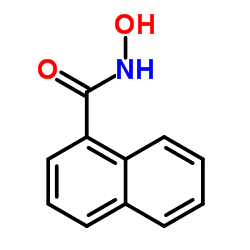
| Chemical & Physical Properties | |
|---|---|
| CAS Number | 6953-61-3 |
| Catalog No. | 2A-9087213 |
| Chinese Name | 1-萘羟肟酸 |
| Synonyms | 1-NAPHTHALENECARBOXAMIDE,N-HYDROXY; a-Naphthohydroxamic acid; N-hydroxynaphthalene-1-carboxamide; N-Hydroxy-1-naphthamide; 1-naphthohydroxamic acid |
| Molecular Formula | C11H9NO2 |
| Molecular Weight | 187.195 |
| Density | 1.3±0.1 g/cm3 |
| Appearance | white to tan |
| Water Solubility | DMSO: ≥5mg/mL |
| Storage Condition | 2-8°C |
| Application | 1-Naphthohydroxamic acid (Compound 2) is a potent and selective HDAC8 inhibitor with an IC50 of 14 μM. 1-Naphthohydroxamic acid is more selective for HDAC8 than class I HDAC1 and class II HDAC6 (IC50 |
| HTC | 2924299090 |
| SMILES | O=C(NO)c1cccc2ccccc12 |
| InChI | InChI=1S/C11H9NO2/c13-11(12-14)10-7-3-5-8-4-1-2-6-9(8)10/h1-7,14H,(H,12,13) |
| InChI Key | JRZGPWOEHDOVMC-UHFFFAOYSA-N |
| MSDS | msds/87213_2_6953_61_3.pdf |
| Bioactivity | 1-Naphthohydroxamic acid (Compound 2) is a potent and selective HDAC8 inhibitor with an IC50 of 14 μM. 1-Naphthohydroxamic acid is more selectively for HDAC8 than class I HDAC1 and class II HDAC6 (IC50 >100 μM). 1-Naphthohydroxamic acid does not increase global histone H4 acetylation and also does not reduce total intracellular HDAC activity[1][2].1-Naphthohydroxamic acid can induce tubulin acetylation[3]. Related Catalog Research Areas >> Cancer Signaling Pathways >> Cell Cycle/DNA Damage >> HDAC Signaling Pathways >> Epigenetics >> HDAC Target HDAC8:14 μM (IC50) HDAC1:>100 μM (IC50) HDAC6:>100 μM (IC50) In Vitro 1-Naphthohydroxamic acid (compound 2; 20-40 µM; 0-144 hours; BE(2)-C, SK-N-BE(2) and SH-SY5Y cells) treatment reduces cell numbers in a concentration-dependent manner[2]. 1-Naphthohydroxamic acid (compound 2) at concentrations in the range of its in vitro IC50 against HDAC8 results in reduced cell density and outgrowth of neurite-like structures that stained positive for neurofilament.1-Naphthohydroxamic acid reduces the formation of clones in soft-agar concentration dependently[2]. When either cell type (HeLa and HEK293 cells) is treated with 1-Naphthohydroxamic acid (compound 2; 0.8 µM, 4 µM, 20 µM or 100 µM), only tubulin becomes hyperacetylated[1]. Cell Proliferation Assay[2] Cell Line: BE(2)-C, SK-N-BE(2) and SH-SY5Y cells Concentration: 20 µM, 40 µM Incubation Time: 0 hours, 24 hours, 48 hours, 72 hours, 96 hours, and 144 hours Result: Reduced cell numbers in a concentration-dependent manner. In Vivo Dose-limiting toxicities (DLTs) of 1-Naphthohydroxamic acid (compound 2; 0-40 mg/kg; intraperitoneal injection; daily; for 10 day; NMRI Foxn1 nude mice) include weight loss and signs of liver toxicity, as evidenced by elevated plasma liver enzymes and detection of necrotic areas on histological liver examination. 1-Naphthohydroxamic acid has the maximum tolerable doses at 50 mg/kg per day. At these concentrations, neither body weight nor blood parameters are critically changed[3]. Pharmacokinetic studies after intraperitoneal administration of the inhibitors identified the half-life of 1-Naphthohydroxamic acid to be ~15 min, with a plasma peak concentration of ~30 μM[3]. Animal Model: NMRI Foxn1 nude mice[3] Dosage: 0 mg/kg, 50 mg/kg, 100mg/kg, 200 mg/kg, 300 mg/kg 400 mg/kg Administration: Intraperitoneal injection; daily; for 10 days Result: Dose-limiting toxicities (DLTs) included weight loss and signs of liver toxicity, as evidenced by elevated plasma liver enzymes and detection of necrotic areas on histological liver examination. References [1]. Krennhrubec K, et al. Design and evaluation of 'Linkerless' hydroxamic acids as selective HDAC8 inhibitors. Bioorg Med Chem Lett. 2007 May 15;17(10):2874-8. [2]. Oehme I, et al. Histone deacetylase 8 in neuroblastoma tumorigenesis. Clin Cancer Res. 2009 Jan 1;15(1):91-9. Chemical & Physical Properties Density 1.3±0.1 g/cm3 Molecular Formula C11H9NO2 Molecular Weight 187.195 Exact Mass 187.063324 PSA 49.33000 LogP 1.49 Appearance of Characters white to tan Index of Refraction 1.678 InChIKey JRZGPWOEHDOVMC-UHFFFAOYSA-N SMILES O=C(NO)c1cccc2ccccc12 Storage condition 2-8°C Water Solubility DMSO: ≥5mg/mL |
| Use of | 1-Naphthohydroxamic acid (Compound 2) is a potent and selective HDAC8 inhibitor with an IC50 of 14 μM. 1-Naphthohydroxamic acid is more selectively for HDAC8 than class I HDAC1 and class II HDAC6 (IC50 >100 μM). 1-Naphthohydroxamic acid does not increase global histone H4 acetylation and also does not reduce total intracellular HDAC activity[1][2].1-Naphthohydroxamic acid can induce tubulin acetylation[3]. Properties Name N-hydroxynaphthalene-1-carboxamide Synonym More Synonyms 1-Naphthohydroxamic acid Biological Activity Description 1-Naphthohydroxamic acid (Compound 2) is a potent and selective HDAC8 inhibitor with an IC50 of 14 μM. 1-Naphthohydroxamic acid is more selectively for HDAC8 than class I HDAC1 and class II HDAC6 (IC50 >100 μM). 1-Naphthohydroxamic acid does not increase global histone H4 acetylation and also does not reduce total intracellular HDAC activity[1][2].1-Naphthohydroxamic acid can induce tubulin acetylation[3]. Related Catalog Research Areas >> Cancer Signaling Pathways >> Cell Cycle/DNA Damage >> HDAC Signaling Pathways >> Epigenetics >> HDAC HDAC8:14 μM (IC50) HDAC1:>100 μM (IC50) HDAC6:>100 μM (IC50) References [1]. Krennhrubec K, et al. Design and evaluation of 'Linkerless' hydroxamic acids as selective HDAC8 inhibitors. Bioorg Med Chem Lett. 2007 May 15;17(10):2874-8. [2]. Oehme I, et al. Histone deacetylase 8 in neuroblastoma tumorigenesis. Clin Cancer Res. 2009 Jan 1;15(1):91-9. Chemical & Physical Properties Molecular Formula C11H9NO2 Exact Mass 187.063324 PSA 49.33000 Appearance of Characters white to tan Index of Refraction 1.678 InChIKey JRZGPWOEHDOVMC-UHFFFAOYSA-N |
| Tax Rebate | 13.0% |
| Supervision | None. MFN tariff: 6.5%. Ordinary tariff: 30.0% |
| Transport Info | Product name: Purity: 98.0% |
| MSDS Transport Info | Module 14. Shipping information United Nations classification: inconsistent with United Nations classification standards UN number: not specified |
| Related Products in Specialty Chemicals | ||
|---|---|---|
| 3-(Dimethylamino)-1-(4-methoxyphenyl)-propan-1-oneHydrochloride | 2125-49-7 | 2A-9087207 |
| 1-Benzoylnaphthalene | 642-29-5 | 2A-9087208 |
| 1-Bromo-2-methoxymethylnaphthalene | 64689-70-9 | 2A-9087209 |
| 3-(Dimethylamino)-1-(4-methylphenyl)propan-1-oneHydrochloride | 5250-02-2 | 2A-9087210 |
| 4'-Methoxy-2'-nitroacetophenone | 67323-06-2 | 2A-9087211 |
| 2,7-Naphthalenedithiol | 71977-56-5 | 2A-9087215 |
| 3-(Dimethylamino)-1-(4-methoxyphenyl)propan-1-one | 2138-33-2 | 2A-9087216 |
| 2-(Methylthio)naphthalene | 7433-79-6 | 2A-9087217 |
| 3,3'-Dibromo-2,2'-dimethoxy-1,1'-binaphthyl | 75714-59-9 | 2A-9087218 |
| 9,10-Dihydrophenanthrene | 776-35-2 | 2A-9087219 |
| Browse all Specialty Chemicals products » | ||
Phone:
630-322-8886
630-322-8887
Email:
Office Locations:
Chicago, IL, USA
San Francisco, CA, USA


 EN
EN


 SDS
SDS