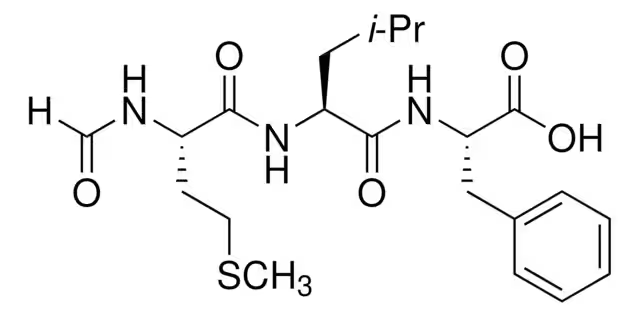
CAS Number59880-97-6
SynonymsN-Formyl-Met-Leu-Phe; formyl-Met-Leu-Phe; N-formyl-methionyl-leucyl-phenylalanine; Chemotactic peptide; formyl-MLF; MFCD00012901; N-Formyl-L-methionyl-L-leucyl-L-phenylalanine; N-Formylmethionine leucyl-phenylalanine; EINECS 200-462-5; N-formyl-L-methyonyl-L-leucyl-L-phenylalanine; NformylLmethionylLleucylLphenylalaninol
Molecular FormulaC21H31N3O5S
Molecular Weight437.55
Purity≥97 (HPLC)%
Density1.2±0.1 g/cm3
Boiling Point783.5±60.0 °C at 760 mmHg
Melting Point271-274 °C(lit.)
Appearancepowder
Symbol
Signal WordWarning
| Chemical & Physical Properties | |
|---|---|
| CAS Number | 59880-97-6 |
| Catalog No. | 2A-9086110 |
| Chinese Name | 酪胺盐酸盐 |
| Synonyms | N-Formyl-Met-Leu-Phe; formyl-Met-Leu-Phe; N-formyl-methionyl-leucyl-phenylalanine; Chemotactic peptide; formyl-MLF; MFCD00012901; N-Formyl-L-methionyl-L-leucyl-L-phenylalanine; N-Formylmethionine leucyl-phenylalanine; EINECS 200-462-5; N-formyl-L-methyonyl-L-leucyl-L-phenylalanine; NformylLmethionylLleucylLphenylalaninol |
| Molecular Formula | C21H31N3O5S |
| Molecular Weight | 437.55 |
| Purity | ≥97 (HPLC) |
| Density | 1.2±0.1 g/cm3 |
| Boiling Point | 783.5±60.0 °C at 760 mmHg |
| Melting Point | 271-274 °C(lit.) |
| Appearance | powder |
| Water Solubility | DMF: 50 mg/mL, clear, colorless |
| Storage Condition | 2-8℃ |
| Application | N-Formyl-Met-Leu-Phe (fMLP; N-Formyl-MLF) is a chemotactic peptide and a specific ligand for the N-formyl peptide receptor (FPR). Reports show that N-Formyl-Met-Leu-Ph can inhibit the secretion of TNF |
| HTC | 2922299090 |
| PubChem ID | 24894846 |
| MDL Number | MFCD00036780 |
| SMILES | CSCC[C@H](NC=O)C(=O)N[C@@H](CC(C)C)C(=O)N[C@@H](Cc1ccccc1)C(O)=O |
| InChI | 1S/C21H31N3O5S/c1-14(2)11-17(23-19(26)16(22-13-25)9-10-30-3)20(27)24-18(21(28)29)12-15-7-5-4-6-8-15/h4-8,13-14,16-18H,9-12H2,1-3H3,(H,22,25)(H,23,26)(H,24,27)(H,28,29)/t16-,17-,18-/m0/s1 |
| InChI Key | PRQROPMIIGLWRP-BZSNNMDCSA-N |
| Beilstein/REAXYS | 2315783 |
| NACRES Code | NA.32 |
| UNSPSC | 12352200 |
| Hazard Symbols | transportation |
| MSDS | msds/86110_1_59880_97_6.pdf |
| Bioactivity | N-Formyl-Met-Leu-Phe (fMLP; N-Formyl-MLF) is a chemotactic peptide and a specific ligand of N-formyl peptide receptor (FPR). N-Formyl-Met-Leu-Ph is reported to inhibit TNF-alpha secretion. Related Catalog Signaling Pathways >> Apoptosis >> TNF Receptor Research Areas >> Inflammation/Immunology Peptides Target TNF-alpha[1] In Vitro Binding of N-Formyl-Met-Leu-Phe to its specific cell surface receptor, N-formyl peptide receptor (FPR), triggers different cascades of biochemical events, eventually leading to cellular activation. FPR is a chemoattractant receptor belonging to the G protein-coupled receptor family. N-Formyl-Met-Leu-Phe promotes osteoblastic commitment and suppresses adipogenic commitment under osteoblastic differentiation conditions. N-Formyl-Met-Leu-Phe stimulates osteogenesis is associated with increased expression of osteogenic markers and mineralization. N-Formyl-Met-Leu-Phe inhibits expression of peroxisome proliferator-activated receptor-γ1. N-Formyl-Met-Leu-Phe-stimulated osteogenic differentiation is mediated via FPR1-phospholipase C/phospholipase D-Ca2+-calmodulin-dependent kinase II-ERK-CREB signaling pathways[1]. N-Formyl-Met-Leu-Phe, a bacterial-derived peptide, induced proinflammatory cytokine gene expression in human peripheral blood monocytes. Bacterial products LPS and N-Formyl-Met-Leu-Phe synergistically induce inflammatory response via multiple signaling pathways. TLR4, IKKβ-IκBα, and NF-κB signaling pathways are involved in the synergistic induction of TNF-α via p65 nuclear translocation-dependent mechanisms[2]. In Vivo N-Formyl-Met-Leu-Phe promotes bone formation in zebrafish and rabbits. Extensive skeletal development is evident at 5 dpf in over 80% of N-Formyl-Met-Leu-Phe-treated zebrafish. Treatment with N-Formyl-Met-Leu-Phe results in increased expression of Runx2. Bone marrow spaces are widely formed, and connective tissue covering bone is dense, like periosteum, in N-Formyl-Met-Leu-Phe-treated calvaria[1]. N-Formyl-Met-Leu-Phe mediate release of calprotectin from PMN in vitro. It induces release of calprotectin from PMN in a dose dependent manner. A minimum of 10% of total PMN calprotectin is retained at concentrations of 0.1-10.0 nM of N-Formyl-Met-Leu-Phe[3]. Cell Assay Cells are cotransfected with either a dominant negative form of IκBα or a dominant negative form of IKKβ together with the NF-κB-dependent luciferase reporter plasmid. The plasmid pCMVβ is used as a control for transfection efficiency and this is monitored via the expression of β-galactosidase. Cells are transiently transfected with plasmids using DEAE-dextran. The transfected cells are cultivated for 48 h before a 6-h incubation in medium ±N-Formyl-Met-Leu-Phe, LPS, or N-Formyl-Met-Leu-Phe/LPS. Luciferase activity is determined by using the luciferase assay kit and a Monolight 3010 luminometer[2]. Animal Admin Mice: N-Formyl-Met-Leu-Phe is prepared in sterile PBS. Under the anesthesia, mice are intranasally treated with LPS (0.3 mg/kg) or N-Formyl-Met-Leu-Phe (0.5 mg/kg) or N-Formyl-Met-Leu-Phe and LPS in 50 μL of sterile PBS (control), BAL is performed by cannulating the trachea with sterilized PBS, and cells from BAL fluid are stained with Wright-Giemsa stain after cytocentrifuge. For TNF-α protein release, BAL fluid is collected and secreted TNF-α is measured by ELISA as described above[2]. References [1]. Shin MK, et al. N-formyl-methionyl-leucyl-phenylalanine (fMLP) promotes osteoblast differentiation via the N-formyl peptide receptor 1-mediated signaling pathway in human mesenchymal stem cells from bone marrow. J Biol Chem. 2011 May 13;286(19):17133-43. [2]. Chen LY, et al. Synergistic induction of inflammation by bacterial products lipopolysaccharide and fMLP: an important microbial pathogenic mechanism. J Immunol. 2009 Feb 15;182(4):2518-24. [3]. Hetland G, et al. Chemotaxins C5a and fMLP induce release of calprotectin (leucocyte L1 protein) from polymorphonuclear cells in vitro. Mol Pathol. 1998 Jun;51(3):143-8. Chemical & Physical Properties Density 1.2±0.1 g/cm3 Boiling Point 783.5±60.0 °C at 760 mmHg Melting Point 271-274 °C(lit.) Molecular Formula C21H31N3O5S Molecular Weight 437.553 Flash Point 427.6±32.9 °C Exact Mass 437.198456 PSA 149.90000 LogP 3.13 Vapour Pressure 0.0±2.9 mmHg at 25°C Index of Refraction 1.551 InChIKey PRQROPMIIGLWRP-BZSNNMDCSA-N SMILES CSCCC(NC=O)C(=O)NC(CC(C)C)C(=O)NC(Cc1ccccc1)C(=O)O Storage condition 2-8°C Water Solubility DMF: 50 mg/mL, clear, colorless |
| Use of | N-Formyl-Met-Leu-Phe (fMLP; N-Formyl-MLF) is a chemotactic peptide and a specific ligand of N-formyl peptide receptor (FPR). N-Formyl-Met-Leu-Ph is reported to inhibit TNF-alpha secretion. Properties Articles108 Name N-formyl-L-methionyl-L-leucyl-L-phenylalanine Synonym More Synonyms For-Met-Leu-Phe-OH Biological Activity Description N-Formyl-Met-Leu-Phe (fMLP; N-Formyl-MLF) is a chemotactic peptide and a specific ligand of N-formyl peptide receptor (FPR). N-Formyl-Met-Leu-Ph is reported to inhibit TNF-alpha secretion. Related Catalog Signaling Pathways >> Apoptosis >> TNF Receptor Research Areas >> Inflammation/Immunology TNF-alpha[1] In Vitro Binding of N-Formyl-Met-Leu-Phe to its specific cell surface receptor, N-formyl peptide receptor (FPR), triggers different cascades of biochemical events, eventually leading to cellular activation. FPR is a chemoattractant receptor belonging to the G protein-coupled receptor family. N-Formyl-Met-Leu-Phe promotes osteoblastic commitment and suppresses adipogenic commitment under osteoblastic differentiation conditions. N-Formyl-Met-Leu-Phe stimulates osteogenesis is associated with increased expression of osteogenic markers and mineralization. N-Formyl-Met-Leu-Phe inhibits expression of peroxisome proliferator-activated receptor-γ1. N-Formyl-Met-Leu-Phe-stimulated osteogenic differentiation is mediated via FPR1-phospholipase C/phospholipase D-Ca2+-calmodulin-dependent kinase II-ERK-CREB signaling pathways[1]. N-Formyl-Met-Leu-Phe, a bacterial-derived peptide, induced proinflammatory cytokine gene expression in human peripheral blood monocytes. Bacterial products LPS and N-Formyl-Met-Leu-Phe synergistically induce inflammatory response via multiple signaling pathways. TLR4, IKKβ-IκBα, and NF-κB signaling pathways are involved in the synergistic induction of TNF-α via p65 nuclear translocation-dependent mechanisms[2]. In Vivo N-Formyl-Met-Leu-Phe promotes bone formation in zebrafish and rabbits. Extensive skeletal development is evident at 5 dpf in over 80% of N-Formyl-Met-Leu-Phe-treated zebrafish. Treatment with N-Formyl-Met-Leu-Phe results in increased expression of Runx2. Bone marrow spaces are widely formed, and connective tissue covering bone is dense, like periosteum, in N-Formyl-Met-Leu-Phe-treated calvaria[1]. N-Formyl-Met-Leu-Phe mediate release of calprotectin from PMN in vitro. It induces release of calprotectin from PMN in a dose dependent manner. A minimum of 10% of total PMN calprotectin is retained at concentrations of 0.1-10.0 nM of N-Formyl-Met-Leu-Phe[3]. References [1]. Shin MK, et al. N-formyl-methionyl-leucyl-phenylalanine (fMLP) promotes osteoblast differentiation via the N-formyl peptide receptor 1-mediated signaling pathway in human mesenchymal stem cells from bone marrow. J Biol Chem. 2011 May 13;286(19):17133-43. [2]. Chen LY, et al. Synergistic induction of inflammation by bacterial products lipopolysaccharide and fMLP: an important microbial pathogenic mechanism. J Immunol. 2009 Feb 15;182(4):2518-24. [3]. Hetland G, et al. Chemotaxins C5a and fMLP induce release of calprotectin (leucocyte L1 protein) from polymorphonuclear cells in vitro. Mol Pathol. 1998 Jun;51(3):143-8. Chemical & Physical Properties Molecular Formula C21H31N3O5S Exact Mass 437.198456 PSA 149.90000 Index of Refraction 1.551 InChIKey PRQROPMIIGLWRP-BZSNNMDCSA-N |
| Tax Rebate | 13.0% |
| Supervision | None. MFN tariff: 6.5%. Ordinary tariff: 30.0% |
| Transport Info | Shipping Name: UN |
| MSDS Transport Info | Module 14. Shipping information 14.1 UN dangerous goods number European Land Transport Dangerous Regulations: -International Maritime Dangerous Regulations: -International Air Transport Dangerous Regulations: - 14.2 United Nations shipping name European Land Transport Dangerous Regulations: Non-dangerous goods IMDG Code: Non-dangerous goods International air transport dangerous goods regulations: non-dangerous goods 14.3 Transport hazard categories European Land Transport Dangerous Regulations: -International Maritime Dangerous Regulations: -International Air Transport Dangerous Regulations: - 14.4 Package group European Land Transport Dangerous Regulations: -International Maritime Dangerous Regulations: -International Air Transport Dangerous Regulations: - 14.5 Environmental hazards European Land Transport Danger Regulations: No International Maritime Danger Regulations International Air Transport Danger Regulations: No Marine pollutants (yes/no): No 14.6 Special reminder to users No data available |
| Related Products in Specialty Chemicals | ||
|---|---|---|
| 3,5-Dibenzyloxybenzoicacid | 28917-43-3 | 2A-9086103 |
| P-Xylenolphthalein | 50984-88-8 | 2A-9086104 |
| 1,2,3,4-Tetrahydroharman-3-carboxylicacid | 5470-37-1 | 2A-9086106 |
| 4-Heptyl-4'-carboxybiphenyl | 58573-94-7 | 2A-9086108 |
| 4-Hexyl-4'-carboxybiphenyl | 59662-48-5 | 2A-9086109 |
| O-Carboxyphenylphosphate | 6064-83-1 | 2A-9086111 |
| 3-Ethoxybenzoicacid | 621-51-2 | 2A-9086112 |
| Sedanolide | 6415-59-4 | 2A-9086113 |
| Methyltetronate | 69556-70-3 | 2A-9086117 |
| 4-[4-(2-Carboxybenzoyl)phenyl]butyricacid | 80866-86-0 | 2A-9086119 |
| Browse all Specialty Chemicals products » | ||
Phone:
630-322-8886
630-322-8887
Email:
Office Locations:
Chicago, IL, USA
San Francisco, CA, USA


 EN
EN


 SDS
SDS