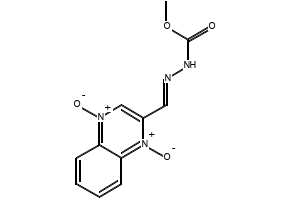
CAS Number6804-07-5
Synonymsfortigro; (1,4-dioxy-quinoxalin-2-ylmethylene)-hydrazinecarboxylic acid methyl ester; methyl-3-(2-quinoxalinylmethylene)carbazate N,N'-dioxide; karbadox; carabadox; methyl 3-(2-quinoxalinylmethylene)carbazate N1,N4-dioxide; Mecadox-S; Mecadox; CARBADO; getroxel; gs6244; EINECS 229-879-0; MFCD00057293
Molecular FormulaC11H10N4O4
Molecular Weight262.22
Purity98%
Density1.447g/cm3
Boiling Point405.47°C (rough estimate)
Melting Point239-240ºC
Symbol
Signal WordWarning
| Chemical & Physical Properties | |
|---|---|
| CAS Number | 6804-07-5 |
| Catalog No. | 2A-9085730 |
| Chinese Name | 卡巴多 |
| Synonyms | fortigro; (1,4-dioxy-quinoxalin-2-ylmethylene)-hydrazinecarboxylic acid methyl ester; methyl-3-(2-quinoxalinylmethylene)carbazate N,N'-dioxide; karbadox; carabadox; methyl 3-(2-quinoxalinylmethylene)carbazate N1,N4-dioxide; Mecadox-S; Mecadox; CARBADO; getroxel; gs6244; EINECS 229-879-0; MFCD00057293 |
| Molecular Formula | C11H10N4O4 |
| Molecular Weight | 262.22 |
| Purity | 98 |
| Density | 1.447g/cm3 |
| Boiling Point | 405.47°C (rough estimate) |
| Melting Point | 239-240ºC |
| Water Solubility | Soluble in 1N NaOH (50 mg/ml), and water (partly). |
| Storage Condition | 2-8°C |
| Application | Carbadox is a quinoxaline nitrogen dioxide antibiotic compound widely used in pigs of reproductive age to control intestinal diseases and improve feed utilization. |
| HTC | 29339900 |
| MDL Number | C11H10N4O4 |
| SMILES | COC(=O)NN=Cc1c[n+]([O-])c2ccccc2[n+]1[O-] |
| InChI | InChI=1S/C11H10N4O4/c1-19-11(16)13-12-6-8-7-14(17)9-4-2-3-5-10(9)15(8)18/h2-7,18H,1H3 |
| InChI Key | OVGGLBAWFMIPPY-WUXMJOGZSA-N |
| Hazard Symbols | transportation |
| MSDS | msds/85730_1_6804_07_5.pdf |
| Bioactivity | Carbadox is a quinoxaline-di-N-oxide antibiotic compound which is widely fed to nursery-age pigs to control enteric diseases and improve feed efficiency. Related Catalog Signaling Pathways >> Anti-infection >> Bacterial Research Areas >> Infection Target Bacterial[1] In Vitro The results of MTT assay demonstrate a dose-dependent decrease in mitochondrial activity in Vero cells at all concentrations of Carbadox. Treatment with Carbadox at the highest concentration of 160 μg/mL results in cell viability down to only 12%. Cells following Carbadox treatment show a dose-dependent increase of the DNA migration (p<0.01). The nuclear division index (NDI) reduces markedly with the increase doses of Carbadox[1]. In Vivo Alpha diversities (Shannon diversity, Heips evenness, and inverse Simpson indices) of samples from medicated piglets compare to non-medicated piglets are significantly different at 2, 3, and 4 days after continuous Carbadox, but not different in either late Carbadox or at any time during the withdrawal period. Analysis of the community structure of bacteria in animals shows significant differences at days 3 and 4 of early Carbadox treatment ([R=0.32, p=0.015] and [R=0.54, p=0.003], respectively), but not before starting antibiotic treatment (p=0.82). No significant differences in E. coli colony forming units (CFUs) are observed during the Carbadox-treatment period of the study or late in the withdrawal period. E. coli CFUs are significantly different between the medicated and non-medicated groups on day 2 after the withdrawal of Carbadox[2]. Cell Assay Exponentially growing Vero cells are seeded at 104 cells/well density in 96 microplates and exposed to various concentrations of Carbadox (5, 10, 20, 40, 80, 160, 210, 260, 310 and 360 μg/mL). Cells incubated with the same concentration DMSO are used as a control. After 4 h or 24 h, each well is added 100 μL MTT solution (200 μg/mL) followed incubation for 4 h at 37 °C, and the medium containing MTT is removed. The formazan crystals in the viable cells are solubilized with 100 μL DMSO and the absorbance at 570 nm of each well is read using a microplate reader. All experiments are performed at least 3 times, with 6 wells for each concentration of Carbadox (n=6 per experiment). Final results are the average of three independent experiments. The cell viability is calculated as follows: OD of experimental group/(OD of control group-OD of blank group)×100%. The data are presented as means±SE[1]. Animal Admin At 3 weeks of age, 12 piglets from 2 litters are divided into two rooms of six pigs each, with equal representation of littermates and gender. All pigs are fed a standard starter diet ad libitum for 3 weeks, after which six control pigs continue to receive non-medicated feed while the other group receives feed containing Carbadox (50 g/ton). After 21 days of continuous feed with or without Carbadox, all pigs (60 days old) are switched to a non-medicated maintenance diet. Feces are collected from each pig at multiple times before, during, and after antibiotic withdrawal[2]. References [1]. Chen Q, et al. Investigation of the genotoxicity of quinocetone, carbadox and olaquindox in vitro using Vero cells. Food Chem Toxicol. 2009 Feb;47(2):328-34. [2]. Looft T, et al. Carbadox has both temporary and lasting effects on the swine gut microbiota. Front Microbiol. 2014 Jun 10;5:276. Chemical & Physical Properties Density 1.447g/cm3 Boiling Point 405.47°C (rough estimate) Melting Point 239-240ºC Molecular Formula C11H10N4O4 Molecular Weight 262.22200 Flash Point 18°(64°F) Exact Mass 262.07000 PSA 101.61000 LogP 1.77760 Index of Refraction 1.648 InChIKey OVGGLBAWFMIPPY-WUXMJOGZSA-N SMILES COC(=O)NN=Cc1c[n+]([O-])c2ccccc2[n+]1[O-] Storage condition 2-8°C Water Solubility Soluble in 1N NaOH (50 mg/ml), and water (partly). |
| Use of | Carbadox is a quinoxaline-di-N-oxide antibiotic compound which is widely fed to nursery-age pigs to control enteric diseases and improve feed efficiency. Properties Articles29 Name Carbadox Synonym More Synonyms Carbadox Biological Activity Description Carbadox is a quinoxaline-di-N-oxide antibiotic compound which is widely fed to nursery-age pigs to control enteric diseases and improve feed efficiency. Related Catalog Signaling Pathways >> Anti-infection >> Bacterial Research Areas >> Infection Bacterial[1] In Vitro The results of MTT assay demonstrate a dose-dependent decrease in mitochondrial activity in Vero cells at all concentrations of Carbadox. Treatment with Carbadox at the highest concentration of 160 μg/mL results in cell viability down to only 12%. Cells following Carbadox treatment show a dose-dependent increase of the DNA migration (p<0.01). The nuclear division index (NDI) reduces markedly with the increase doses of Carbadox[1]. References [1]. Chen Q, et al. Investigation of the genotoxicity of quinocetone, carbadox and olaquindox in vitro using Vero cells. Food Chem Toxicol. 2009 Feb;47(2):328-34. [2]. Looft T, et al. Carbadox has both temporary and lasting effects on the swine gut microbiota. Front Microbiol. 2014 Jun 10;5:276. Chemical & Physical Properties Molecular Formula C11H10N4O4 Exact Mass 262.07000 PSA 101.61000 LogP 1.77760 Index of Refraction 1.648 InChIKey OVGGLBAWFMIPPY-WUXMJOGZSA-N |
| Transport Info | Shipping Name: UN |
| MSDS Transport Info | Module 14. Shipping information 14.1 UN dangerous goods number European Land Transport Danger Regulations: 1325 International Maritime Transport Danger Regulations: 1325 International Air Transport Danger Regulations: 1325 14.2 United Nations shipping name European Land Transport Dangerous Regulations: FLAMMABLE SOLID, ORGANIC, N.O.S. (Carbadox) IMDG: FLAMMABLE SOLID, ORGANIC, N.O.S. (Carbadox) International Air Transport Dangerous Regulations: Flammable solid, organic, n.o.s. (Carbadox) 14.3 Transport hazard categories European Land Transport Danger Regulations: 4.1 International Maritime Transport Danger Regulations: 4.1 International Air Transport Danger Regulations: 4.1 14.4 Package group European Dangerous Regulations for land transport: II International Dangerous Regulations for sea transport: II International Dangerous Regulations for air transport: II 14.5 Environmental hazards European Land Transport Danger Regulations: No International Maritime Danger Regulations International Air Transport Danger Regulations: No Marine pollutants (yes/no): No 14.6 Special reminder to users No data available The above information is believed to be correct, but is not all-inclusive and should be used as a guide only. The information in this document is based on our current knowledge and is Correct safety instructions apply to this product. This information does not represent a warranty as to the properties of this product. See reverse side of invoice or packing slip. |
| Related Products in Specialty Chemicals | ||
|---|---|---|
| 5-Bromo-n-(carboxymethyl)anthranilicacid | 32253-75-1 | 2A-9085721 |
| Arachidicacidethylester | 18281-05-5 | 2A-9085723 |
| Benzylxoycarbonyl-L-proline4-nitrophenylester | 3304-59-4 | 2A-9085725 |
| Calciumphthalatehydrate | 5793-85-1 | 2A-9085727 |
| Caproicacid2,4,6-tribromophenylester | 16732-09-5 | 2A-9085728 |
| 1-Bromo-2-(trifluoromethoxy)benzene | 641115-88-4 | 2A-9085732 |
| N-Hydroxynaphthalimidesodiumsalt | 6207-89-2 | 2A-9085733 |
| 5-Amino-2-methylbenzotrifluoride | 65934-79-9 | 2A-9085735 |
| 4-Bromo-2-fluorocinnamicacid | 14994-19-3 | 2A-9085737 |
| 3-(Trifluoromethoxy)benzylchloride | 89807-43-2 | 2A-9085739 |
| Browse all Specialty Chemicals products » | ||
Phone:
630-322-8886
630-322-8887
Email:
Office Locations:
Chicago, IL, USA
San Francisco, CA, USA


 EN
EN


 SDS
SDS