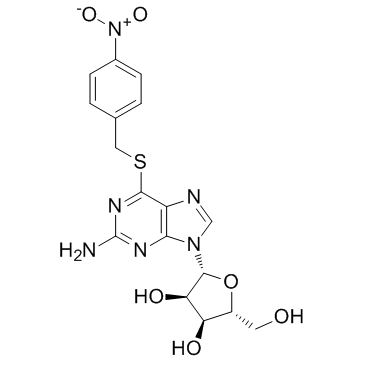
CAS Number13153-27-0
SynonymsS-(P-NITROBENZYL)-6-THIOGUANOSINE; S-(4-NITROBENZYL)-6-THIOGUANOSINE (NBTG) POTENT ADENOSINE TRAN; 6-(4-nitrobenzylthio)guanosine; S-(4-nitro-benzyl)-6-thio-guanosine
Molecular FormulaC17H18N6O6S
Molecular Weight434.42600
Purity99%
Density1.87g/cm3
Boiling Point858.3ºC at 760mmHg
Melting Point203-205ºC
| Chemical & Physical Properties | |
|---|---|
| CAS Number | 13153-27-0 |
| Catalog No. | 2A-9008510 |
| Chinese Name | S-(对硝基苄基)-6-硫鸟嘌呤 |
| Synonyms | S-(P-NITROBENZYL)-6-THIOGUANOSINE; S-(4-NITROBENZYL)-6-THIOGUANOSINE (NBTG) POTENT ADENOSINE TRAN; 6-(4-nitrobenzylthio)guanosine; S-(4-nitro-benzyl)-6-thio-guanosine |
| Molecular Formula | C17H18N6O6S |
| Molecular Weight | 434.42600 |
| Purity | 99 |
| Density | 1.87g/cm3 |
| Boiling Point | 858.3ºC at 760mmHg |
| Melting Point | 203-205ºC |
| Storage Condition | Sealed in a cool, dry environment at 0-6 ºC |
| Application | NBTGR (p-Nitrobenzylthioguanosine) is a potent inhibitor of nucleoside transport; the Ki value for inhibiting adenosine uptake is 70 nM. |
| SMILES | Nc1nc(SCc2ccc([N+](=O)[O-])cc2)c2ncn(C3OC(CO)C(O)C3O)c2n1 |
| InChI | InChI=1S/C17H18N6O6S/c18-17-20-14-11(19-7-22(14)16-13(26)12(25)10(5-24)29-16)15(21-17)30-6-8-1-3-9(4-2-8)23(27)28/h1-4,7,10,12-13,16,24-26H,5-6H2,(H2,18,20,21) |
| InChI Key | BRSNNJIJEZWSBU-XNIJJKJLSA-N |
| Bioactivity | NBTGR (p-Nitrobenzylthioguanosine) is a potent inhibitor of nucleoside transport; inhibits adenosine uptake with a Ki of 70 nM. Related Catalog Signaling Pathways >> Others >> Others Research Areas >> Cardiovascular Disease Target Ki: 70 nM (adenosine uptake)[1] In Vitro A group of purine ribonucleosides with alkarylmercapto substituents at the purine 6-position are potent inhibitors of several aspects of nucleoside metabolism that involved the transfer of ribosyl groups. NBTGR is one of the compounds that inhibits nucleoside transport by human erythrocytes; initial rates of uridine uptake are reduced to zero upon exposure of cells to 1 μM NBTGR. The inhibitor is firmly bound because repeated washing cannot restore uridine transport capability to NBTGR-treated cells. NBTGR inhibits the influx of uridine, inosine, and cytidine, without inhibiting the uptake of the corresponding bases, or that of D-glucose or L-leucine. Uridine antagonizes the NBTGR inhibition of uidine transport in a concentration-dependent manner. NBTGR and related compounds appear to interact with the mechanism for the facilitated transport of nucleosides[2]. References [1]. Turnheim K, et al. Inhibition of adenosine uptake in human erythrocytes by adenosine-5'-carboxamides, xylosyladenine, dipyridamole, hexobendine, and p-nitrobenzylthioguanosine. Biochem Pharmacol. 1978;27(18):2191-7. [2]. Parterson A, et al. Nucleoside Transport II Inhibition by p-Nitrobeazylthiogoanosine and Related Compounds. Can. J. Biochem. 49,271-274 (1971) Chemical & Physical Properties Density 1.87g/cm3 Boiling Point 858.3ºC at 760mmHg Melting Point 203-205ºC Molecular Formula C17H18N6O6S Molecular Weight 434.42600 Flash Point 472.9ºC Exact Mass 434.10100 PSA 210.66000 LogP 1.32490 Vapour Pressure 2.2E-31mmHg at 25°C Index of Refraction 1.844 InChIKey BRSNNJIJEZWSBU-XNIJJKJLSA-N SMILES Nc1nc(SCc2ccc([N+](=O)[O-])cc2)c2ncn(C3OC(CO)C(O)C3O)c2n1 |
| Use of | NBTGR (p-Nitrobenzylthioguanosine) is a potent inhibitor of nucleoside transport; inhibits adenosine uptake with a Ki of 70 nM. Properties Name nbtgr Synonym More Synonyms NBTGR Biological Activity Description NBTGR (p-Nitrobenzylthioguanosine) is a potent inhibitor of nucleoside transport; inhibits adenosine uptake with a Ki of 70 nM. Related Catalog Signaling Pathways >> Others >> Others Research Areas >> Cardiovascular Disease Ki: 70 nM (adenosine uptake)[1] In Vitro A group of purine ribonucleosides with alkarylmercapto substituents at the purine 6-position are potent inhibitors of several aspects of nucleoside metabolism that involved the transfer of ribosyl groups. NBTGR is one of the compounds that inhibits nucleoside transport by human erythrocytes; initial rates of uridine uptake are reduced to zero upon exposure of cells to 1 μM NBTGR. The inhibitor is firmly bound because repeated washing cannot restore uridine transport capability to NBTGR-treated cells. NBTGR inhibits the influx of uridine, inosine, and cytidine, without inhibiting the uptake of the corresponding bases, or that of D-glucose or L-leucine. Uridine antagonizes the NBTGR inhibition of uidine transport in a concentration-dependent manner. NBTGR and related compounds appear to interact with the mechanism for the facilitated transport of nucleosides[2]. References [1]. Turnheim K, et al. Inhibition of adenosine uptake in human erythrocytes by adenosine-5'-carboxamides, xylosyladenine, dipyridamole, hexobendine, and p-nitrobenzylthioguanosine. Biochem Pharmacol. 1978;27(18):2191-7. [2]. Parterson A, et al. Nucleoside Transport II Inhibition by p-Nitrobeazylthiogoanosine and Related Compounds. Can. J. Biochem. 49,271-274 (1971) Chemical & Physical Properties Molecular Formula C17H18N6O6S Exact Mass 434.10100 PSA 210.66000 LogP 1.32490 Index of Refraction 1.844 InChIKey BRSNNJIJEZWSBU-XNIJJKJLSA-N |
| Transport Info | Product name: S-(p-nitrobenzyl)-6-thioguanine |
| Related Products in Specialty Chemicals | ||
|---|---|---|
| N-Benzylglycine hydrochloride | 7689-50-1 | 2A-9008491 |
| N-Benzylisatoic anhydride | 35710-05-5 | 2A-9008492 |
| N-Benzyloxycarbonyl-3-fluoro-4-morpholinoaniline | 168828-81-7 | 2A-9008493 |
| N-Benzyloxycarbonylglycine thioamide | 49548-40-5 | 2A-9008494 |
| N-Benzylphthalimide | 2142-01-0 | 2A-9008497 |
| n-butyl glycidyl ether | 2426-08-6 | 2A-9008511 |
| n-Butyl-1,1,2,2-tetrafluoroethyl ether | 358-37-2 | 2A-9008512 |
| N-Butyl-3-cyano-6-hydroxy-4-methyl-2-pyridone | 39108-47-9 | 2A-9008513 |
| n-Butyllithium | 109-72-8 | 2A-0201935 |
| n-Butylmalonic acid | 534-59-8 | 2A-9008516 |
| Browse all Specialty Chemicals products » | ||
Phone:
630-322-8886
630-322-8887
Email:
Office Locations:
Chicago, IL, USA
San Francisco, CA, USA


 EN
EN


 SDS
SDS