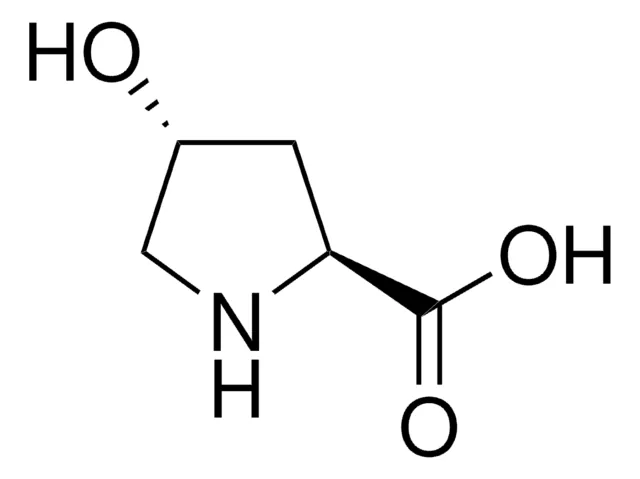
CAS Number51-35-4
Synonyms4-Hydroxyproline; (2S,4R)-4-hydroxypyrrolidinium-2-carboxylate; Hydroxyproline; MFCD00064320; L-Hydroxyproline; trans-Lachnophyllol; trans-4-hydroxyproline; trans-L-4-hydroxyproline; (2S,4R)-(-)-4-Hydroxypyrrolidine-2-carboxylic acid; trans-4-Hydroxy-L-proline; dec-2t-ene-4,6-diyn-1-ol; L-trans-4-hydroxyproline; (2S,4R)-4-Hydroxy-pyrrolidine-2-carboxylic acid; Dec-2t-en-4,6-diin-1-ol; EINECS 200-091-9; rans-4-Hydroxy-L-proline; (-)-(2S,4R)-4-HYDROXYPROLINE; (2S,4R)-4-hydroxyproline; (2S,4R)-4-Hydroxypyrrolidine-2-carboxylic acid; 4-Hydroxy-2-pyrrolidinecarboxylic acid; (trans)-4-Hydroxy-L-proline; (2S,4R)-trans-4-hydroxyproline; (4R)-4-Hydroxy-L-proline; (2S,4R)-4-Hydroxypyrrolidine-2-carboxylic acid,Hyp
Molecular FormulaC5H9NO3
Molecular Weight131.13
Purity≥99%
Density1.4±0.1 g/cm3
Boiling Point355.2±42.0 °C at 760 mmHg
Melting Point273 °C (dec.) (lit.)
Appearancecrystalline powder
EINECS200-091-9
Symbol
Signal WordWarning
| Chemical & Physical Properties | |
|---|---|
| CAS Number | 51-35-4 |
| Catalog No. | 2A-9008131 |
| Chinese Name | L-羟脯氨酸 |
| Synonyms | 4-Hydroxyproline; (2S,4R)-4-hydroxypyrrolidinium-2-carboxylate; Hydroxyproline; MFCD00064320; L-Hydroxyproline; trans-Lachnophyllol; trans-4-hydroxyproline; trans-L-4-hydroxyproline; (2S,4R)-(-)-4-Hydroxypyrrolidine-2-carboxylic acid; trans-4-Hydroxy-L-proline; dec-2t-ene-4,6-diyn-1-ol; L-trans-4-hydroxyproline; (2S,4R)-4-Hydroxy-pyrrolidine-2-carboxylic acid; Dec-2t-en-4,6-diin-1-ol; EINECS 200-091-9; rans-4-Hydroxy-L-proline; (-)-(2S,4R)-4-HYDROXYPROLINE; (2S,4R)-4-hydroxyproline; (2S,4R)-4-Hydroxypyrrolidine-2-carboxylic acid; 4-Hydroxy-2-pyrrolidinecarboxylic acid; (trans)-4-Hydroxy-L-proline; (2S,4R)-trans-4-hydroxyproline; (4R)-4-Hydroxy-L-proline; (2S,4R)-4-Hydroxypyrrolidine-2-carboxylic acid,Hyp |
| Molecular Formula | C5H9NO3 |
| Molecular Weight | 131.13 |
| Purity | ≥99 |
| Density | 1.4±0.1 g/cm3 |
| Boiling Point | 355.2±42.0 °C at 760 mmHg |
| Melting Point | 273 °C (dec.) (lit.) |
| Appearance | crystalline powder |
| Water Solubility | 357.8 g/L (20 º C) |
| Storage Condition | 1. Protect from light and store in a sealed contai |
| Application | L-Hydroxyproline is one of the isomers of hydroxyproline (Hyp) and a useful chiral building block in the production of many drugs. |
| EINECS | 200-091-9 |
| HTC | 2933990090 |
| PubChem ID | 24895692 |
| MDL Number | MFCD00064320 |
| SMILES | O[C@H]1CN[C@@H](C1)C(O)=O |
| InChI | 1S/C5H9NO3/c7-3-1-4(5(8)9)6-2-3/h3-4,6-7H,1-2H2,(H,8,9)/t3-,4+/m1/s1 |
| InChI Key | PMMYEEVYMWASQN-DMTCNVIQSA-N |
| Beilstein/REAXYS | 81441 |
| NACRES Code | NA.22 |
| UNSPSC | 12352209 |
| Hazard Symbols | Transport |
| MSDS | msds/8131_1_51_35_4.pdf |
| Bioactivity | L-Hydroxyproline, one of the hydroxyproline (Hyp) isomers, is a useful chiral building block in the production of many pharmaceuticals. Related Catalog Natural Products >> Others Research Areas >> Others Target Human Endogenous Metabolite In Vitro L-Hydroxyproline (Trans-4-hydroxy-L-proline;Trans-Hyp) has been widely used in medicine, biochemistry, food, cosmetic and other aspects of industry. Additionally, L-Hydroxyproline has also been found in the composition of some secondary metabolites such as actinomycins and echinocandins. L-Hydroxyproline is manufactured industrially most by acid hydrolysis of mammalian collagen because of its rich amount in the collagen[1]. References [1]. Yi Y, et al. Biosynthesis of trans-4-hydroxyproline by recombinant strains of Corynebacterium glutamicum and Escherichia coli. BMC Biotechnol. 2014 May 19;14:44. Chemical & Physical Properties Density 1.4±0.1 g/cm3 Boiling Point 355.2±42.0 °C at 760 mmHg Melting Point 273 °C (dec.)(lit.) Molecular Formula C5H9NO3 Molecular Weight 131.130 Flash Point 168.6±27.9 °C Exact Mass 131.058243 PSA 69.56000 LogP -1.84 Vapour Pressure 0.0±1.8 mmHg at 25°C Index of Refraction 1.540 Water Solubility 357.8 g/L (20 º C) |
| Use of | L-Hydroxyproline, one of the hydroxyproline (Hyp) isomers, is a useful chiral building block in the production of many pharmaceuticals. Properties Articles133 Name 4-hydroxy-L-proline Synonym More Synonyms L-Hydroxyproline Biological Activity Description L-Hydroxyproline, one of the hydroxyproline (Hyp) isomers, is a useful chiral building block in the production of many pharmaceuticals. Related Catalog Natural Products >> Others Research Areas >> Others Human Endogenous Metabolite In Vitro L-Hydroxyproline (Trans-4-hydroxy-L-proline;Trans-Hyp) has been widely used in medicine, biochemistry, food, cosmetic and other aspects of industry. Additionally, L-Hydroxyproline has also been found in the composition of some secondary metabolites such as actinomycins and echinocandins. L-Hydroxyproline is manufactured industrially most by acid hydrolysis of mammalian collagen because of its rich amount in the collagen[1]. References [1]. Yi Y, et al. Biosynthesis of trans-4-hydroxyproline by recombinant strains of Corynebacterium glutamicum and Escherichia coli. BMC Biotechnol. 2014 May 19;14:44. Chemical & Physical Properties Molecular Formula C5H9NO3 Exact Mass 131.058243 PSA 69.56000 LogP -1.84 Index of Refraction 1.540 |
| Tax Rebate | 13.0% |
| Supervision | None. MFN tariff: 6.5%. Ordinary tariff: 20.0% |
| Transport Info | Shipping Name: UN |
| MSDS Transport Info | Module 14. Shipping information 14.1 UN dangerous goods number European Land Transport Dangerous Regulations: -International Maritime Dangerous Regulations: -International Air Transport Dangerous Regulations: - 14.2 United Nations shipping name European Land Transport Dangerous Regulations: Non-dangerous goods IMDG Code: Non-dangerous goods International air transport dangerous goods regulations: non-dangerous goods 14.3 Transport hazard categories European Land Transport Dangerous Regulations: -International Maritime Dangerous Regulations: -International Air Transport Dangerous Regulations: - 14.4 Package group European Land Transport Dangerous Regulations: -International Maritime Dangerous Regulations: -International Air Transport Dangerous Regulations: - 14.5 Environmental hazards European Land Transport Danger Regulations: No International Maritime Danger Regulations International Air Transport Danger Regulations: No Marine pollutants (yes/no): No 14.6 Special reminder to users No data available |
| Related Products in Specialty Chemicals | ||
|---|---|---|
| Levosimendan dazinones intermediates | 36725-28-7 | 2A-9008121 |
| L-Homoarginine hydrochloride | 1483-01-8 | 2A-9008127 |
| L-Homophenylalanine | 943-73-7 | 2A-9008128 |
| L-Homophenylalanine ethyl ester hydrochloride | 90891-21-7 | 2A-9008129 |
| L-Homoserine | 672-15-1 | 2A-9008130 |
| Lithium bromide | 7550-35-8 | 2A-9008132 |
| L-Lysine base | 70-54-2 | 2A-9008134 |
| L-Menthyl glyoxylate hydrate | 111969-64-3 | 2A-9008135 |
| L-Menthyl lactate | 61597-98-6 | 2A-9008136 |
| L-Menthylacrylate | 4835-96-5 | 2A-9008137 |
| Browse all Specialty Chemicals products » | ||
Phone:
630-322-8886
630-322-8887
Email:
Office Locations:
Chicago, IL, USA
San Francisco, CA, USA


 EN
EN


 SDS
SDS