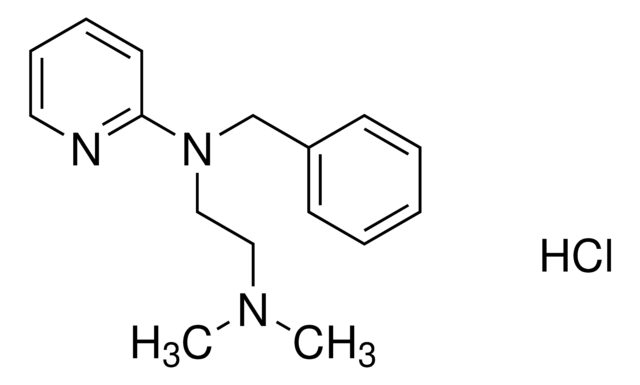
CAS Number154-69-8
SynonymsAhistamin; Tripelennamine (hydrochloride); EINECS 205-833-5; ReCovr; dehistin; pyrabenzamine; pyrinamine; piristin; stanzamine; Tripelenamin*HCl; TRIPELENAMINEHCL; Azaron; tri-tumine; tripelennamine HCl
Molecular FormulaC16H22ClN3
Molecular Weight291.827
Density1.20
Boiling Point387.8ºC at 760 mmHg
Melting Point192-193ºC
Appearancewhite solid
Symbol
Signal WordWarning
| Chemical & Physical Properties | |
|---|---|
| CAS Number | 154-69-8 |
| Catalog No. | 2A-9080569 |
| Chinese Name | 盐酸曲吡那敏 |
| Synonyms | Ahistamin; Tripelennamine (hydrochloride); EINECS 205-833-5; ReCovr; dehistin; pyrabenzamine; pyrinamine; piristin; stanzamine; Tripelenamin*HCl; TRIPELENAMINEHCL; Azaron; tri-tumine; tripelennamine HCl |
| Molecular Formula | C16H22ClN3 |
| Molecular Weight | 291.827 |
| Density | 1.20 |
| Boiling Point | 387.8ºC at 760 mmHg |
| Melting Point | 192-193ºC |
| Appearance | white solid |
| Storage Condition | Refrigerator |
| Application | Tripelennamine hydrochloride is an H1 receptor antagonist. |
| HTC | 2933399090 |
| MDL Number | MFCD00012815 |
| SMILES | CN(C)CCN(Cc1ccccc1)c1ccccn1.Cl |
| InChI | InChI=1S/C16H21N3.ClH/c1-18(2)12-13-19(16-10-6-7-11-17-16)14-15-8-4-3-5-9-15;/h3-11H,12-14H2,1-2H3;1H |
| InChI Key | FSSICIQKZGUEAE-UHFFFAOYSA-N |
| Hazard Symbols | transportation |
| MSDS | msds/80569_1_154_69_8.pdf |
| Bioactivity | Tripelennamine Hcl, a H1-receptor antagonist, is a psychoactive drug and member of the pyridine andethylenediamine classes that is used as an antipruritic and first-generation antihistamine.IC50 Value:Target: Histamine H1 receptorTripelennamine can be used in the treatment of asthma, hay fever, rhinitus and urticaria.in vitro: Arterial and mixed venous blood-gas and pH measurements were made at rest before and after saline or drug administration and during incremental exercise leading to maximal exertion at 14 m/s on 3.5% uphill grade for 120 s. Galloping at this workload elicited maximal heart rate and induced exercise-induced pulmonary hemorrhage in all horses in both treatments, thereby indicating that capillary stress failure-related pulmonary injury had occurred [1].in vivo: The data obtained (median and range in brackets) in camels and horses, respectively, were as follows: the terminal elimination half-lives were 2.39 (1.91-6.54) and 2.08 (1.31-5.65) h, total body clearances were 0.97 (0.82-1.42) and 0.84 (0.64-1.17)L/h/kg. The volumes of distribution at steady state were 2.87 (1.59-6.67) and 1.69 (1.18-3.50) L/kg, the volumes of the central compartment of the two compartment pharmacokinetic model were 1.75 (0.68-2.27) and 1.06 (0.91-2.20) L/kg [2]. After intramuscular administration of 50 or 100 mg tripelennamine, mean plasma concentrations at 30 minutes were 105 and 194 ng/ml, respectively, and mean plasma t1/2 values were 2.9 and 4.4 hours, respectively [3]. Related Catalog Signaling Pathways >> GPCR/G Protein >> Histamine Receptor Signaling Pathways >> Immunology/Inflammation >> Histamine Receptor Research Areas >> Inflammation/Immunology References [1]. Manohar M, Goetz TE, Humphrey S, H1-receptor antagonist, tripelennamine, does not affect arterial hypoxemia in exercising Thoroughbreds. J Appl Physiol. 2002 Apr;92(4):1515-23. [2]. Wasfi IA, Abdel Hadi AA, Elghazali M, Comparative disposition of tripelennamine in horses and camels after intravenous administration. J Vet Pharmacol Ther. 2000 Jun;23(3):145-52. [3]. Yeh SY, Todd GD, Johnson RE, The pharmacokinetics of pentazocine and tripelennamine. Clin Pharmacol Ther. 1986 Jun;39(6):669-76. Chemical & Physical Properties Density 1.20 Boiling Point 387.8ºC at 760 mmHg Melting Point 192-193ºC Molecular Formula C16H22ClN3 Molecular Weight 291.81900 Flash Point 188.3ºC Exact Mass 291.15000 PSA 19.37000 LogP 3.45180 Vapour Pressure 3.21E-06mmHg at 25°C InChIKey FSSICIQKZGUEAE-UHFFFAOYSA-N SMILES CN(C)CCN(Cc1ccccc1)c1ccccn1.Cl Storage condition Refrigerator |
| Use of | Properties Articles28 Name tripelennamine hydrochloride Synonym More Synonyms Tripelennamine (hydrochloride) Biological Activity Related Catalog Signaling Pathways >> GPCR/G Protein >> Histamine Receptor Signaling Pathways >> Immunology/Inflammation >> Histamine Receptor Research Areas >> Inflammation/Immunology References [1]. Manohar M, Goetz TE, Humphrey S, H1-receptor antagonist, tripelennamine, does not affect arterial hypoxemia in exercising Thoroughbreds. J Appl Physiol. 2002 Apr;92(4):1515-23. [2]. Wasfi IA, Abdel Hadi AA, Elghazali M, Comparative disposition of tripelennamine in horses and camels after intravenous administration. J Vet Pharmacol Ther. 2000 Jun;23(3):145-52. [3]. Yeh SY, Todd GD, Johnson RE, The pharmacokinetics of pentazocine and tripelennamine. Clin Pharmacol Ther. 1986 Jun;39(6):669-76. Chemical & Physical Properties Exact Mass 291.15000 PSA 19.37000 LogP 3.45180 InChIKey FSSICIQKZGUEAE-UHFFFAOYSA-N Storage condition Refrigerator |
| Tax Rebate | 13.0% |
| Supervision | None. MFN tariff: 6.5%. Ordinary tariff: 20.0% |
| Transport Info | Shipping Name: UN |
| MSDS Transport Info | Module 14. Shipping information 14.1 UN dangerous goods number European Land Transport Dangerous Regulations: -International Maritime Dangerous Regulations: -International Air Transport Dangerous Regulations: - 14.2 United Nations shipping name European Land Transport Dangerous Regulations: Non-dangerous goods IMDG Code: Non-dangerous goods International air transport dangerous goods regulations: non-dangerous goods 14.3 Transport hazard categories European Land Transport Dangerous Regulations: -International Maritime Dangerous Regulations: -International Air Transport Dangerous Regulations: - 14.4 Package group European Land Transport Dangerous Regulations: -International Maritime Dangerous Regulations: -International Air Transport Dangerous Regulations: - 14.5 Environmental hazards European Land Transport Danger Regulations: No International Maritime Danger Regulations International Air Transport Danger Regulations: No Marine pollutants (yes/no): No 14.6 Special reminder to users No data available |
| Related Products in Plastic & Specialty Additives | ||
|---|---|---|
| 2-Chloro-5-fluoro-4-iodopyridine | 884494-49-9 | 2A-9080384 |
| 3-Bromo-2-fluoro-4-iodopyridine | 884494-52-4 | 2A-9080385 |
| 2,4,6-Triphenylaniline | 6864-20-6 | 2A-9080436 |
| (2-Dimethylaminoethyl)triphenylphosphoniumBromide | 21331-80-6 | 2A-9080557 |
| (N-Methyl-N-Phenylamino)triphenylphosphoniumIodide | 34257-63-1 | 2A-9080558 |
| 3-Acetamidopiperidine | 5810-55-9 | 2A-9080737 |
| Indophenol | 500-85-6 | 2A-9080766 |
| Alpha-Propyldopacetamide | 154-62-1 | 2A-9080987 |
| 5-(3-Iodopropoxy)-2-nitrobenzylalcohol | 185994-27-8 | 2A-9081561 |
| N-(2-Acetamidophenethyl)-1-hydroxy-2-naphthamide | 5254-41-1 | 2A-9081573 |
| Browse all Plastic & Specialty Additives products » | ||
Phone:
630-322-8886
630-322-8887
Email:
Office Locations:
Chicago, IL, USA
San Francisco, CA, USA


 EN
EN


 SDS
SDS