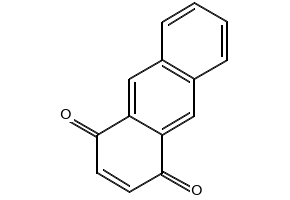
| Chemical & Physical Properties | |
|---|---|
| CAS Number | 635-12-1 |
| Catalog No. | 2A-9080049 |
| Chinese Name | 1,4-蒽醌 |
| Synonyms | anthracene-1,4-dione; EINECS 211-228-7; MFCD00013724 |
| Molecular Formula | C14H8O2 |
| Molecular Weight | 208.22 |
| Density | 1.328 g/cm3 |
| Boiling Point | 406ºC at 760 mmHg |
| Melting Point | 217°C |
| Appearance | orange brown solid |
| Storage Condition | Store in an airtight container in a cool, dry plac |
| Application | 1,4-Anthraquinone is a potent anticancer agent. 1,4-Anthraquinone blocks nucleoside transport, inhibits macromolecule synthesis, induces DNA fragmentation, and reduces the growth and viability of canc |
| HTC | 2914690090 |
| MDL Number | MFCD00013724 |
| SMILES | O=C1C=CC(=O)c2cc3ccccc3cc21 |
| InChI | InChI=1S/C14H8O2/c15-13-5-6-14(16)12-8-10-4-2-1-3-9(10)7-11(12)13/h1-8H |
| InChI Key | LSOTZYUVGZKSHR-UHFFFAOYSA-N |
| MSDS | msds/80049_1_635_12_1.pdf |
| Bioactivity | 1,4-Anthraquinone is a potent anticancer agent. 1,4-Anthraquinone blocks nucleoside transport, inhibits macromolecule synthesis, induces DNA fragmentation, and decreases the growth and viability of cancer cells. 1,4-Anthraquinone can be used to research anti-leukemia[1]. Related Catalog Research Areas >> Cancer Signaling Pathways >> Cell Cycle/DNA Damage >> DNA/RNA Synthesis Target DNA/RNA synthesis[1] In Vitro 1,4-Anthraquinone (2.62 nM-1.6 μM; 4 days) induces significant antiproliferative and cytotoxic effects in L1210 cells after 4 days at 6.55 nM; inhibits cell viability with IC50s of 100 nM at day 2 and 25 nM at day 4[1]. 1,4-Anthraquinone (40.96 nM-25 μM; 30 min; L1210 cells) inhibits nucleoside transport by 71 and 92% and DNA synthesis by 84 and 96% at 4 and 10 μM, respectively, and are both irreversible upon drug removal[1]. 1,4-Anthraquinone (0.1024-25 μM; 3 h) inhibits the rates of RNA and protein syntheses (IC50 = 2 μM) in a dose-dependent manner[1]. Cell Proliferation Assay[1] Cell Line: L1210 cells Concentration: 2.62 nM-1.6 μM Incubation Time: 4 days Result: Induced significant antiproliferative and cytotoxic effects after 4 days at 6.55 nM. Cell Viability Assay[1] Cell Line: L1210 cells Concentration: 2.62 nM-1.6 μM Incubation Time: 4 days Result: Inhibited cell viability with IC50s of 100 nM at day 2 and 25 nM at day 4. Chemical & Physical Properties Density 1.328 g/cm3 Boiling Point 406ºC at 760 mmHg Melting Point 217°C Molecular Formula C14H8O2 Molecular Weight 208.21200 Flash Point 152ºC Exact Mass 208.05200 PSA 34.14000 LogP 2.77500 Index of Refraction 1.702 InChIKey LSOTZYUVGZKSHR-UHFFFAOYSA-N SMILES O=C1C=CC(=O)c2cc3ccccc3cc21 |
| Use of | 1,4-Anthraquinone is a potent anticancer agent. 1,4-Anthraquinone blocks nucleoside transport, inhibits macromolecule synthesis, induces DNA fragmentation, and decreases the growth and viability of cancer cells. 1,4-Anthraquinone can be used to research anti-leukemia[1]. Properties Name 1,4-Anthraquinone Synonym More Synonyms 1,4-Anthracenedione Biological Activity Description 1,4-Anthraquinone is a potent anticancer agent. 1,4-Anthraquinone blocks nucleoside transport, inhibits macromolecule synthesis, induces DNA fragmentation, and decreases the growth and viability of cancer cells. 1,4-Anthraquinone can be used to research anti-leukemia[1]. Related Catalog Research Areas >> Cancer Signaling Pathways >> Cell Cycle/DNA Damage >> DNA/RNA Synthesis DNA/RNA synthesis[1] Chemical & Physical Properties Molecular Formula C14H8O2 Exact Mass 208.05200 PSA 34.14000 LogP 2.77500 Index of Refraction 1.702 InChIKey LSOTZYUVGZKSHR-UHFFFAOYSA-N |
| Tax Rebate | 9.0% |
| Supervision | None MFN tariff: 5.5% Ordinary tariff: 30.0% |
| Transport Info | Product name: Purity: 95.0% |
| MSDS Transport Info | Module 14. Shipping information United Nations classification: inconsistent with United Nations classification standards UN number: not specified |
Phone:
630-322-8886
630-322-8887
Email:
Office Locations:
Chicago, IL, USA
San Francisco, CA, USA


 EN
EN


 SDS
SDS