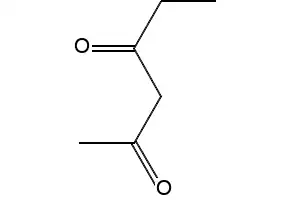
CAS Number3002-24-2
SynonymsMethylacetylacetone; EINECS 221-094-1; hexane-2,4-dione; 2,4-hexandione; 3-methyl-acetylacetone; Propionylacetone; methyl acetylacetone; 2,4-Hexanedione; 2,4-DICHLORO-1,1,1,6,6,6-HEXAFLUORO-2-HEXENE; Acetone,propionyl
Molecular FormulaC6H10O2
Molecular Weight114.142
Density0.9±0.1 g/cm3
Boiling Point161.2±13.0 °C at 760 mmHg
AppearanceTransparent colorless to yellow liquid
Symbol
Signal WordWarning
| Chemical & Physical Properties | |
|---|---|
| CAS Number | 3002-24-2 |
| Catalog No. | 2A-9078398 |
| Chinese Name | 2,4-己二酮 |
| Synonyms | Methylacetylacetone; EINECS 221-094-1; hexane-2,4-dione; 2,4-hexandione; 3-methyl-acetylacetone; Propionylacetone; methyl acetylacetone; 2,4-Hexanedione; 2,4-DICHLORO-1,1,1,6,6,6-HEXAFLUORO-2-HEXENE; Acetone,propionyl |
| Molecular Formula | C6H10O2 |
| Molecular Weight | 114.142 |
| Density | 0.9±0.1 g/cm3 |
| Boiling Point | 161.2±13.0 °C at 760 mmHg |
| Appearance | Transparent colorless to yellow liquid |
| Storage Condition | 2-8°C |
| Packaging | III |
| HTC | 2914190090 |
| PubChem ID | 396363 |
| SMILES | CCC(=O)CC(C)=O |
| InChI | InChI=1S/C6H10O2/c1-3-6(8)4-5(2)7/h3-4H2,1-2H3 |
| InChI Key | NDOGLIPWGGRQCO-UHFFFAOYSA-N |
| Hazard Symbols | 3.2 |
| MSDS | msds/78398_1_3002_24_2.pdf |
| Use of | Flammable liquid and vapor. Vapors may be heavier than air. They can spread along the ground and collect in low or confined areas. Extinguishing Media: For small fires, use dry chemical, carbon dioxide, water spray or alcohol-resistant foam. For large fires, use water spray, fog, or alcohol-resistant foam. Use water spray to cool fire-exposed containers. Water may be ineffective. Do NOT use straight streams of water. Section 6 - ACCIDENTAL RELEASE MEASURES General Information: Use proper personal protective equipment as indicated in Section 8. Spills/Leaks: Absorb spill with inert material (e.g. vermiculite, sand or earth), then place in suitable container. Avoid runoff into storm sewers and ditches which lead to waterways. Clean up spills immediately, observing precautions in the Protective Equipment section. Remove all sources of ignition. Use a spark-proof tool. Provide ventilation. A vapor suppressing foam may be used to reduce vapors. Section 7 - HANDLING and STORAGE Wash thoroughly after handling. Remove contaminated clothing and wash before reuse. Use with adequate ventilation. Ground and bond containers when transferring material. Use spark-proof tools and explosion proof equipment. Avoid contact with eyes, skin, and clothing. Empty containers retain product residue, (liquid and/or vapor), and can be dangerous. Keep container tightly closed. Keep away from heat, sparks and flame. Avoid ingestion and inhalation. Do not pressurize, cut, weld, braze, solder, drill, grind, or expose empty containers to heat, sparks or open flames. Keep away from heat, sparks, and flame. Keep away from sources of ignition. Store in a tightly closed container. Store in a cool, dry, well-ventilated area away from incompatible substances. Flammables-area. Section 8 - EXPOSURE CONTROLS, PERSONAL PROTECTION Engineering Controls: Facilities storing or utilizing this material should be equipped with an eyewash facility and a safety shower. Use adequate general or local explosion-proof ventilation to keep airborne levels to acceptable levels. Wear appropriate protective gloves to prevent skin exposure. Wear appropriate protective clothing to prevent skin exposure. Respirators: Section 9 - PHYSICAL AND CHEMICAL PROPERTIES Physical State: Liquid Color: colorless Odor: acetone-like pH: Not available. Vapor Pressure: Not available. Viscosity: Not available. Autoignition Temperature: Not available. Explosion Limits, lower: Not available. Explosion Limits, upper: Not available. Decomposition Temperature: Solubility in water: Molecular Formula: C6H10O2 Section 10 - STABILITY AND REACTIVITY Chemical Stability: Stable at room temperature in closed containers under normal storage and handling conditions. Conditions to Avoid: Incompatible materials, ignition sources, excess heat, strong oxidants. Incompatibilities with Other Materials: Oxidizing agents. Hazardous Decomposition Products: Carbon monoxide, irritating and toxic fumes and gases, carbon dioxide. Hazardous Polymerization: Has not been reported Section 11 - TOXICOLOGICAL INFORMATION Not available. Carcinogenicity: 2,4-Hexanedione - Not listed by ACGIH, IARC, or NTP. See actual entry in RTECS for complete information. Section 12 - ECOLOGICAL INFORMATION Section 13 - DISPOSAL CONSIDERATIONS Dispose of in a manner consistent with federal, state, and local regulations. Section 14 - TRANSPORT INFORMATION Shipping Name: KETONES, LIQUID, N.O.S.* Hazard Class: 3 UN Number: 1224 Packing Group: III Shipping Name: KETONES, LIQUID, N.O.S. Hazard Class: 3.3 UN Number: 1224 Packing Group: III Shipping Name: KETONES, N.O.S. Hazard Class: 3 UN Number: 1224 Packing group: III Section 15 - REGULATORY INFORMATION European/International Regulations European Labeling in Accordance with EC Directives Hazard Symbols: XI Risk Phrases: R 10 Flammable. Safety Phrases: S 9 Keep container in a well-ventilated place. S 16 Keep away from sources of ignition - No S 28A After contact with skin, wash immediately with plenty of water. S 33 Take precautionary measures against static discharges. S 37 Wear suitable gloves. S 45 In case of accident or if you feel unwell, seek medical advice immediately (show the label where possible). WGK (Water Danger/Protection) CAS# 3002-24-2: No information available. CAS# 3002-24-2 is listed on Canada's DSL List. CAS# 3002-24-2 is not listed on Canada's Ingredient Disclosure List. US FEDERAL CAS# 3002-24-2 is listed on the TSCA inventory. SECTION 16 - ADDITIONAL INFORMATION Toxicological Information CHEMICAL IDENTIFICATION RTECS NUMBER : CHEMICAL NAME : 2,4-Hexanedione CAS REGISTRY NUMBER : BEILSTEIN REFERENCE NO. : LAST UPDATED : DATA ITEMS CITED : MOLECULAR FORMULA : MOLECULAR WEIGHT : HEALTH HAZARD DATA ACUTE TOXICITY DATA TYPE OF TEST : LD - Lethal dose ROUTE OF EXPOSURE : Intraperitoneal SPECIES OBSERVED : Rodent - mouse DOSE/DURATION : TOXIC EFFECTS : Details of toxic effects not reported other than lethal dose value REFERENCE : Safety Information Hazard Codes F+ RIDADR UN 1224 Packaging Group III Hazard Class 3.2 HS Code 2914190090 Synthetic Route lithio potassio... 82958-29-0 n-Ethyl propano... 2,4-Hexanedione Literature: Hubbard, James S.; Harris, Thomas M. Journal of the American Chemical Society, 1980 , vol. 102, # 6 p. 2110 - 2112 n-Ethyl propano... 2,4-Hexanedione Literature: Journal of Organic Chemistry, , vol. 16, p. 57,58 2,4-Hexadiyne 2,4-Hexanedione |
| Tax Rebate | 9.0% |
| Supervision | none |
| Transport Info | Product name: Summary 2914190090 other acyclic ketones without other oxygen function. Supervision conditions:None. VAT: 17.0%. Tax rebate rate:9.0%. MFN tariff:5.5%. General tariff:30.0% |
| Related Products in Industrial Applications | ||
|---|---|---|
| (1H-Pyrrol-2-yl)-methanol | 27472-36-2 | 2A-9078018 |
| 1-(4-Chloro-3-methylphenyl)-2,2,2-trifluoroethanol | 286017-73-0 | 2A-9078074 |
| 1-Phenyl-2-bromoethanol | 199343-14-1 | 2A-9078123 |
| (4-Methylpiperidin-4-yl)methanol | 297172-16-8 | 2A-9078353 |
| 2-Methoxy-2-phenyl-ethanol | 2979-22-8 | 2A-9078367 |
| 2-Trifluoromethoxytoluene | 42908-77-0 | 2A-9078510 |
| 1-Cyclopropylacetone | 4160-75-2 | 2A-9078567 |
| (2-Amino-5-bromophenyl)methanol | 20712-12-3 | 2A-9078627 |
| (3-Chloro-5-nitrophenyl)methanol | 79944-62-0 | 2A-9078680 |
| 2-Fluoro-6-aminotoluene | 433-86-7 | 2A-9078753 |
| Browse all Industrial Applications products » | ||
Phone:
630-322-8886
630-322-8887
Email:
Office Locations:
Chicago, IL, USA
San Francisco, CA, USA


 EN
EN


 SDS
SDS