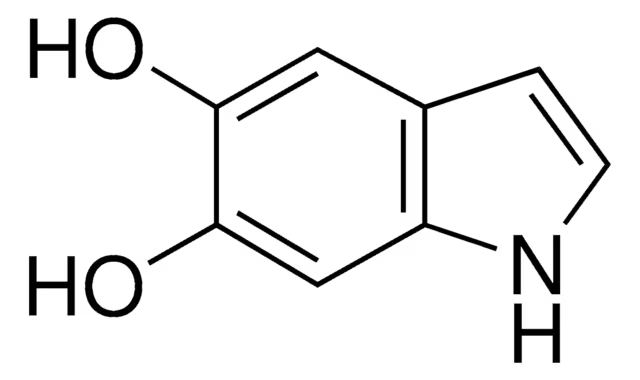
CAS Number3131-52-0
Synonyms5,6-Dihydroxyindoline; 5,6-Dihydroxy-1H-indole; 5,6-dihydroxyindol; 5,6-Dihydroxyindole; dhi; indole-5,6-diol; Dopamine lutine; Indol-5,6-diol; 1H-Indole-5,6-diol; 3H-INDOLE-5,6-DIOL; 3ID; 5,6-dihydroxy-indole
Molecular FormulaC8H7NO2
Molecular Weight149.15
Density1.5±0.1 g/cm3
Boiling Point411.2±25.0 °C at 760 mmHg
| Chemical & Physical Properties | |
|---|---|
| CAS Number | 3131-52-0 |
| Catalog No. | 2A-9076975 |
| Chinese Name | 5,6-二羟基吲哚 |
| Synonyms | 5,6-Dihydroxyindoline; 5,6-Dihydroxy-1H-indole; 5,6-dihydroxyindol; 5,6-Dihydroxyindole; dhi; indole-5,6-diol; Dopamine lutine; Indol-5,6-diol; 1H-Indole-5,6-diol; 3H-INDOLE-5,6-DIOL; 3ID; 5,6-dihydroxy-indole |
| Molecular Formula | C8H7NO2 |
| Molecular Weight | 149.15 |
| Density | 1.5±0.1 g/cm3 |
| Boiling Point | 411.2±25.0 °C at 760 mmHg |
| Storage Condition | 2-8°C |
| Application | 5,6-Dihydroxyindole is a melanin precursor with broad-spectrum antibacterial, antifungal, antiviral, and antiparasitic activities. 5,6-Dihydroxyindole has cytotoxic effects and is highly toxic to vari |
| HTC | 2933990090 |
| PubChem ID | 7904 |
| SMILES | Oc1cc2cc[nH]c2cc1O |
| InChI | InChI=1S/C8H7NO2/c10-7-3-5-1-2-9-6(5)4-8(7)11/h1-4,9-11H |
| InChI Key | SGNZYJXNUURYCH-UHFFFAOYSA-N |
| Bioactivity | 5,6-Dihydroxyindole, a melanin precursor, has a broad-spectrum antibacterial, antifungal, antiviral, antiparasitic activity. 5,6-Dihydroxyindole has cytotoxic effects and is strongly toxic against various pathogens[1]. Related Catalog Research Areas >> Infection Signaling Pathways >> Anti-infection >> Fungal Research Areas >> Inflammation/Immunology Signaling Pathways >> Anti-infection >> Bacterial Target Human Endogenous Metabolite In Vitro 5,6-Dihydroxyindole (1, 10, 20, 50, 100 μM; for 4 hours) dose-dependently decreases OD492 values. Pretreatment of Sf9 cells with 1.0 mM 5,6-Dihydroxyindole for 4 hours results in 97% mortality, and LC50 values of 20.3 μM in buffer and 131.8 μM in a culture medium[1]. Preincubation of a baculovirus stock with 1.25 mM 5,6-Dihydroxyindole for 3 hours near fully disables recombinant protein production. The LC50 for lambda bacteriophage and eggs of the wasp Microplitis demolitor are 5.6 and 111.0 μM, respectively[1]. 5,6-Dihydroxyindole and its spontaneous oxidation products are also active against viruses and parasitic wasps[1]. References [1]. Zhao P, et al. Antiviral, anti-parasitic, and cytotoxic effects of 5,6-dihydroxyindole (DHI), a reactive compound generated by phenoloxidase during insect immune response. Insect Biochem Mol Biol. 2011 Sep;41(9):645-52. [2]. Heiduschka P, et al. Melanin precursor 5,6-dihydroxyindol: protective effects and cytotoxicity on retinal cells in vitroand in vivo. Toxicol Pathol. 2007 Dec;35(7):1030-8. Chemical & Physical Properties Density 1.5±0.1 g/cm3 Boiling Point 411.2±25.0 °C at 760 mmHg Molecular Formula C8H7NO2 Molecular Weight 149.147 Flash Point 202.5±23.2 °C Exact Mass 149.047684 PSA 56.25000 LogP 0.37 Vapour Pressure 0.0±1.0 mmHg at 25°C Index of Refraction 1.802 InChIKey SGNZYJXNUURYCH-UHFFFAOYSA-N SMILES Oc1cc2cc[nH]c2cc1O Storage condition 2-8°C |
| Use of | 5,6-Dihydroxyindole, a melanin precursor, has a broad-spectrum antibacterial, antifungal, antiviral, antiparasitic activity. 5,6-Dihydroxyindole has cytotoxic effects and is strongly toxic against various pathogens[1]. Properties Name 5,6-dihydroxyindole Synonym More Synonyms 1H-Indole-5,6-diol Biological Activity Description 5,6-Dihydroxyindole, a melanin precursor, has a broad-spectrum antibacterial, antifungal, antiviral, antiparasitic activity. 5,6-Dihydroxyindole has cytotoxic effects and is strongly toxic against various pathogens[1]. Related Catalog Research Areas >> Infection Signaling Pathways >> Anti-infection >> Fungal Research Areas >> Inflammation/Immunology Signaling Pathways >> Anti-infection >> Bacterial Human Endogenous Metabolite References [1]. Zhao P, et al. Antiviral, anti-parasitic, and cytotoxic effects of 5,6-dihydroxyindole (DHI), a reactive compound generated by phenoloxidase during insect immune response. Insect Biochem Mol Biol. 2011 Sep;41(9):645-52. [2]. Heiduschka P, et al. Melanin precursor 5,6-dihydroxyindol: protective effects and cytotoxicity on retinal cells in vitroand in vivo. Toxicol Pathol. 2007 Dec;35(7):1030-8. Chemical & Physical Properties Molecular Formula C8H7NO2 Exact Mass 149.047684 PSA 56.25000 Index of Refraction 1.802 InChIKey SGNZYJXNUURYCH-UHFFFAOYSA-N |
| Tax Rebate | 13.0% |
| Supervision | None. MFN tariff: 6.5%. Ordinary tariff: 20.0% |
| Transport Info | Product name: Summary 2933990090. heterocyclic compounds with nitrogen hetero-atom(s) only. VAT:17.0%. Tax rebate rate:13.0%. . MFN tariff:6.5%. General tariff:20.0% |
| Related Products in Heterocyclic Building Blocks | ||
|---|---|---|
| 5-Chloro-2-formylpyridine | 31181-89-2 | 2A-9076967 |
| 5-Hydroxypyridine-2-carboxaldehyde | 31191-08-9 | 2A-9076969 |
| 5-(Trifluoromethyl)-2-pyridinecarboxyaldehyde | 31224-82-5 | 2A-9076970 |
| 5,5-Dimethyl-dihydro-furan-2-one | 3123-97-5 | 2A-9076972 |
| 4-Benzylpiperidine | 31252-42-3 | 2A-9076973 |
| 2,5-Diiodo-4-methyl-1H-imidazole | 149510-85-0 | 2A-9076982 |
| 5-(3-Bromophenyl)-1H-pyrazole | 149739-65-1 | 2A-9076987 |
| 2-Iodothiophene | 149762-92-5 | 2A-9076988 |
| 4-(4-Bromophenyl)-2,6-diphenylpyridine | 1498-81-3 | 2A-9076990 |
| 2,5-Dinitropyridine | 15009-92-4 | 2A-9076995 |
| Browse all Heterocyclic Building Blocks products » | ||
Phone:
630-322-8886
630-322-8887
Email:
Office Locations:
Chicago, IL, USA
San Francisco, CA, USA


 EN
EN


 SDS
SDS