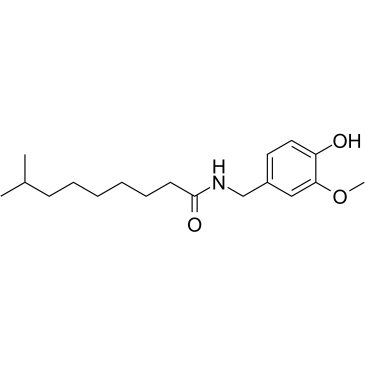
CAS Number19408-84-5
SynonymsN-(4-Hydroxy-3-methoxybenzyl)-8-methylnonanamide; (1Z)-N-(4-Hydroxy-3-methoxybenzyl)-8-methylnonanimidic acid; 6,7-Dihydrocapsaicin; 8-methyl-nonanoic acid vanillylamide; N-[(4-Hydroxy-3-methoxy-phenyl)methyl]-8-methyl-nonanamide; Nonanamide,8-methyl-N-vanillyl; Dihydro Capsaicin; MFCD00017259; N-[(4-hydroxy-3-methoxyphenyl)methyl]-8-methylnonanamide; 8-Methyl-N-vanillyl-nonamide; Dihydrocapsaicin; EINECS 206-969-8; 8-Methyl-N-vanillylnonanamide; N-(4-hydroxy-3-methoxybenzyl)isodecanamide
Molecular FormulaC18H29NO3
Molecular Weight307.428
Purity98%
Density1.0±0.1 g/cm3
Boiling Point457.3±55.0 °C at 760 mmHg
Melting Point62-65 °C(lit.)
Appearancewhite crystal
Symbol
Signal WordWarning
| Chemical & Physical Properties | |
|---|---|
| CAS Number | 19408-84-5 |
| Catalog No. | 2A-9007590 |
| Chinese Name | 二氢辣椒素 |
| Synonyms | N-(4-Hydroxy-3-methoxybenzyl)-8-methylnonanamide; (1Z)-N-(4-Hydroxy-3-methoxybenzyl)-8-methylnonanimidic acid; 6,7-Dihydrocapsaicin; 8-methyl-nonanoic acid vanillylamide; N-[(4-Hydroxy-3-methoxy-phenyl)methyl]-8-methyl-nonanamide; Nonanamide,8-methyl-N-vanillyl; Dihydro Capsaicin; MFCD00017259; N-[(4-hydroxy-3-methoxyphenyl)methyl]-8-methylnonanamide; 8-Methyl-N-vanillyl-nonamide; Dihydrocapsaicin; EINECS 206-969-8; 8-Methyl-N-vanillylnonanamide; N-(4-hydroxy-3-methoxybenzyl)isodecanamide |
| Molecular Formula | C18H29NO3 |
| Molecular Weight | 307.428 |
| Purity | 98 |
| Density | 1.0±0.1 g/cm3 |
| Boiling Point | 457.3±55.0 °C at 760 mmHg |
| Melting Point | 62-65 °C(lit.) |
| Appearance | white crystal |
| Water Solubility | H2O: insoluble |
| Storage Condition | 2-8°C |
| Packaging | II |
| Application | Dihydrocapsaicin is a natural capsaicin that is a selective TRPV1 agonist and can increase p-Akt levels. Dihydrocapsaicin enhances hypothermia-induced neuroprotection. |
| HTC | 3302109090 |
| UN(IATA) | UN 3462 |
| SMILES | COc1cc(CNC(=O)CCCCCCC(C)C)ccc1O |
| InChI | InChI=1S/C18H29NO3/c1-14(2)8-6-4-5-7-9-18(21)19-13-15-10-11-16(20)17(12-15)22-3/h10-12,14,20H,4-9,13H2,1-3H3,(H,19,21) |
| InChI Key | XJQPQKLURWNAAH-UHFFFAOYSA-N |
| Hazard Symbols | 6.1(a) |
| Risk Codes | R25;R36/37/38 |
| Safety Description | S26;S36/37/39;S45 |
| MSDS | msds/7590_2_19408_84_5.pdf |
| Bioactivity | Dihydrocapsaicin is a natural capsaicin, acts as a selective TRPV1 agonist, and also increases p-Akt levels. Dihydrocapsaicin enhances the hypothermia-induced neuroprotection[1][2]. Related Catalog Signaling Pathways >> Membrane Transporter/Ion Channel >> TRP Channel References [1]. Gao F, et al. Impairment in function and expression of transient receptor potential vanilloid type 4 in Dahl salt-sensitive rats: significance and mechanism. Hypertension. 2010 Apr;55(4):1018-25. [2]. Dihydrocapsaicin, et al. Dihydrocapsaicin (DHC) enhances the hypothermia-induced neuroprotection following ischemic stroke via PI3K/Akt regulation in rat. Brain Res. 2017 Sep 15;1671:18-25. Chemical & Physical Properties Density 1.0±0.1 g/cm3 Boiling Point 457.3±55.0 °C at 760 mmHg Melting Point 62-65 °C(lit.) Molecular Formula C18H29NO3 Molecular Weight 307.428 Flash Point 230.4±31.5 °C Exact Mass 307.214752 PSA 58.56000 LogP 4.72 Vapour Pressure 0.0±1.2 mmHg at 25°C Index of Refraction 1.508 InChIKey XJQPQKLURWNAAH-UHFFFAOYSA-N SMILES COc1cc(CNC(=O)CCCCCCC(C)C)ccc1O Storage condition 2-8°C Water Solubility H2O: insoluble |
| Use of | Dihydrocapsaicin is a natural capsaicin, acts as a selective TRPV1 agonist, and also increases p-Akt levels. Dihydrocapsaicin enhances the hypothermia-induced neuroprotection[1][2]. Properties Articles34 Name dihydrocapsaicin Synonym More Synonyms Dihydrocapsaicin Biological Activity Description Dihydrocapsaicin is a natural capsaicin, acts as a selective TRPV1 agonist, and also increases p-Akt levels. Dihydrocapsaicin enhances the hypothermia-induced neuroprotection[1][2]. Related Catalog Signaling Pathways >> Membrane Transporter/Ion Channel >> TRP Channel References [1]. Gao F, et al. Impairment in function and expression of transient receptor potential vanilloid type 4 in Dahl salt-sensitive rats: significance and mechanism. Hypertension. 2010 Apr;55(4):1018-25. [2]. Dihydrocapsaicin, et al. Dihydrocapsaicin (DHC) enhances the hypothermia-induced neuroprotection following ischemic stroke via PI3K/Akt regulation in rat. Brain Res. 2017 Sep 15;1671:18-25. Chemical & Physical Properties Molecular Formula C18H29NO3 Exact Mass 307.214752 PSA 58.56000 Index of Refraction 1.508 InChIKey XJQPQKLURWNAAH-UHFFFAOYSA-N Water Solubility H2O: insoluble |
| Tax Rebate | 13.0% |
| Supervision | None. MFN tariff: 6.5%. Ordinary tariff: 30.0% |
| Transport Info | Shipping Name: UN |
| MSDS Transport Info | Module 14. Shipping information 14.1 UN dangerous goods number European Land Transport Danger Regulations: 3462 International Maritime Transport Danger Regulations: 3462 International Air Transport Danger Regulations: 3462 14.2 United Nations shipping name European Land Transport Dangerous Regulations: TOXINS EXTRACTED FROM LIVING SOURCES, SOLID, N.O.S. (8-Methyl-N- vanillylnonanamide) IMDG Code: TOXINS, EXTRACTED FROM LIVING SOURCES, SOLID, N.O.S. (8-Methyl-N- vanillylnonanamide) IFRS: Toxins, extracted from living sources, solid, n.o.s. (8-Methyl-N-vanillylnonanamide) 14.3 Transport hazard categories European Land Transport Danger Regulations: 6.1 International Maritime Transport Danger Regulations: 6.1 International Air Transport Danger Regulations: 6.1 14.4 Package group European Dangerous Regulations for land transport: II International Dangerous Regulations for sea transport: II International Dangerous Regulations for air transport: II 14.5 Environmental hazards European Land Transport Danger Regulations: No International Maritime Danger Regulations International Air Transport Danger Regulations: No Marine pollutants (yes/no): No 14.6 Special reminder to users No data available |
| Related Products in Alkaloids | ||
|---|---|---|
| (1S,2S)-(+)-Pseudoephedrine hydrochloride | 345-78-8 | 2A-9000036 |
| Chelidonine | 476-32-4 | 2A-9007390 |
| L-Tetrahydropalmatine hydrochloride | 10097-84-4 | 2A-9008152 |
| Sanguinarine | 2447-54-3 | 2A-9008737 |
| (-)-Lupinine | 486-70-4 | 2A-9008923 |
| (-)-Sparteine 左旋 | 90-39-1 | 2A-9008925 |
| 1-N-hexyltheobromine | 1028-33-7 | 2A-9008958 |
| Browse all Alkaloids products » | ||
Phone:
630-322-8886
630-322-8887
Email:
Office Locations:
Chicago, IL, USA
San Francisco, CA, USA


 EN
EN


 SDS
SDS