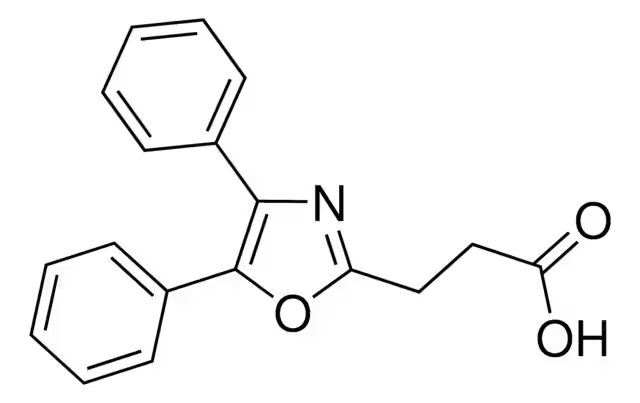
CAS Number21256-18-8
SynonymsOxapro; MFCD00215977; OXAPROSIN; Daypro; 4,5-Diphenyl-2-oxazolepropanoic acid Daypro; Oxaprozin; 4,5-Diphenyl-2-oxazolepropanoic acid,Daypro; 4,5-Diphenyl-2-oxazolepropionic Acid; Duraprost; 3-(4,5-Diphenyloxazol-2-yl)propanoic acid; Durapro; Dxaprozin; 3-(4,5-Diphenyl-1,3-oxazol-2-yl)propanoic acid; 4,5-diphenyloxazole-2-propanoic acid; Actirin; Alvo; EINECS 244-296-1
Molecular FormulaC18H15NO3
Molecular Weight293.32
Purity97%
Density1.2±0.1 g/cm3
Boiling Point467.0±33.0 °C at 760 mmHg
Melting Point154ºC
Appearancesolid
EINECS244-296-1
Symbol
Signal WordWarning
| Chemical & Physical Properties | |
|---|---|
| CAS Number | 21256-18-8 |
| Catalog No. | 2A-9007514 |
| Chinese Name | 奥沙普秦 |
| Synonyms | Oxapro; MFCD00215977; OXAPROSIN; Daypro; 4,5-Diphenyl-2-oxazolepropanoic acid Daypro; Oxaprozin; 4,5-Diphenyl-2-oxazolepropanoic acid,Daypro; 4,5-Diphenyl-2-oxazolepropionic Acid; Duraprost; 3-(4,5-Diphenyloxazol-2-yl)propanoic acid; Durapro; Dxaprozin; 3-(4,5-Diphenyl-1,3-oxazol-2-yl)propanoic acid; 4,5-diphenyloxazole-2-propanoic acid; Actirin; Alvo; EINECS 244-296-1 |
| Molecular Formula | C18H15NO3 |
| Molecular Weight | 293.32 |
| Purity | 97 |
| Density | 1.2±0.1 g/cm3 |
| Boiling Point | 467.0±33.0 °C at 760 mmHg |
| Melting Point | 154ºC |
| Appearance | solid |
| Water Solubility | Water solubility: insoluble; soluble in: methanol; |
| Storage Condition | room temperature, sealed |
| Application | Oxaprozin is an inhibitor of COX-1 and COX-2, with IC50 values of 2.2 and 36 μM for human platelet COX-1 and IL-1-stimulated human synovial cell COX-2, respectively. Oxaprozin also inhibits NF-κB ac |
| EINECS | 244-296-1 |
| HTC | 2934999090 |
| PubChem ID | 24278617 |
| MDL Number | MFCD00215977 |
| SMILES | OC(=O)CCc1nc(-c2ccccc2)c(o1)-c3ccccc3 |
| InChI | 1S/C18H15NO3/c20-16(21)12-11-15-19-17(13-7-3-1-4-8-13)18(22-15)14-9-5-2-6-10-14/h1-10H,11-12H2,(H,20,21) |
| InChI Key | OFPXSFXSNFPTHF-UHFFFAOYSA-N |
| NACRES Code | NA.77 |
| UNSPSC | 12352200 |
| Hazard Symbols | Transport |
| Risk Codes | R20/21/22 |
| Safety Description | S24/25;S36/37/39 |
| MSDS | msds/7514_1_21256_18_8.pdf |
| Bioactivity | Oxaprozin is an inhibitor of both COX-1 and COX-2 with IC50s of 2.2 μM and 36 μM for human platelet COX-1 and IL-1-stimulated human synovial cell COX-2, respectively. Oxaprozin also inhibits the activation of NF-κB. Related Catalog Research Areas >> Inflammation/Immunology Target COX-1:2.2 μM (IC50) COX-2:36 μM (IC50) NF-κB In Vitro Oxaprozin induces apoptosis in a dose-dependent manner. Oxaprozin increases caspase-3 activity in the activated but not in the resting condition. NF-κB activation is inhibited by 50 μM Oxaprozin. Oxaprozin inhibits activation of the IKK system induced by the reagent IκBα[1]. Oxaprozin dose dependently increase CD40L-treated monocyte apoptosis. 100 μM Oxaprozin induces the strongest proapoptotic effect. 100 μM Oxaprozin significantly increases CD40L-treated monocyte apoptosis. Oxaprozin treatment inhibits CD40L-induced Akt and NF-κB (p65) phosphorylation[2]. Kinase Assay Caspase 3 activity in the presence or absence of 200 ng/mL CD40L plus 1 μg/mL CD40L enhancer and 100 μM Oxaprozin is performed. The enzymatic activity is spectrophotometrically determined for 60 minutes at 405 nm assuming an extinction coefficient of 8.8×10³ M1/cm[2]. Cell Assay Purified monocytes are resuspended at 106/mL and cultured for 48 hours. In selective experiments, cells are cultured in the presence or absence of 50 μM PD98059, 1 μM SB203580, 50 μM LY294002, 20 μM SN-50, 50 μM Ac-DEVD-CHO, different doses (5, 10, 50, 100 μM) of Oxaprozin, 100 μM ibuprofen,100 μM indomethacin, or 100 μM naproxene. Percentages of apoptotic cells are measured by both fluorescence microscope and flow cytometer[2]. References [1]. Ottonello L, et al. Delayed apoptosis of human monocytes exposed to immune complexes is reversed byoxaprozin: role of the Akt/IkappaB kinase/nuclear factor kappaB pathway. Br J Pharmacol. 2009 May;157(2):294-306. [2]. Montecucco F, et al. Oxaprozin-induced apoptosis on CD40 ligand-treated human primary monocytes is associated with the modulation of defined intracellular pathways. J Biomed Biotechnol. 2009;2009:478785. Chemical & Physical Properties Density 1.2±0.1 g/cm3 Boiling Point 467.0±33.0 °C at 760 mmHg Melting Point 154ºC Molecular Formula C18H15NO3 Molecular Weight 293.317 Flash Point 236.2±25.4 °C Exact Mass 293.105194 PSA 63.33000 LogP 4.19 Vapour Pressure 0.0±1.2 mmHg at 25°C Index of Refraction 1.595 InChIKey OFPXSFXSNFPTHF-UHFFFAOYSA-N SMILES O=C(O)CCc1nc(-c2ccccc2)c(-c2ccccc2)o1 |
| Use of | Oxaprozin is an inhibitor of both COX-1 and COX-2 with IC50s of 2.2 μM and 36 μM for human platelet COX-1 and IL-1-stimulated human synovial cell COX-2, respectively. Oxaprozin also inhibits the activation of NF-κB. Properties Articles31 Name oxaprozin Synonym More Synonyms Oxaprozin Biological Activity Description Oxaprozin is an inhibitor of both COX-1 and COX-2 with IC50s of 2.2 μM and 36 μM for human platelet COX-1 and IL-1-stimulated human synovial cell COX-2, respectively. Oxaprozin also inhibits the activation of NF-κB. Related Catalog Research Areas >> Inflammation/Immunology COX-1:2.2 μM (IC50) COX-2:36 μM (IC50) References [1]. Ottonello L, et al. Delayed apoptosis of human monocytes exposed to immune complexes is reversed byoxaprozin: role of the Akt/IkappaB kinase/nuclear factor kappaB pathway. Br J Pharmacol. 2009 May;157(2):294-306. Chemical & Physical Properties Molecular Formula C18H15NO3 Exact Mass 293.105194 PSA 63.33000 Index of Refraction 1.595 InChIKey OFPXSFXSNFPTHF-UHFFFAOYSA-N |
| Tax Rebate | 13.0% |
| Supervision | None. MFN tariff: 6.5%. Ordinary tariff: 20.0% |
| Transport Info | Product name: Purity: 98.0% |
| MSDS Transport Info | Module 14. Shipping information 14.1 UN dangerous goods number European Land Transport Dangerous Regulations: -International Maritime Dangerous Regulations: -International Air Transport Dangerous Regulations: - 14.2 Names specified by the United Nations (UN) European Land Transport Dangerous Regulations: Non-dangerous goods IMDG Code: Non-dangerous goods International air transport dangerous goods regulations: non-dangerous goods 14.3 Transport hazard categories European Land Transport Dangerous Regulations: -International Maritime Dangerous Regulations: -International Air Transport Dangerous Regulations: - 14.4 Package group European Land Transport Dangerous Regulations: -International Maritime Dangerous Regulations: -International Air Transport Dangerous Regulations: - 14.5 Environmental hazards European Land Transport Dangerous Regulations: No International Maritime Transport Dangerous Regulations Maritime Pollutants: No International Air Transport Risk Regulations: No 14.6 Special reminder to users No data available |
| Related Products in Specialty Chemicals | ||
|---|---|---|
| D-Alloisoleucine | 1509-35-9 | 2A-9007508 |
| D-alpha-Allyl-Gly | 108412-04-0 | 2A-9007509 |
| D-Arabinose | 10323-20-3 | 2A-9007511 |
| D-Arginine | 157-06-2 | 2A-9007512 |
| D-Arginine hydrochloride | 627-75-8 | 2A-9007513 |
| D-Carnitine hydrochloride | 16224-32-1 | 2A-9007515 |
| D-Cysteine hydrochloride monohydrate | 32443-99-5 | 2A-9007517 |
| Decafluorobenzophenone | 853-39-4 | 2A-9007519 |
| Decafluorodiphenyl sulphide | 1043-50-1 | 2A-9007521 |
| Decafluoropent-2-ene | 72804-49-0 | 2A-9007522 |
| Browse all Specialty Chemicals products » | ||
Phone:
630-322-8886
630-322-8887
Email:
Office Locations:
Chicago, IL, USA
San Francisco, CA, USA


 EN
EN


 SDS
SDS