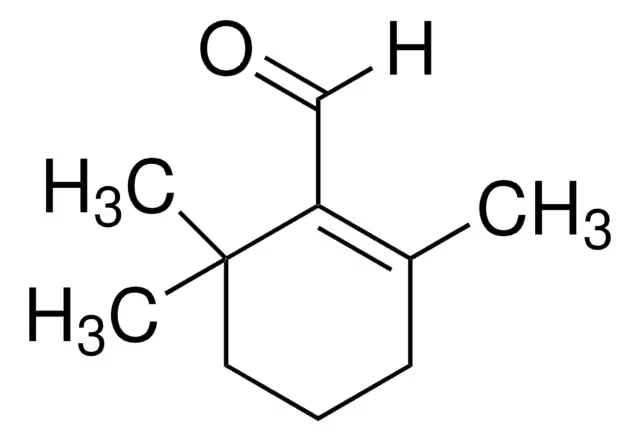
CAS Number432-25-7
SynonymsMFCD00079078; 2,6,6-Trimethyl-1-cyclohexene-1-carboxaldehyde; BETA-CYCLOCITRAL; 2,6,6-trimethylcyclohexene-1-carbaldehyde; EINECS 207-081-3
Molecular FormulaC10H16O
Molecular Weight152.23
Purity≥97.0 (GC)%
Density0.947g/cm3
Boiling Point62-63 °C/3 mmHg (lit.)
Melting Point62-63ºC
Appearancecolorless liquid
EINECS207-081-3
Symbol
Signal WordWarning
| Chemical & Physical Properties | |
|---|---|
| CAS Number | 432-25-7 |
| Catalog No. | 2A-9071104 |
| Chinese Name | β-环柠檬醛 |
| Synonyms | MFCD00079078; 2,6,6-Trimethyl-1-cyclohexene-1-carboxaldehyde; BETA-CYCLOCITRAL; 2,6,6-trimethylcyclohexene-1-carbaldehyde; EINECS 207-081-3 |
| Molecular Formula | C10H16O |
| Molecular Weight | 152.23 |
| Purity | ≥97.0 (GC) |
| Density | 0.947g/cm3 |
| Boiling Point | 62-63 °C/3 mmHg (lit.) |
| Melting Point | 62-63ºC |
| Appearance | colorless liquid |
| Water Solubility | Soluble in chloroform, dichloromethane, ethyl acet |
| Storage Condition | 2-8°C |
| Packaging | III |
| Application | β-Cyclocitral is a volatile oxidized derivative of β-carotene and is a unique predator defense signal of Microcystis. β-Cyclocitral is one of the major volatile terpenoids that can upregulate the expr |
| EINECS | 207-081-3 |
| HTC | 2912299000 |
| PubChem ID | 329751425 |
| MDL Number | MFCD00079078 |
| SMILES | [H]C(=O)C1=C(C)CCCC1(C)C |
| InChI | 1S/C10H16O/c1-8-5-4-6-10(2,3)9(8)7-11/h7H,4-6H2,1-3H3 |
| InChI Key | MOQGCGNUWBPGTQ-UHFFFAOYSA-N |
| NACRES Code | NA.24 |
| UNSPSC | 85151701 |
| Hazard Symbols | transportation |
| Bioactivity | β-Cyclocitral, a volatile oxidized derivative of β-carotene, is a grazer defence signal unique to the Cyanobacterium Microcystis. β-Cyclocitral, one of the predominant volatile terpenoid compounds, can upregulate the expression of defence genes to enhance excess light (EL) acclimation. β-Cyclocitral is a powerful repellent[1][2][3]. Related Catalog Research Areas >> Others Signaling Pathways >> Others >> Others In Vitro β-Cyclocitral is derived from the catalytic breakdown of β-carotene, and evidence indicates that it is produced by the activation of a specific carotene oxygenase by all species of the bloom-forming cyanobacterium Microcystis. β-cyclocitral affects grazer behavior[3]. References [1]. Alexandra J Dickinson, et al. β-Cyclocitral Is a Conserved Root Growth Regulator. Proc Natl Acad Sci U S A. 2019 May 21;116(21):10563-10567. [2]. Feifei Lv, et al. β-Cyclocitral Upregulates Salicylic Acid Signalling to Enhance Excess Light Acclimation in Arabidopsis. J Exp Bot. 2015 Aug;66(15):4719-32. [3]. Friedrich Jüttner, et al. β-Cyclocitral, a Grazer Defence Signal Unique to the Cyanobacterium Microcystis. J Chem Ecol. 2010 Dec;36(12):1387-97. Chemical & Physical Properties Density 0.947g/cm3 Boiling Point 212.1ºC at 760mmHg Melting Point 62-63ºC Molecular Formula C10H16O Molecular Weight 152.23300 Flash Point 76.9ºC Exact Mass 152.12000 PSA 17.07000 LogP 2.71190 Vapour Pressure 0.176mmHg at 25°C Index of Refraction n20/D 1.497(lit.) InChIKey MOQGCGNUWBPGTQ-UHFFFAOYSA-N SMILES CC1=C(C=O)C(C)(C)CCC1 Storage condition 2-8°C Water Solubility Soluble in chloroform, dichloromethane, ethyl acetate and methanol. Insoluble in water. |
| Use of | β-Cyclocitral, a volatile oxidized derivative of β-carotene, is a grazer defence signal unique to the Cyanobacterium Microcystis. β-Cyclocitral, one of the predominant volatile terpenoid compounds, can upregulate the expression of defence genes to enhance excess light (EL) acclimation. β-Cyclocitral is a powerful repellent[1][2][3]. Properties Name β-cyclocitral Synonym More Synonyms β-Cyclocitral Biological Activity Description β-Cyclocitral, a volatile oxidized derivative of β-carotene, is a grazer defence signal unique to the Cyanobacterium Microcystis. β-Cyclocitral, one of the predominant volatile terpenoid compounds, can upregulate the expression of defence genes to enhance excess light (EL) acclimation. β-Cyclocitral is a powerful repellent[1][2][3]. Related Catalog Research Areas >> Others Signaling Pathways >> Others >> Others In Vitro β-Cyclocitral is derived from the catalytic breakdown of β-carotene, and evidence indicates that it is produced by the activation of a specific carotene oxygenase by all species of the bloom-forming cyanobacterium Microcystis. β-cyclocitral affects grazer behavior[3]. References [1]. Alexandra J Dickinson, et al. β-Cyclocitral Is a Conserved Root Growth Regulator. Proc Natl Acad Sci U S A. 2019 May 21;116(21):10563-10567. [2]. Feifei Lv, et al. β-Cyclocitral Upregulates Salicylic Acid Signalling to Enhance Excess Light Acclimation in Arabidopsis. J Exp Bot. 2015 Aug;66(15):4719-32. [3]. Friedrich Jüttner, et al. β-Cyclocitral, a Grazer Defence Signal Unique to the Cyanobacterium Microcystis. J Chem Ecol. 2010 Dec;36(12):1387-97. Chemical & Physical Properties Molecular Formula C10H16O Exact Mass 152.12000 PSA 17.07000 LogP 2.71190 InChIKey MOQGCGNUWBPGTQ-UHFFFAOYSA-N SMILES CC1=C(C=O)C(C)(C)CCC1 Water Solubility Soluble in chloroform, dichloromethane, ethyl acetate and methanol. Insoluble in water. |
| Tax Rebate | 13.0% |
| Supervision | None. MFN tariff: 5.5%. Ordinary tariff: 30.0% |
| Transport Info | Shipping Name: UN |
| MSDS Transport Info | Module 14. Shipping information 14.1 United Nations number European Land Transport Dangerous Regulations: -International Maritime Dangerous Regulations: -International Air Transport Dangerous Regulations: - 14.2 United Nations shipping name European Land Transport Dangerous Regulations: Non-dangerous goods IMDG Code: Non-dangerous goods International air transport dangerous goods regulations: non-dangerous goods 14.3 Transport hazard categories European Land Transport Dangerous Regulations: -International Maritime Dangerous Regulations: -International Air Transport Dangerous Regulations: - 14.4 Package group European Land Transport Dangerous Regulations: -International Maritime Dangerous Regulations: -International Air Transport Dangerous Regulations: - 14.5 Environmental hazards European Land Transport Danger Regulations: No International Maritime Danger Regulations International Air Transport Danger Regulations: No Marine pollutants (yes/no): No 14.6 Special precautions No data available The above information is believed to be correct, but is not all-inclusive and should be used as a guide only. The information in this document is based on our current knowledge and is Correct safety instructions apply to this product. This information does not represent a warranty as to the properties of this product. See reverse side of invoice or packing slip. |
| Related Products in Specialty & Botanical Ingredients | ||
|---|---|---|
| 4,6,7-Trimethoxy-5-methylcoumarin | 62615-63-8 | 2A-9067800 |
| 9-Oxonerolidol | 58865-88-6 | 2A-9067840 |
| LinderaspironeA | 1235126-46-1 | 2A-9068938 |
| 4-(Trifluoromethyl)cinnamaldehyde | 41917-83-3 | 2A-9069449 |
| d-Isomenthol | 23283-97-8 | 2A-9070235 |
| 4-Methyl-6-hydroxy-7-acetoxycoumarin | 46895-13-0 | 2A-9072902 |
| Mca-OSuN-(7-methoxycoumarin-4-acetyloxy)succinimide | 359436-89-8 | 2A-9073817 |
| 3-Acetyl-7-hydroxycoumarin | 10441-27-7 | 2A-9076091 |
| 7-(Diethylamino)coumarin-3-carboxylicacidN-succinimidylester | 139346-57-9 | 2A-9076093 |
| 7-Dimethylaminocoumarin-4-aceticacid | 80883-54-1 | 2A-9078854 |
| Browse all Specialty & Botanical Ingredients products » | ||
Phone:
630-322-8886
630-322-8887
Email:
Office Locations:
Chicago, IL, USA
San Francisco, CA, USA


 EN
EN


 SDS
SDS