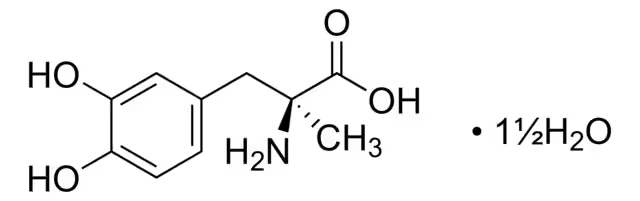
CAS Number41372-08-1
Synonymsa-Methyl-L-dopa; α-Methyl-L-dopa; Dopegyt; L-(-)-b-(3,4-Dihydroxyphenyl)-a-methylalanine; L-(-)-α-Methyl-β-(3,4-dihydroxyphenyl)alanine; L-(-)-a-Methyl-b-(3,4-dihydroxyphenyl)alanine; a-Methyl Dopa; L-α-Methyl-DOPA; α-Methyl dopa; EINECS 209-089-2; L-Tyrosine, 3-hydroxy-α-methyl-, hydrate (2:3); Tyrosine, 3-hydroxy-α-methyl-, hydrate (1:1); L-(a-Md); L-α-Methyldopa; α-Methyldopa sesquihydrate; (-)-α-Methyldopa; 3-Hydroxy-α-methyl-L-tyrosine; Dopamet; (−)-3-(3,4-Dihydroxyphenyl)-2-methyl-L-alanine sesquihydrate; 3-(3,4-Dihydroxyphenyl)-2-methyl-L-alanine,MK-351,Methyl-L-DOPA; (S)-(-)-a-Methyldopa; a-Methyl-b-(3,4-dihydroxyphenyl)-L-alanine; Methyl dopa; Aldomet; (-)-3-(3,4-Dihydroxyphenyl)-2-Methyl-L-Alanine Sesquihydrate; l-a-Methyldopa; (S)-a-Methyldopa; ALDORIL; Alpha-Methyldopa Sesquihy
Molecular Formula(HO)2C6H3CH2C(CH3)(NH2)CO2H · 11/2H2O
Molecular Weight238.24
Purity99%
Density1.4±0.1 g/cm3
Boiling Point441.6±45.0 °C at 760 mmHg
Melting Point>300 °C (lit.)
Appearancepowder
EINECS209-089-2
Symbol
Signal WordWarning
| Chemical & Physical Properties | |
|---|---|
| CAS Number | 41372-08-1 |
| Catalog No. | 2A-9007101 |
| Chinese Name | 左旋甲基多巴 |
| Synonyms | a-Methyl-L-dopa; α-Methyl-L-dopa; Dopegyt; L-(-)-b-(3,4-Dihydroxyphenyl)-a-methylalanine; L-(-)-α-Methyl-β-(3,4-dihydroxyphenyl)alanine; L-(-)-a-Methyl-b-(3,4-dihydroxyphenyl)alanine; a-Methyl Dopa; L-α-Methyl-DOPA; α-Methyl dopa; EINECS 209-089-2; L-Tyrosine, 3-hydroxy-α-methyl-, hydrate (2:3); Tyrosine, 3-hydroxy-α-methyl-, hydrate (1:1); L-(a-Md); L-α-Methyldopa; α-Methyldopa sesquihydrate; (-)-α-Methyldopa; 3-Hydroxy-α-methyl-L-tyrosine; Dopamet; (−)-3-(3,4-Dihydroxyphenyl)-2-methyl-L-alanine sesquihydrate; 3-(3,4-Dihydroxyphenyl)-2-methyl-L-alanine,MK-351,Methyl-L-DOPA; (S)-(-)-a-Methyldopa; a-Methyl-b-(3,4-dihydroxyphenyl)-L-alanine; Methyl dopa; Aldomet; (-)-3-(3,4-Dihydroxyphenyl)-2-Methyl-L-Alanine Sesquihydrate; l-a-Methyldopa; (S)-a-Methyldopa; ALDORIL; Alpha-Methyldopa Sesquihy |
| Molecular Formula | (HO)2C6H3CH2C(CH3)(NH2)CO2H · 11/2H2O |
| Molecular Weight | 238.24 |
| Purity | 99 |
| Density | 1.4±0.1 g/cm3 |
| Boiling Point | 441.6±45.0 °C at 760 mmHg |
| Melting Point | >300 °C (lit.) |
| Appearance | powder |
| Water Solubility | 0.1-1 g/100 mL at 23 ºC |
| Storage Condition | Sealed, cool, dry storage |
| Application | L-(-)-_alpha_-Methyldopa hydrate is an _alpha_-adrenoceptor agonist. |
| EINECS | 209-089-2 |
| HTC | 2922.50.3500 |
| PubChem ID | 24888444 |
| MDL Number | MFCD30179484 |
| SMILES | O.O.O.C[C@](N)(Cc1ccc(O)c(O)c1)C(O)=O.C[C@](N)(Cc2ccc(O)c(O)c2)C(O)=O |
| InChI | 1S/2C10H13NO4.3H2O/c2*1-10(11,9(14)15)5-6-2-3-7(12)8(13)4-6;;;/h2*2-4,12-13H,5,11H2,1H3,(H,14,15);3*1H2/t2*10-;;;/m00.../s1 |
| InChI Key | YKFCISHFRZHKHY-NGQGLHOPSA-N |
| NACRES Code | NA.22 |
| eCl@ss | 32160406 |
| UNSPSC | 12352209 |
| Hazard Symbols | Transport |
| Safety Description | S24/25 |
| MSDS | msds/7101_1_41372_08_1.pdf |
| Bioactivity | L-(-)-α-Methyldopa hydrate is an alpha-adrenergic agonist (selective for α2-adrenergic receptors) psychoactive drug used as a sympatholytic or antihypertensive.Target: alpha-adrenergic agonistMethyldopa is an alpha-adrenergic agonist (selective for α2-adrenergic receptors) psychoactive drug used as a sympatholytic or antihypertensive. Its use is now mostly deprecated following the introduction of alternative safer classes of agents. However, it continues to have a role in otherwise difficult to treat hypertension and gestational hypertension (also known as pregnancy-induced hypertension (PIH)).Methyldopa has a dual mechanism of action. It is a competitive inhibitor of the enzyme DOPA decarboxylase, also known as aromatic L-amino acid decarboxylase, which converts L-DOPA into dopamine. Dopamine is a precursor for norepinephrine (noradrenaline) and subsequently epinephrine (adrenaline). This inhibition results in reduced dopaminergic and adrenergic neurotransmission in the peripheral nervous system. This effect may lower blood pressure and cause central nervous system effects such as depression, anxiety, apathy, anhedonia, and parkinsonism. It is converted to α-methylnorepinephrine by dopamine beta-hydroxylase (DBH). α-methylnorepinephrine is an agonist of presynaptic central nervous system α2-adrenergic receptors. Activation of these receptors in the brainstem appears to inhibit sympathetic nervous system output and lower blood pressure. This is also the mechanism of action of clonidine. Related Catalog Signaling Pathways >> GPCR/G Protein >> Adrenergic Receptor Research Areas >> Cardiovascular Disease References [1]. BAILA MR, et al. The use of the combination of L-alpha-methyldopa and dichlorothiazide in the treatment of arterial hypertension. Dia Med. 1962 Dec 6;34:2422-4. Chemical & Physical Properties Density 1.4±0.1 g/cm3 Boiling Point 441.6±45.0 °C at 760 mmHg Melting Point >300 °C(lit.) Molecular Formula C10H13NO4.3/2H2O Molecular Weight 238.24 Flash Point 220.9±28.7 °C PSA 113.01000 LogP 0.13 Vapour Pressure 0.0±1.1 mmHg at 25°C Index of Refraction 1.635 InChIKey XDJUBZFLFDODNF-PPHPATTJSA-N SMILES CC(N)(Cc1ccc(O)c(O)c1)C(=O)O.O Storage condition Refrigerator Stability Stable, but may be light sensitive. Very hygroscopic. Undergoes catalytic oxygenation in the presence of magnesium, cupric, cobalt, nickel and ferric ions. Store under a dry atmosphere. Water Solubility 0.1-1 g/100 mL at 23 ºC |
| Use of | L-(-)-α-Methyldopa hydrate is an alpha-adrenergic agonist (selective for α2-adrenergic receptors) psychoactive drug used as a sympatholytic or antihypertensive.Target: alpha-adrenergic agonistMethyldopa is an alpha-adrenergic agonist (selective for α2-adrenergic receptors) psychoactive drug used as a sympatholytic or antihypertensive. Its use is now mostly deprecated following the introduction of alternative safer classes of agents. However, it continues to have a role in otherwise difficult to treat hypertension and gestational hypertension (also known as pregnancy-induced hypertension (PIH)).Methyldopa has a dual mechanism of action. It is a competitive inhibitor of the enzyme DOPA decarboxylase, also known as aromatic L-amino acid decarboxylase, which converts L-DOPA into dopamine. Dopamine is a precursor for norepinephrine (noradrenaline) and subsequently epinephrine (adrenaline). This inhibition results in reduced dopaminergic and adrenergic neurotransmission in the peripheral nervous system. This effect may lower blood pressure and cause central nervous system effects such as depression, anxiety, apathy, anhedonia, and parkinsonism. It is converted to α-methylnorepinephrine by dopamine beta-hydroxylase (DBH). α-methylnorepinephrine is an agonist of presynaptic central nervous system α2-adrenergic receptors. Activation of these receptors in the brainstem appears to inhibit sympathetic nervous system output and lower blood pressure. This is also the mechanism of action of clonidine. Properties Name L-α-Methyl DOPA Hydrate Synonym More Synonyms Methyldopa Sesquihydrate Biological Activity Description L-(-)-α-Methyldopa hydrate is an alpha-adrenergic agonist (selective for α2-adrenergic receptors) psychoactive drug used as a sympatholytic or antihypertensive.Target: alpha-adrenergic agonistMethyldopa is an alpha-adrenergic agonist (selective for α2-adrenergic receptors) psychoactive drug used as a sympatholytic or antihypertensive. Its use is now mostly deprecated following the introduction of alternative safer classes of agents. However, it continues to have a role in otherwise difficult to treat hypertension and gestational hypertension (also known as pregnancy-induced hypertension (PIH)).Methyldopa has a dual mechanism of action. It is a competitive inhibitor of the enzyme DOPA decarboxylase, also known as aromatic L-amino acid decarboxylase, which converts L-DOPA into dopamine. Dopamine is a precursor for norepinephrine (noradrenaline) and subsequently epinephrine (adrenaline). This inhibition results in reduced dopaminergic and adrenergic neurotransmission in the peripheral nervous system. This effect may lower blood pressure and cause central nervous system effects such as depression, anxiety, apathy, anhedonia, and parkinsonism. It is converted to α-methylnorepinephrine by dopamine beta-hydroxylase (DBH). α-methylnorepinephrine is an agonist of presynaptic central nervous system α2-adrenergic receptors. Activation of these receptors in the brainstem appears to inhibit sympathetic nervous system output and lower blood pressure. This is also the mechanism of action of clonidine. Related Catalog Signaling Pathways >> GPCR/G Protein >> Adrenergic Receptor Research Areas >> Cardiovascular Disease References [1]. BAILA MR, et al. The use of the combination of L-alpha-methyldopa and dichlorothiazide in the treatment of arterial hypertension. Dia Med. 1962 Dec 6;34:2422-4. Chemical & Physical Properties PSA 113.01000 Index of Refraction 1.635 InChIKey XDJUBZFLFDODNF-PPHPATTJSA-N Storage condition Refrigerator Stability Stable, but may be light sensitive. Very hygroscopic. Undergoes catalytic oxygenation in the presence of magnesium, cupric, cobalt, nickel and ferric ions. Store under a dry atmosphere. |
| Transport Info | Product name: Purity: 98.0% |
| MSDS Transport Info | Module 14. Shipping information 14.1 UN dangerous goods number European Land Transport Dangerous Regulations: -International Maritime Dangerous Regulations: -International Air Transport Dangerous Regulations: - 14.2 Names specified by the United Nations (UN) European Land Transport Dangerous Regulations: Non-dangerous goods IMDG Code: Non-dangerous goods International air transport dangerous goods regulations: non-dangerous goods 14.3 Transport hazard categories European Land Transport Dangerous Regulations: -International Maritime Dangerous Regulations: -International Air Transport Dangerous Regulations: - 14.4 Package group European Land Transport Dangerous Regulations: -International Maritime Dangerous Regulations: -International Air Transport Dangerous Regulations: - 14.5 Environmental hazards European Land Transport Dangerous Regulations: No International Maritime Transport Dangerous Regulations Maritime Pollutants: No International Air Transport Risk Regulations: No 14.6 Special reminder to users No data available See reverse side of invoice or packing slip. |
| Related Products in Plastic & Specialty Additives | ||
|---|---|---|
| 4-Iodophenoxyacetic acid | 1878-94-0 | 2A-9005913 |
| 4-Iodopyridine | 15854-87-2 | 2A-9005914 |
| 4-Sulfonamidophenylhydrazine hydrochloride | 27918-19-0 | 2A-9006114 |
| 5-Bromo-2-iodopyridine | C5H3BrIN | 2A-9006359 |
| 6-Bromo-2-(4-iodophenyl)quinoline-4-carboxylicacid | 364383-14-2 | 2A-9006731 |
| Benzylidene(triphenyl)phosphorane | 1100-88-5 | 2A-9007209 |
| Cyclohexyltriphenylphosphonium bromide | 7333-51-9 | 2A-9007462 |
| Cyclopentyltriphenylphosphonium bromide | 7333-52-0 | 2A-9007466 |
| Decafluoro-2-trifluoromethyl-2-iodopentane | 102780-88-1 | 2A-9007518 |
| Diphenyl azidophosphate | 26386-88-9 | 2A-9007622 |
| Browse all Plastic & Specialty Additives products » | ||
Phone:
630-322-8886
630-322-8887
Email:
Office Locations:
Chicago, IL, USA
San Francisco, CA, USA


 EN
EN


 SDS
SDS